AI Health Assistants Built for Chronic Illness Management
Most AI health tools miss the complexity of living with chronic illness day to day.
Patient-centered care for chronic illness has three defining characteristics: it supports patients in developing self-efficacy, it integrates patients' perspectives to render them active partners, and it acknowledges the individualized and contextual nature of chronic illness. Nobody's on the other end of the phone at that hour. This is where chronic illness actually gets managed, in the gaps between visits, not in the visits themselves. Diabetes, heart failure, COPD, MS, fibromyalgia, Long COVID: none of these take a break while a patient waits for the next slot on a doctor's calendar. People living with them make daily calls about medication, activity, and pacing, mostly without any structured backup.
Self-management, in the clinical sense, is a bigger job than it sounds like from the outside. It covers medical management (doses, side effects, flare triggers), role management (work, parenting, the rest of a life that doesn't pause for illness), and emotional management (the grief and burnout that come bundled in). A tool built to answer one question at a time, or track one number, can't touch most of that. Patients build their own knowledge of their disease through years of trial and error: what triggers a flare, what a bad day actually feels like versus a normal one, which symptoms to flag and which to ride out. Any assistant that's going to help has to work with that complexity, not sand it down into a checklist.
The clinic model has a hard ceiling here. No practice can call every chronic patient every day to ask how they're doing, and small problems can go unwatched before anyone on the care team hears about them. That gap between appointments is exactly the space a well-built AI assistant is supposed to fill.
What most AI health tools do for chronic patients
A scoping review of 55 papers presented at CHI 2026 found that AI-driven virtual assistants prioritize reductionist approaches over holistic care, with minimal patient involvement in design, exposing a gap between the technology's potential and what is actually being built. This reflects the ambition of the field running ahead of a specific, fixable design gap.
Look at what most AI health VAs actually do day to day: remind you to take a pill, log a symptom, book an appointment. All useful, none of it close to sufficient for someone managing a lifelong condition. The CHI review draws a sharper line than "AI versus dumb chatbot" here. Its real distinction is AI-driven systems against non-AI, rule-based bots, and even within the AI-driven camp, reductionist design still wins out over anything holistic.
A founder's guide from Layer3 Labs says the gap between a scripted bot and something that deserves the word "assistant" comes down to five things: memory that persists across sessions, integration with a patient's actual health data, a real path to escalate to a clinician when something looks wrong, personalization instead of one script for everyone, and safety design that doesn't overreach. A tool missing most of these functions like a scripted question-and-answer system with a chat window bolted on.
There is a more encouraging thread in the CHI data. Systems built around holistic care used two-way conversation more often, for disease education, psychosocial support, and better communication between patients and their care teams. These remain a minority of what's out there. The capability exists. Most tools just aren't built around it yet.
The five capabilities that separate a chronic-illness-ready AI assistant from a general wellness tool
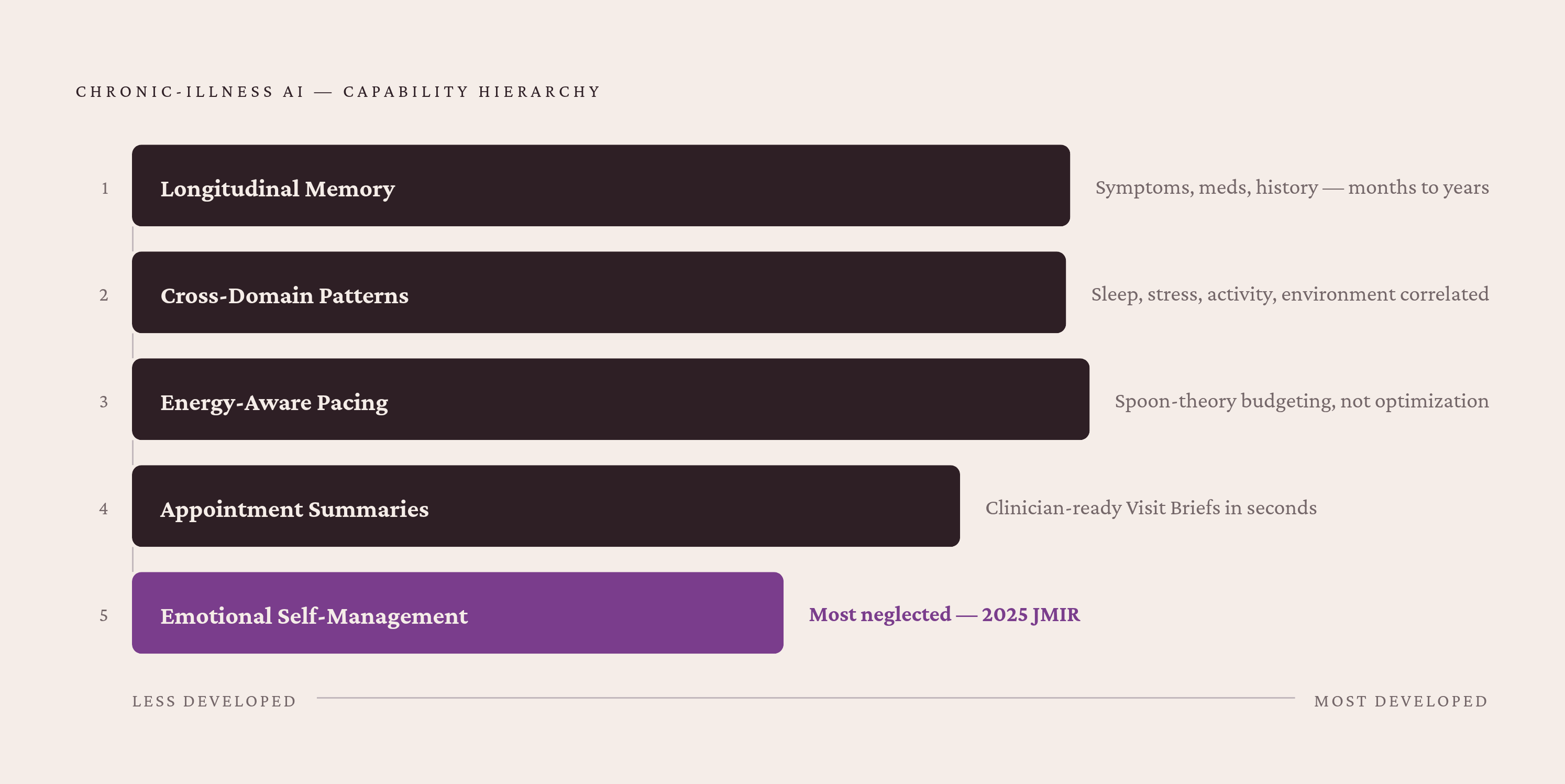
Five capabilities separate an assistant that's actually ready for chronic illness from one that just tracks steps and sends reminders: longitudinal memory, cross-domain pattern recognition, energy-aware pacing, appointment-ready summaries, and support for emotional self-management. Together they read less like a feature list and more like a direct response to everything the first two sections laid out.
Start with memory, because nothing else works without it. The Layer3 Labs guide identifies longitudinal health memory, not clever conversation design, as the hardest engineering problem in this whole category: an assistant that actually remembers symptoms, meds, and history over months and years, not just within one chat session. Skipping that step makes pattern recognition impossible, since the tool has no way to tell whether today's exhaustion is ordinary or the start of a cycle it's seen before. Platforms built for complex diagnoses show what this looks like in practice. jinIX, a digital health platform built for rare and hard-to-diagnose conditions, uses AI to build a visual timeline of symptoms and medical records, which is what lets patients and clinicians actually spot the patterns a good appointment depends on. Citizen Health (formerly Ciitizen) pulls clinical data, genetic reports, clinic notes, imaging, from multiple providers into one searchable profile; its AI Advocate, launched in 2025, helps patients read their own records, catch trends, and figure out what to prioritize across years of fragmented care.
Memory feeds directly into the second capability. Sleep, activity, medication, stress, and environment all interact in chronic symptoms, so a tool watching only one of those threads misses the connections that matter most. Machine learning models that analyze wearable data, electronic health records, and what patients report about their own context together can reveal patterns no single stream would find on its own. That's the shift from reactive to proactive: assistants that pull in heart rate, glucose, and activity data from wearables, and alert a clinician when something's drifting off, instead of waiting for the patient to notice and call in. Wellally's 2026 research put a number on what that shift is worth: predictive models that catch disease exacerbations before symptoms turn acute can cut hospitalizations by as much as 30%.
Energy-aware pacing is where spoon theory earns its place, and it deserves to be taken as literally as it's meant. It's a functional model of energy budgeting, not a metaphor: patients wake up with a finite number of spoons, small tasks cost a few, big ones cost more, and during a flare even the small stuff gets expensive. An assistant built around that framework can help someone plan a day's activity load, flag when the plan already outspends the budget, and warn a clinician about a downward trend before it turns into a crash that lands someone in the hospital. General wellness apps are built the opposite way: they push optimization, more steps, better sleep scores, more output, when what chronic patients often need is conservation.
Appointment-ready summaries solve a much more mundane problem, but a real one. ClinBox lets patients build a full health narrative, track treatments inside one case file, and generate a "Visit Brief" so nothing important gets missed, designed for patients who want to be deeply informed and organized partners in their care. Patients who show up with a structured, chronological summary get more out of limited consultation time and are less likely to have real symptoms waved off. Conversational AI removes the social friction of raising a concern at any hour without embarrassment, and a well-built assistant answers at whatever pace the patient needs, unlike a hurried appointment.
The fifth capability is the one most tools skip entirely: emotional self-management. A 2025 scoping review in the Journal of Medical Internet Research found that AI tools have mostly been built for medication, symptom, and lifestyle management, leaving emotional self-management the least developed of the bunch. That's a real gap, because chronic illness carries an emotional weight, grief, shame, burnout, the feeling of being invisible, that compounds the physical symptoms and shapes how well someone sticks with treatment or advocates for themselves. Spoon theory applies here too: navigating medical gaslighting, pushing for a diagnosis to be taken seriously, keeping up relationships while sick, all of it draws from the same finite reserve as physical tasks. Logging an emotional state next to a physical one, and getting something back that feels like acknowledgment instead of just data processing, is a distinct need on its own terms. It's a distinct need on its own terms.
How these capabilities hold up in practice
Multiple sclerosis is a good stress test for all five capabilities, because it's data-heavy, unpredictable, and genuinely hard to manage even with a full care team paying attention. Research in complex, data-intensive chronic conditions shows both the genuine promise and the real limits of these tools in practice.
Start with the encouraging side. Researchers at the Center of Clinical Neuroscience at TUD Dresden University of Technology, Hernan Inojosa and Tjalf Ziemssen, published a paper in Multiple Sclerosis Journal in April 2026 on how fast AI and digital health tools are opening up new options for personalized MS care. A companion paper in PLOS Digital Health, from the same Dresden and Münster research teams, looked at how AI gets folded into care for data-intensive chronic diseases that depend on long-term monitoring. The National MS Society's 2024 Pathways to Cures Roadmap goes a step further and recommends AI specifically for early detection, reading MRI biomarkers and profiling environmental risk, putting AI squarely inside the research and care pipeline for MS rather than treating it as an outside experiment. Doctronic gives a concrete look at what that looks like for a patient day to day: it supports adults diagnosed with MS, or showing symptoms consistent with demyelinating disease, with ongoing management, symptom relief, and coordination across the care team, while its physicians review neurological history, current medications, and prior workup before touching a treatment plan.
Now the warnings, and they deserve full weight, not a footnote. A 2024 pilot evaluation in Translational Neuroscience ran an AI model against 98 peer-reviewed MS case reports and got the diagnosis right 78.6% of the time. The rest were misdiagnosed, and the errors traced back to how differently MS presents from patient to patient, plus the fact that a real MS diagnosis leans on imaging alongside clinical and lab data, not clinical judgment alone. That result draws a line that matters for anyone evaluating these tools: an assistant that helps someone manage symptoms and spot patterns over time operates in a much safer lane than one asked to diagnose. The misdiagnosis risk occurs when a tool tries to do a doctor's job instead of a patient's daily-tracking job.
A study in npj Digital Medicine found that under controlled test conditions, several AI systems out-diagnosed human physicians on accuracy but leaned harder toward overprescribing. In a chronic illness context, where a medication change can carry real consequences, that's a safety flag. The same study cites earlier research, Zack et al. in Lancet Digital Health, 2024, showing that AI systems can carry forward racial and gender bias, so patients from groups already underserved by the health system risk getting worse guidance from the AI too. That doesn't shrink existing disparities. It repeats them in a new format.
The evidence base is still catching up to the ambition. A systematic review in Cureus found the research on AI in chronic disease management remains scattered, without the kind of systematic, comprehensive analysis that would let anyone draw firm conclusions. An honest assistant says so rather than overselling itself. A bibliometric analysis in Frontiers in Medicine confirmed that research output in this space jumped sharply between 2013 and 2024, with mobile health tools and machine learning driving most of it. The same analysis flagged unresolved problems around data standardization and ethics that haven't gone away just because the publication count went up.
How the design process shapes whether a tool is patient-centered
The CHI scoping review, built on those same 55 papers examining how virtual assistants for chronic illness actually get designed, found that most AI-driven tools favor reductionist approaches over holistic care, with patients barely involved in shaping the tool in the first place. That single finding explains a pattern seen across the field: tools that work fine on paper but feel wrong the moment a real patient tries to live with them day to day.
The review points to AI-powered assistants specifically as the main driver of this reductionist, non-patient-centered pattern. More AI horsepower under the hood doesn't automatically translate into a tool that fits how patients actually live. Chronic illness self-management is shaped by relationships, bounded and enabled by context, and refined through trial and error over years. A tool built without patients in the room will miss that adaptive, relational texture almost by default.
The CHI review lays out three traits that define patient-centered care for chronic illness: it builds patients' self-efficacy, it treats patients' own perspectives as central rather than incidental, making them active partners rather than passive recipients, and it takes seriously how individualized and context-dependent chronic illness actually is. A tool built through real interviews with patients, grounded in their lived experience, tends to surface requirements a spec sheet written without them never includes: spoon theory calibration, a place to log emotional state, support for navigating a doctor who doesn't believe the symptoms. None of that gets invented by an engineering team working from assumptions.
The clearest signal a patient has for judging whether to trust a tool is whether it was built with patients or just built for them, based on guesses about what they'd probably want.
What to look for when choosing an AI health assistant for chronic illness management
Choosing an assistant comes down to five checks: does it remember health history over time, does it pull in data from more than one source, can it turn that into a structured summary a doctor can use, was it built with real patient input, and is it honest about its own limits.
On memory, ask directly whether the tool remembers past symptom logs, medication changes, and old conversations, or whether it resets every time a new session starts. Without that continuity, there's no way for it to reveal a pattern, which makes it no more useful than a paper journal with a chat window stapled on.
On data integration, look for a tool that pulls in wearable and health data, activity, sleep, physiological signals, alongside whatever the patient reports themselves, instead of relying only on what someone remembers to type in. Citizen Health shows what that looks like when it's done well: fragmented records from multiple providers pulled into one coherent profile instead of scattered across portals.
On appointment prep, the tool should hand over a structured summary a clinician can scan in seconds instead of a raw export of every data point ever logged. ClinBox's Visit Brief format organizes a narrative around treatments, a timeline, and the questions still open.
That distinction, more than any other single feature, separates a tool built for chronic illness from one that was simply repurposed for it.
Sources
- Self-management for Chronic Illness: A Scoping Review on Designing Virtual Assistants for Patient-Centered Care | Proceedings of the 2026 CHI Conference on Human Factors in Computing Systems
- Build an AI Health Assistant: 2026 Founder's Guide
- Application of artificial intelligence in the health management of chronic disease: bibliometric analysis
- How AI Is Transforming Chronic Disease Management in 2026
- Journal of Medical Internet Research - AI Applications for Chronic Condition Self-Management: Scoping Review