EDS Symptoms That Are Frequently Dismissed by Clinicians
Ninety-four percent of hEDS patients were first misdiagnosed with psychiatric illness.
Ehlers-Danlos syndrome covers a group of heritable connective tissue disorders, thirteen subtypes as of the 2017 international classification, and twelve of them have known genetic markers you can test for in a lab. Hypermobile EDS, the most common form by far at roughly 80 to 90% of all cases, has no known gene and no blood test. Diagnosis rests entirely on a clinician's ability to recognize a pattern across joints, skin, gut, heart, and brain, and that's exactly where the system breaks down.
The symptoms doctors most often dismiss as anxiety in hEDS patients are chronic fatigue, brain fog, autonomic dysfunction (especially POTS), gut problems, widespread pain, and subluxations, because none of them produce clear findings on standard lab work or imaging. A 2025 retrospective chart review of 429 hEDS patients found 94.4% had been misdiagnosed with a psychiatric illness before receiving the correct diagnosis, with anxiety, depression, and migraines as the most common wrong answers. The diagnosis takes so long because hypermobile EDS has no known genetic marker and no confirmatory blood test, leaving diagnosis entirely dependent on a clinician's ability to recognize a pattern spread across joints, skin, gut, heart, and brain simultaneously. Specialists are trained to work in silos, medical school curricula give connective tissue disorders minimal coverage, and hEDS affects women disproportionately in a system that routinely attributes female physical symptoms to stress, all of which push the average diagnostic delay to between 15.9 and 21.7 years.
The condition affects somewhere a small fraction of the population — somewhere in the low thousands to one range, though most people who work in this space believe the real number is higher, since underdiagnosis is baked into how the disorder presents. It shows up more in women, often starting in the teenage years or early twenties, which happens to be the exact population most likely to have physical symptoms waved off as stress or anxiety. The invisibility of hEDS is structural: it's built into how modern medicine sorts and labels disease in the first place.
How long patients wait, and how many doors they knock on before getting an answer
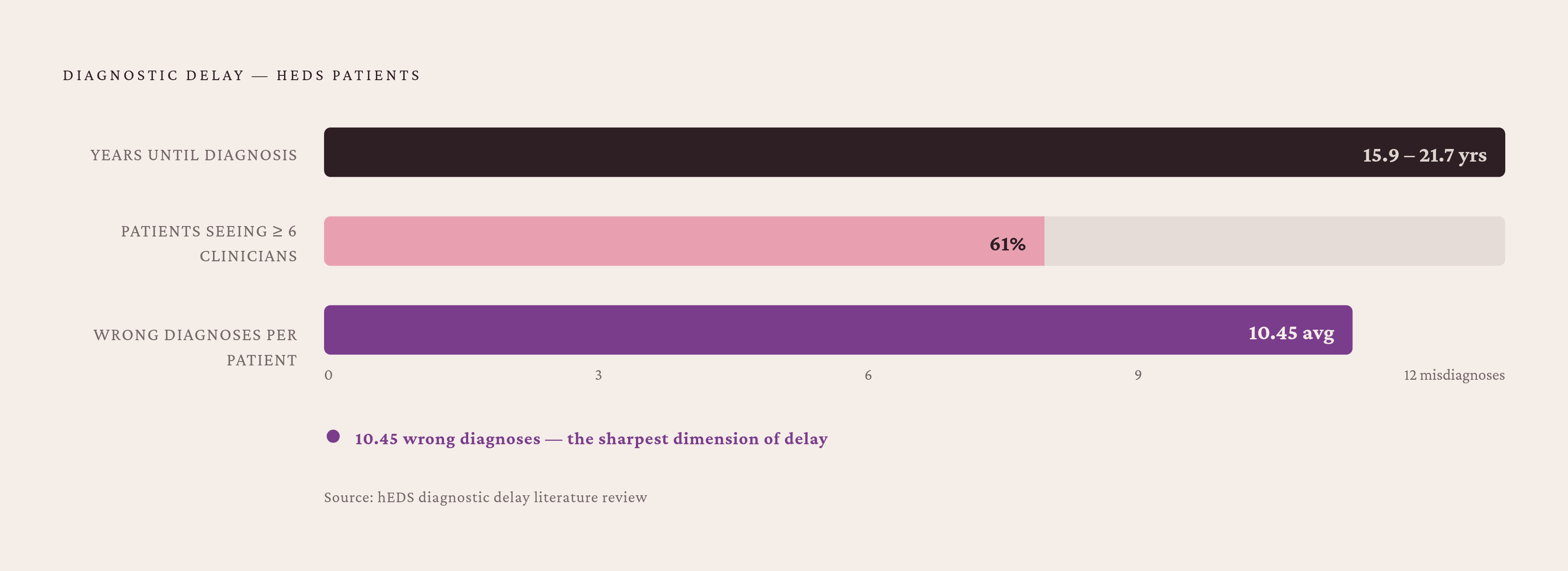
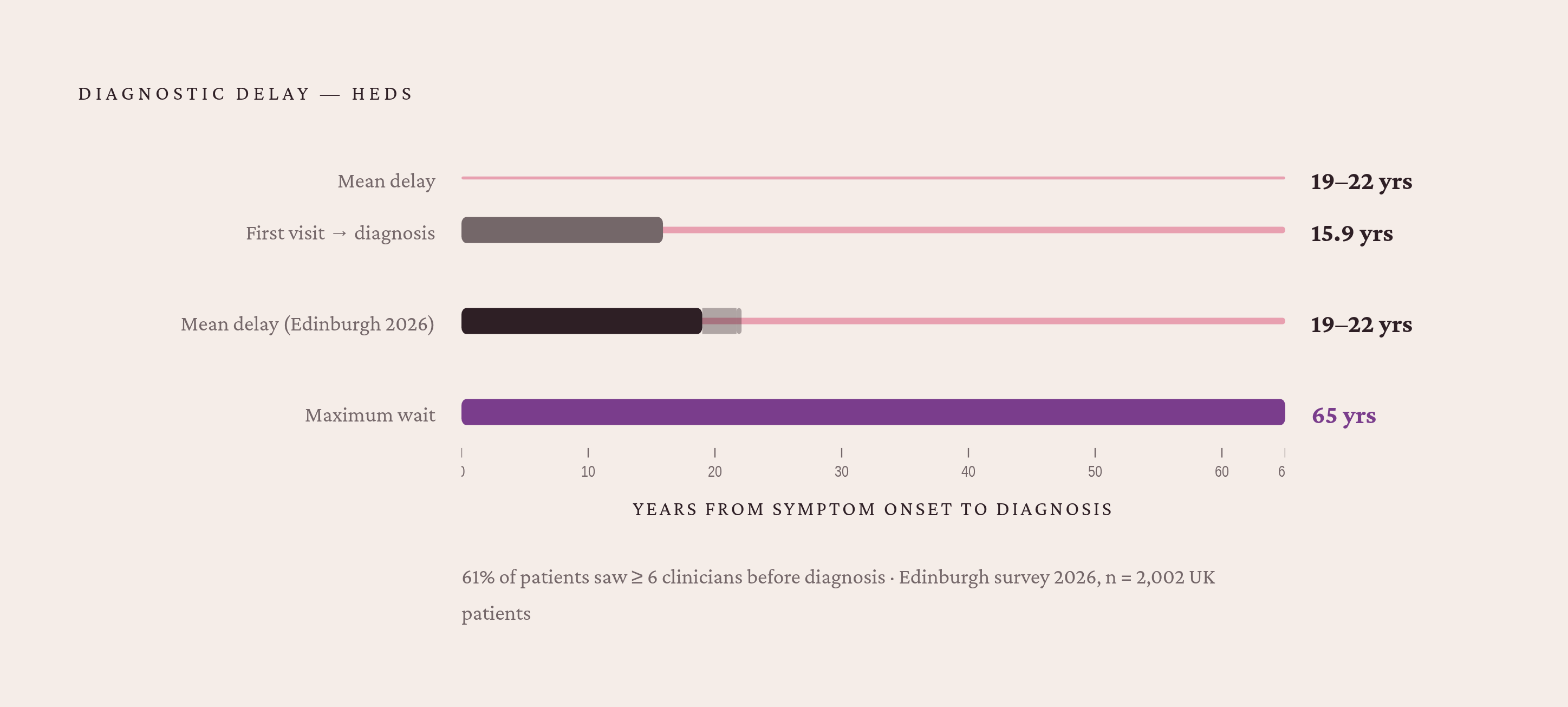
Start with the number that stops most people cold. A 2026 University of Edinburgh survey of 2,002 UK patients found a mean diagnostic delay of 19.0 to 21.7 years. Another study clocked the average gap between a patient's first medical visit and an actual hEDS diagnosis at 15.9 years, with some patients waiting as long as 65.
That's not a typo. Sixty-five years.
Along the way, 61% of patients saw at least six different healthcare professionals before anyone gave them an answer. A survey of 505 people with confirmed hEDS found the average patient collected 10.45 wrong diagnoses first. The most common wrong answers: anxiety, depression, migraines. When those same patients were asked which diagnoses actually felt true to their experience, they pointed to POTS, cervical instability, and mast cell activation syndrome, none of which showed up much in their charts until years later.
A 2024 Australian pilot study of 152 women found more than half noticed symptoms over 15 years before diagnosis, and more than three-quarters were handed some other diagnosis first. These patients kept showing up to a system that kept looking at the wrong thing.
What EDS symptoms do doctors most often dismiss or attribute to anxiety, and why does each one confuse the clinical picture?
Every symptom below has a mechanism behind it. None of this is vague.
Chronic fatigue involves unrefreshing sleep, post-exertional crashes, and exhaustion that doesn't match activity level. Loose connective tissue forces stabilizing muscles to work overtime just to hold joints in place; autonomic instability wrecks restorative sleep; pain itself burns energy around the clock. There's no blood test for any of it, so it gets pinned on depression or deconditioning. In the Edinburgh survey, 84% of patients reported chronic pain, and fatigue rides along with pain at that level almost by default.
Brain fog shows up as memory lapses, losing words mid-sentence, trouble holding a thought. It likely comes from reduced blood flow to the brain during autonomic episodes, plus sleep so disrupted it never lets the brain fully reset. No scan catches it in a standard workup, so patients get told it's anxiety.
Autonomic dysfunction, or dysautonomia, means the body's regulation system misfires: heart rate spikes, blood pressure swings, temperature control goes haywire, standing up triggers near-fainting. Weak connective tissue in blood vessel walls is the likely culprit. POTS, postural orthostatic tachycardia syndrome, is the best-known version. Among EDS patients, 38% meet criteria for it; under age 25, that number jumps to 72%. Fainting spells and heart palpitations get chalked up to panic attacks long before anyone runs autonomic testing.
Gut symptoms hit 66% of patients in the Edinburgh survey: gastroparesis, reflux, food intolerances, bloating, constipation swapping with diarrhea, poor nutrient absorption. Connective tissue laxity affects the gut wall directly, and autonomic dysfunction scrambles the nerve signals that run digestion. Doctors tend to treat it as IBS or "stress gut" in isolation, never connecting it back to a systemic disorder.
Pain beyond the joints shows up as nerve pain, widespread muscle pain, and allodynia, where a light touch hurts like a burn. It gets misdiagnosed as fibromyalgia constantly, when fibromyalgia may itself be downstream of untreated EDS rather than its own separate illness. The pain is measurable in what it does to daily function, but once it gets pinned on a psychiatric cause, it stops getting treated seriously.
Subluxations, partial joint dislocations during totally ordinary movement, hit 74% of Edinburgh respondents. A joint slips while someone's walking, reaching for a shelf, or turning over in bed. No trauma, no visible injury on imaging, so it gets dismissed on the spot.
Migraines affected 54% of the Edinburgh cohort. Craniocervical instability, laxity at the base of the skull, is one proposed driver, along with pressure changes inside the skull and vascular instability. Most patients get treated for a standard migraine disorder with nobody asking why.
Dental and oral issues like a high palate, crowded teeth, gum disease, and jaw dysfunction rarely get traced back to connective tissue at all. Dentists manage them as standalone problems.
Voice and swallowing trouble comes from hypermobility in the throat and voice box itself: vocal fatigue, frequent throat-clearing, trouble swallowing. Patients get sent to an ENT with no one asking about the rest of the body.
Slow wound healing and odd scarring are textbook EDS features, fragile skin that stretches and scars wide or thin after a minor cut, but in appointments focused on joint pain, nobody thinks to look.
Why psychiatric misdiagnosis is so common — and what it costs patients
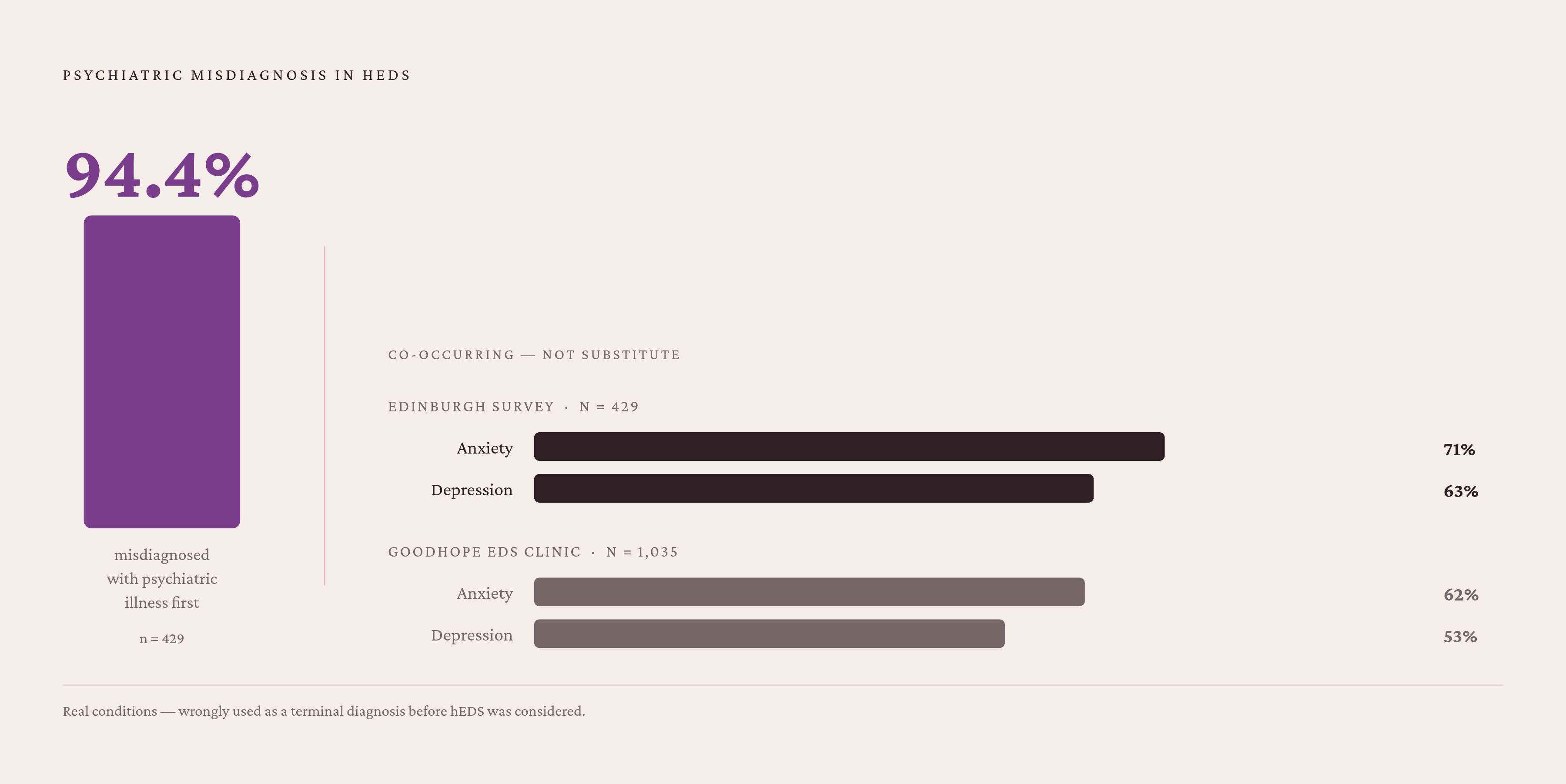
Here's the number that should stop every clinician reading this: a 2025 retrospective chart review of 429 hEDS patients found that 94.4% had been misdiagnosed with a psychiatric illness at some point before getting the right answer. Patients were told they were making it up, that it was all in their head, that they were seeking attention.
Here's the part that takes real care to explain right: anxiety and depression genuinely do occur alongside EDS at high rates, 71% and 63% respectively in the Edinburgh survey. That's not in dispute. What's dangerous is when clinicians treat those conditions as the cause of the physical symptoms instead of a consequence of years of unmanaged pain and being disbelieved. A 2025 GoodHope EDS Clinic chart review of 1,035 consecutive patients found 62% had anxiety and 53% had depression noted in their history. Those are real, co-occurring conditions, and treating them as evidence that the physical symptoms are psychosomatic is a category error with consequences.
Stephanie Aston, a woman in New Zealand with EDS, was misdiagnosed with a psychiatric disorder, denied critical care, and died from symptoms that went untreated. That's the extreme end of what diagnostic failure looks like.
For most patients the cost isn't that acute. It's years of being undertreated. Years of doubting your own body. Years without the physiotherapy, pain management, or autonomic support that could have helped from day one.
The structural reasons dismissal happens — gender bias, medical education gaps, and the limits of specialist silos
Over 70% of people diagnosed with EDS and hypermobility spectrum disorder are female. Research has documented how female pain gets disbelieved, trivialized, normalized, or blamed on mental health: patients trust a system that lets them down, and that experience worsens their physical health. A 2025 survey of 900 women aged 25 to 34 found 93% felt dismissed when seeking medical care. This dynamic sits at the center of what this community experiences.
Western medicine built its diagnostic frameworks and clinical trials mostly around male physiology. Conditions that show up differently in female bodies, or that mostly affect women in the first place, start with a recognition deficit baked in before a patient ever walks through the door.
Race and income stack on top of that. Women of color, disabled women, and patients in lower income brackets get dismissed more often, get less pain relief, and wait longer for a name for what's happening to them.
Then there's training. EDS gets minimal coverage in standard medical school curricula, so most general practitioners, and plenty of specialists, have thin exposure to connective tissue disorders. And specialists work in silos by design: a rheumatologist looks at joints, a gastroenterologist looks at the gut, a cardiologist looks at the heart. Nobody's looking across all of it at once, which is precisely what spotting hEDS requires. Add in the fact that there's no test to confirm it, and clinical judgment, the weakest link in a chain nobody trained properly, has to carry the whole diagnosis.
The EDS-POTS-MCAS overlap and why it creates compounding diagnostic confusion
EDS, POTS, and mast cell activation syndrome (MCAS) show up together often enough that patients and clinicians call it the trifecta. The mechanism makes sense on paper: loose connective tissue destabilizes blood vessel walls, which worsens POTS; the circulatory swings from POTS can trigger mast cell flares, which worsens MCAS; the immune overactivation from MCAS then ramps up inflammation, pain, and fatigue across the board. A 2026 Bayesian meta-analysis pooling 22 published cohorts put the probability of POTS given an hEDS diagnosis at 46.6%, with a credible interval spanning 32.5 to 61.5%.
Since POTS and MCAS are each underrecognized on their own, patients can spend a decade fighting for an EDS diagnosis and still walk away with half their symptoms unexplained.
The science here deserves an honest caveat. A 2026 Mayo Clinic retrospective chart review found that 95% of patients labeled with suspected MCAS had diagnoses that were never actually confirmed; 56% of that group had a comorbid anxiety disorder and 48% had depression. A separate review turned up no studies meeting strict diagnostic criteria that clearly establish the POTS-EDS-MCAS link; the existing research doesn't yet use validated standards across the board. The trifecta is a pattern plenty of patients and clinicians recognize in real time, even as the confirming evidence is still catching up. That means patients should push for clinicians willing to actually investigate, not settle for a self-diagnosis pulled off a forum and call it done.
Worth sitting with: in the survey of 505 hEDS patients, POTS, cervical instability, and MCAS were the three diagnoses patients felt most confident were accurate, the same three conditions their prior doctors had most often brushed aside.
How dismissal compounds into a mental health crisis of its own
The GoodHope EDS Clinic chart review of 1,035 patients found 53 to 87% reported current or past anxiety or depressive symptoms. Smaller but still serious portions reported PTSD (4.7 to 34.8%), disordered eating (19%), self-harm (3 to 29.2%), and suicidal behavior (7.8 to 18.6%). Patients with generalized hypermobility spectrum disorder were 2.77 times more likely to report past depression and three times more likely to report anxiety than patients with non-hypermobile EDS subtypes.
The direction of causation matters here, and the assumption most people make gets it backward. Years of disbelief, unmanaged pain, and institutional betrayal do real damage to a person over time, separate from whatever role EDS itself plays.
The EDS Society puts it plainly: having real physical symptoms dismissed as "in your head" breeds frustration. Not being believed breeds anger. And coping with pain for years without effective treatment is, on its own, enough to cause depression, anxiety, and panic attacks. Being disbelieved long enough is sufficient on its own to produce that outcome.