EDS and Pregnancy Risks and Considerations
Vascular EDS pregnancy carries 5% mortality risk.
EDS is a group of 13 recognized subtypes (a 14th has since been added), and all of them involve fragile connective tissue. But the mechanisms differ, and so do the stakes during pregnancy. Someone with hypermobile EDS (hEDS) is looking at a pregnancy that's elevated-risk but generally manageable with the right team. Someone with vascular EDS (vEDS) is looking at something else entirely: a condition where the tissue failures that define the disease line up almost exactly with the tissues pregnancy puts under the most strain. Knowing which subtype you have is essential information that shapes treatment decisions. It's the difference between one conversation with an OB and a completely different conversation involving cardiology, hematology, and a delivery plan built months in advance.
The formal prevalence estimate for EDS overall is 1 in 5,000 people, though some advocacy groups put the real number closer to 1 in 900. That gap is contested and unresolved, but it doesn't change the clinical picture much: EDS affects people across genders and races, and hEDS, specifically, is mainly symptomatic in people assigned female at birth. That alone makes pregnancy planning a bigger deal for this community than it might be elsewhere. The 2017 international classification tied every subtype except hEDS to specific mutations in genes that build connective tissue proteins, with molecular confirmation required for diagnosis. hEDS still has no genetic test. Diagnosis stays clinical, and that shapes everything from preconception counseling to how a delivery team assesses risk on the fly.
What vascular EDS does to the body during pregnancy, and why the risk profile is in a category of its own
vEDS, once called EDS type IV, comes from mutations in COL3A1, the gene that encodes type III procollagen. That protein is a structural component of arteries, the uterus, and the bowel. When it's defective, those three tissues lose integrity, not in a minor way, but fundamentally. vEDS is rare even by EDS standards, affecting somewhere between 1 and 9 people per 100,000. Rare, yes. But when it shows up in a pregnancy, the mechanical and hormonal stress of gestation lands directly on the tissues most likely to fail.
Documented complications include arterial dissection and rupture, uterine rupture, hemorrhage, premature rupture of membranes, severe perineal lacerations, and wound dehiscence after any surgical repair. A 2024 systematic review in BJOG, which screened 121 publications and drew on six studies totaling 412 pregnancies, found something less discussed but just as significant: 30% of women with vEDS were infertile. That's a piece of the condition that rarely gets airtime next to the more dramatic vascular risks. The same review put the miscarriage rate at 13.8% (57 of 412 pregnancies), and 8.8% of live births arrived premature.
The mechanism matters here more than in most conditions. Arterial fragility doesn't announce itself with gradual warning signs the way some pregnancy complications do. It can go from stable to catastrophic within hours, which is exactly why clinician awareness of vEDS specifically, not just "EDS" as a general label, changes outcomes.
The numbers behind vEDS maternal mortality and what they mean for shared decision-making
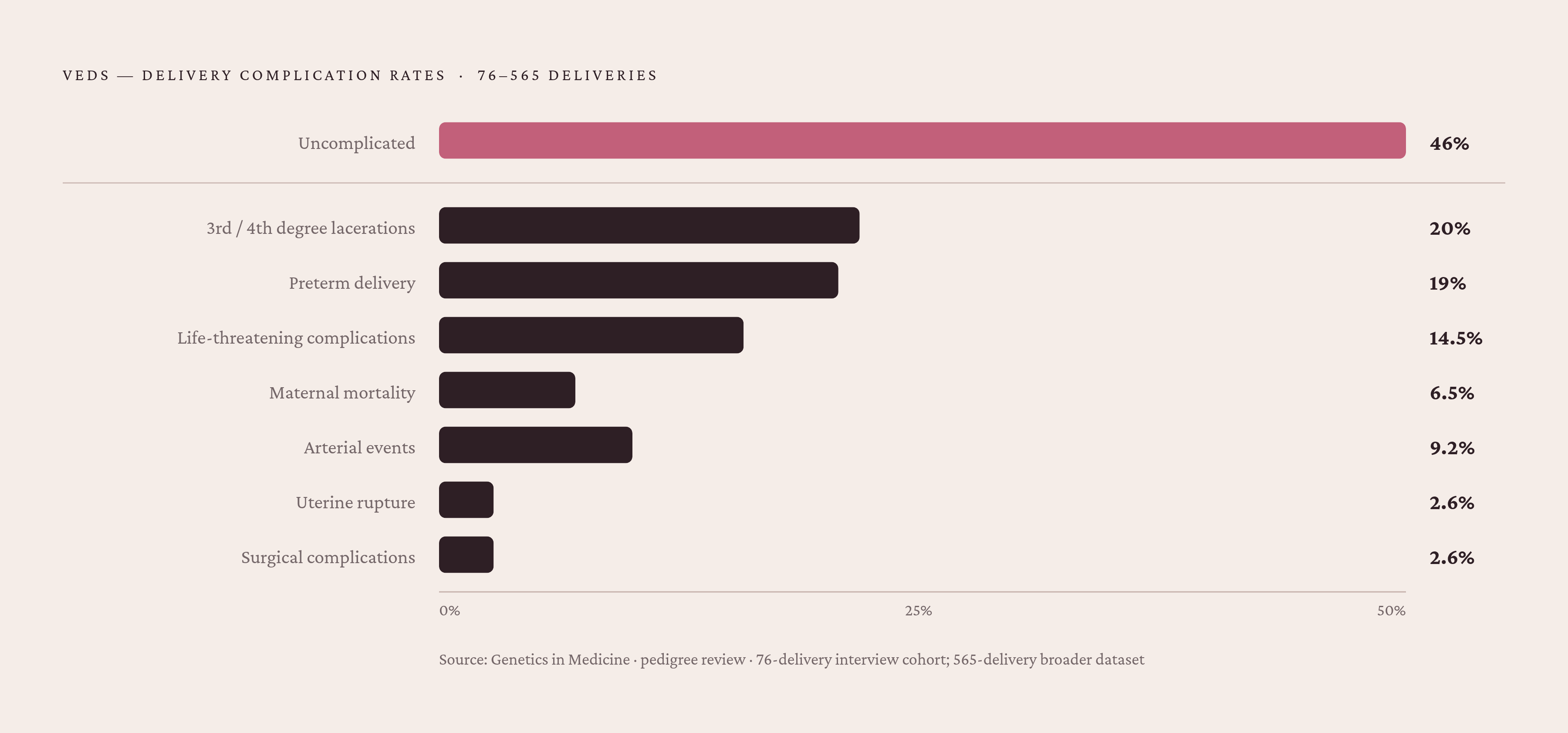
The maternal mortality numbers for vEDS are wide-ranging and unsettling: a pedigree review published in Genetics in Medicine put the risk per pregnancy anywhere from 4.3% to 25%, depending on the population studied. Within that same review, pregnancy-related deaths occurred in 30 of 565 deliveries, or 5.3%.
Here's the part that deserves equal weight, though. Interviews with 39 women from that same study found that 46% of deliveries were uncomplicated. That statistic matters, because the mortality figures alone can make it sound like every vEDS pregnancy ends in crisis. Most don't. Among the complications that did occur, third- and fourth-degree lacerations were the most common at 20%, followed by preterm delivery at 19%. Life-threatening complications, arterial dissection or rupture, uterine rupture, or serious surgical complications, occurred in 14.5% of deliveries. Broken down further: arterial events at 9.2%, uterine rupture at 2.6%, and surgical complications at another 2.6%. Five deaths occurred across 76 deliveries in the interview cohort, a rate of 6.5%.
One finding from that research complicates the whole picture in an important way: survival data suggest pregnancy doesn't change overall mortality risk compared to women with vEDS who never became pregnant. In other words, vEDS carries serious risk on its own, pregnancy or not. That reframes the conversation. It's not that pregnancy creates a new danger out of nowhere, it's that an existing danger gets tested under new conditions. The same study also found the data insufficient to determine whether delivery timing or mode changed outcomes at all. Filling that gap requires more than a generic protocol. It's a reason every vEDS pregnancy needs individualized planning with specialists who understand the mechanism, not a one-size playbook borrowed from general obstetrics.
How hEDS pregnancy risk differs, elevated compared to the general population, but not uniformly high-risk
hEDS is the most common subtype, and it comes with a complication baked into diagnosis itself: no genetic test exists. Risk stratification depends on symptom severity and comorbidities, not a lab result. That makes hEDS pregnancy planning more of a clinical judgment call than a checklist.
The population-level data does show elevated risk. A study observing 13,881,592 births found that pregnancies among people with EDS carried higher odds of antepartum hemorrhage (odds ratio 1.79) and placenta previa (odds ratio 2.23). Premature birth also showed up more often in that population.
But current evidence-based guidelines are direct about the other side of this: people with hEDS or hypermobility spectrum disorder (HSD) "should not automatically be considered to have a high-risk pregnancy." Some studies even found that adverse outcomes in certain EDS subtypes matched the general obstetric population closely. That's not a reason to wave off concern, it's a reflection of how varied hEDS presentation actually is. Someone with mild joint hypermobility and no major comorbidities is in a completely different situation than someone managing severe POTS, pelvic instability, or mast cell activation syndrome (MCAS) on top of a pregnancy. Risk in hEDS exists, but it's individual, not universal.
One number belongs in every preconception conversation regardless of severity: a parent with hEDS has a 50% chance of passing it to their child. That fact alone shapes how a family thinks about genetic counseling and how a newborn gets assessed after birth.
How pregnancy changes the body for people with hEDS, and what that means trimester by trimester
Relaxin is the hormone responsible for loosening the pelvis ahead of birth, and in a body where connective tissue is already hypermobile, relaxin doesn't just do its normal job, it can amplify instability that was previously under control. Pelvic girdle pain is common in hEDS pregnancies, and in severe cases, it's disabling enough that some women need a wheelchair to get through daily mobility during pregnancy.
There's no single trajectory here. Some women find their symptoms, especially GI complaints, fatigue, and pain, get worse as pregnancy progresses. Others report improvement or no real change at all. That unpredictability is itself a planning problem, because a care team can't assume week 20 will look like week 10.
A handful of comorbidities tend to travel with hEDS and complicate things further:
POTS (postural orthostatic tachycardia syndrome) frequently shows up alongside hEDS, and pregnancy's cardiovascular demands, more blood volume, a faster heart rate, shifting blood pressure, can make it worse. MCAS adds another layer, since it complicates medication choices throughout pregnancy and delivery. GI issues like nausea and dysmotility often get amplified by pregnancy hormones on top of whatever baseline symptoms already existed. And chronic fatigue, already a fixture for many with hEDS, compounds fast when joint instability and pain get added to the physical toll of carrying a pregnancy to term.
For someone already managing a limited energy budget day to day, this isn't just a matter of feeling more tired. It calls for deliberate pacing, real support at home, and a level of planning that standard obstetric care usually isn't built to provide.
What the postpartum period adds, the risks that begin after delivery
Delivery isn't the finish line. Wound healing is its own concern across EDS subtypes, since collagen abnormalities slow healing and raise the risk of wounds reopening after surgery. Surgical teams managing an EDS patient need to adjust suture technique and use wound pressure dressings with that risk in mind, not as an afterthought.
Hormonal shifts after birth can undo whatever stability pregnancy hormones provided. Some women describe a kind of protection during pregnancy that reverses hard once those hormones drop, bringing joint instability, pain, and fatigue back with force. Pelvic floor weakness is a shared postpartum challenge across hypermobility conditions generally, and it can lead to incontinence or pelvic organ prolapse. Pelvic floor rehab isn't an optional nicety here, it's an active clinical priority that should start early.
Postpartum depression is a real concern for women with EDS given the accumulated physical and emotional load they carry. That's not surprising once you count up the load: physical setback, disrupted sleep, and the ongoing weight of managing a chronic condition while caring for a newborn. Mental health monitoring needs to be part of postpartum follow-up, not a footnote.
Breastfeeding and infant feeding are addressed in the 2024 international guidelines, though the specific findings there go beyond what's covered here. And if the baby inherited hEDS, a 50/50 chance, recognizing it early matters. Recognizing hypermobility early in a newborn shapes pediatric care decisions down the line.
Anesthesia and delivery mode, the decisions that require subtype-specific planning
No general recommendation exists for delivery mode or anesthesia in hEDS. Every plan gets built around the individual, and for good reason: hEDS carries a specific set of anesthesia risks that don't show up in a standard pregnancy.
Cervical spine instability, or collapse of the cartilage in the larynx or trachea, can make intubation genuinely difficult and risks damaging delicate mucosal tissue. Lung-protective ventilation becomes necessary to avoid pneumothorax. Spinal pathology can interfere with epidural or spinal anesthesia technique. And there's a documented increase in post-dural puncture headache, along with resistance to local anesthetics, so the doses that work for most patients may simply not work the same way here.
A 2025 case report out of Shaare Zedek Medical Center, published in Cureus that August, walked through how a multidisciplinary team built a full perioperative plan for a patient with classical EDS (cEDS). The plan included ultrasound-guided spinal anesthesia, extended observation after anesthesia, and coordinated input from cardiology, hematology, endocrinology, and pulmonology. That's what individualized planning looks like when it's done right, not a single specialist making a call alone, but several disciplines working from the same page.
For vEDS, delivery mode and timing decisions have to account for the underlying arterial and uterine rupture risk. The evidence base for vEDS remains insufficient to say whether delivery mode changes outcomes either way. That's not a loophole, it's confirmation that these calls belong to specialists, not to a standard checklist. For patients, that means the birth plan functions as a medical directive rather than a document about preferences and atmosphere. It's a clinical plan that needs review and buy-in from the anesthesiology team well before labor starts.
What the first comprehensive international hEDS pregnancy guidelines say, and where the evidence gaps remain
In 2024, an international team led by midwife Dr. Sally Pezaro, with backing from the Ehlers-Danlos Society, published the first comprehensive guidelines covering pregnancy, birth, and postpartum recovery for people with hEDS and HSD. Fifteen co-creators contributed from the UK, the US, Canada, France, and the Netherlands, spanning a range of clinical and research disciplines relevant to pregnancy and connective tissue disorders.
The evidence behind the guidelines draws on 14 primary research studies and 21 case studies, covering a combined 1,260,317 participants. The guidance is organized into four stages: preconceptual, antenatal, intrapartum, and postpartum. Pain management, mental health, nutrition, and comorbidities, specifically POTS and mast cell disease, are all folded in as well.
The guidelines are honest about their own limits: high-quality evidence remains limited overall, and individualized strategies get proposed throughout rather than fixed rules. This is a framework, not a protocol, and a multidisciplinary approach is recommended explicitly to address tissue fragility, joint hypermobility, pain, and comorbidities together rather than one at a time.
For patients, the practical value here is concrete. These guidelines exist, they're citable, and they give patients something to bring into an appointment when asking for individualized risk assessment instead of a generic obstetric plan that doesn't account for hEDS at all.
Building a care team that actually understands EDS, who needs to be involved and why patients often have to advocate for this
Case reports and formal guidelines keep landing on the same conclusion: managing an EDS pregnancy well requires several specialties working together, because no single specialty covers the full picture. Well-managed cases documented so far have involved obstetrics, anesthesiology, cardiology, hematology, endocrinology, pulmonology, rheumatology, physical therapy, pelvic floor therapy, pain management, clinical genetics, and mental health providers, sometimes all at once.
That level of coordination doesn't happen automatically. People with EDS report that many health professionals simply don't know enough about the condition, and that gap in awareness leads to delays in getting appropriate care. This shows up in patient communities constantly: questions about whether an OB is taking EDS seriously, whether bringing printed material from an EDS foundation to an appointment actually helps. Often, it does, mostly because it gives the provider a starting point they didn't have.
Preconception genetic counseling is built into the 2024 guidelines as a core piece, and ideally that conversation happens before conception, not after a positive pregnancy test forces the issue. For vEDS, given that life-threatening complications occurred in 14.5% of deliveries in the pedigree study cited earlier, specialist involvement isn't a nice-to-have. A vEDS pregnancy managed by a general OB with no specialist backup is a pregnancy without the resources it needs.
Putting a team like this together is its own kind of advocacy work, and patients who show up with documentation, their diagnosis, their subtype where it's confirmed, their comorbidities, and a copy of the 2024 guidelines, tend to have a very different conversation with a new provider than patients who show up without it.
How to track symptoms and prepare for appointments when managing pregnancy with EDS
Every section of this piece points back to the same evidence gap: limited high-quality studies, outcomes that vary person to person, and no general rule for delivery mode or anesthesia that applies across the board. That gap doesn't go away with more willpower, it gets narrowed with better documentation.
Tracking specific symptoms trimester by trimester gives a care team something concrete to work from instead of a vague "things feel worse lately." That means noting joint pain location and severity, GI symptoms and their timing relative to meals, heart rate and dizziness patterns if POTS is in the picture, fatigue levels day to day, and any new instability or subluxation events. Bringing that record into each appointment, alongside the diagnosis, subtype (where confirmed), and relevant guideline sections, turns a rushed 15-minute visit into a real conversation about risk.
None of this replaces specialist care. But for a condition where individualized planning is the entire point, a detailed, organized symptom history is one of the few things a patient fully controls. That control matters more in EDS pregnancy than in almost any other area of prenatal care, precisely because the standard playbook wasn't built with this condition in mind.
Sources
- Pregnancy-related deaths and complications in women with vascular Ehlers–Danlos syndrome | Genetics in Medicine
- Vascular Ehlers‐Danlos syndrome and pregnancy: A systematic review - Haem - 2024 - BJOG: An International Journal of Obstetrics & Gynaecology - Wiley Online Library
- Anesthetic Management of a Pregnant Patient With Ehlers-Danlos Syndrome Undergoing Elective Cesarean Delivery: A Case Report - PMC
- britishjournalofmidwifery.com
- jeanniedibon.com
- ehlers-danlos.com
- cureus.com