The 2017 EDS International Classification Criteria
New criteria reorganized EDS into 13 subtypes, each requiring genetic confirmation except one.
The 2017 International Classification reorganized Ehlers-Danlos syndrome from six recognized subtypes into 13, each with its own diagnostic criteria. For anyone with EDS, or anyone chasing a diagnosis for unexplained joint pain and skin symptoms, this document is the actual rulebook clinicians use to decide what tests to run and what label finally gets applied.
The 2017 International Classification was authored by Fransiska Malfait as primary author, working within the International EDS Consortium, a multinational group of researchers. It was published in March 2017 in the American Journal of Medical Genetics Part C: Seminars in Medical Genetics. Companion papers in the same journal issue were contributed by Brady and colleagues (covering rarer subtypes) and Byers and colleagues (covering vascular EDS diagnosis, natural history, and management).
EDS isn't one disease. It's a group of inherited connective tissue disorders that share a triad of features: joints that move past a normal range, skin that stretches more than it should, and tissue that tears, bruises, or heals poorly. Before 2017, doctors worked from the 1997 Villefranche Nosology, a six-subtype system that held up for two decades before genetic research outran it. Labs kept finding new causative variants that didn't fit anywhere in the old framework. So the International EDS Consortium, a multinational group of researchers with Fransiska Malfait as primary author, rebuilt the classification from the ground up and published it in March 2017 in the American Journal of Medical Genetics Part C. It wasn't just a renaming exercise, either. Alongside the new subtypes, the consortium published the first formal management guidelines for the comorbidities that tend to travel with EDS, things like autonomic dysfunction and chronic pain, addressed here alongside the new subtype criteria.
Who authored and published the 2017 EDS international classification criteria?
Thirteen subtypes now exist where six used to. Some names carried over from Villefranche with minor updates; others are entirely new categories built around genetic discoveries made after 1997. Classical-like EDS (clEDS) and cardiac-valvular EDS (cvEDS) are among the additions, sitting alongside familiar names like Classical EDS, Hypermobile EDS (hEDS), Vascular EDS (vEDS), Kyphoscoliotic EDS, Arthrochalasia EDS, and Dermatosparaxis EDS. A handful of rarer subtypes get fuller treatment in a companion paper by Brady and colleagues, printed in the same journal issue.
One thing worth flagging for anyone reading genetic reports or older patient forums: a 14th subtype, linked to variants in the AEBP1 gene, gets mentioned occasionally online, but it wasn't formally described until 2018, a year after this classification came out. It's not part of the 2017 document, even though a preliminary case report hinting at it appeared back in 2016.
The consortium also grouped the 13 subtypes by shared biological pathway, a kind of family tree based on which part of the collagen or connective tissue machinery breaks down. That's the language behind terms like "collagen-related" or "TGF-beta pathway" that sometimes show up in genetic counseling notes.
Maybe the most consequential addition wasn't a subtype at all. The classification introduced hypermobility spectrum disorders (HSD), a new diagnostic category for people with symptomatic joint hypermobility that doesn't meet full EDS criteria and isn't explained by some other connective tissue condition. This matters because HSD isn't a watered-down version of hEDS. It's its own diagnosis, with its own legitimacy, and patients who land there aren't being told their symptoms are less real.
The major/minor criteria structure, and why molecular confirmation is required for 12 of the 13 subtypes
Every subtype in the 2017 classification gets scored against major and minor criteria, a structure borrowed straight from Villefranche. Major criteria carry high specificity: they show up in nearly everyone with that subtype and help rule out other conditions. Minor criteria carry less weight individually but strengthen the case when they stack up alongside a major one. Each subtype specifies exactly how many of each you need.
Here's the part that trips people up: for 12 of the 13 subtypes, clinical criteria alone aren't enough. A definitive diagnosis needs a genetic test confirming the actual causative variant. The classification lists the known genes by subtype:
- Classical EDS: COL5A1 or COL5A2, rarely a specific COL1A1 variant
- Vascular EDS: COL3A1
- Kyphoscoliotic EDS: PLOD1 or FKBP14
- Arthrochalasia EDS: COL1A1 or COL1A2
- Dermatosparaxis EDS: ADAMTS2
So if a clinician says a patient's presentation "looks like" Classical EDS, that's a hypothesis, not a diagnosis. The genetic test is what closes the loop. Knowing this ahead of an appointment saves a lot of frustration, because it explains why a doctor might delay a formal label pending bloodwork instead of just going with the clinical picture.
It also changes how a patient should show up to that appointment. A vague list of aches and unusual flexibility doesn't map cleanly onto major and minor criteria. A history organized around specific features, skin texture, scarring pattern, joint instability, does.
Hypermobile EDS: the most common subtype, and the one no genetic test can confirm
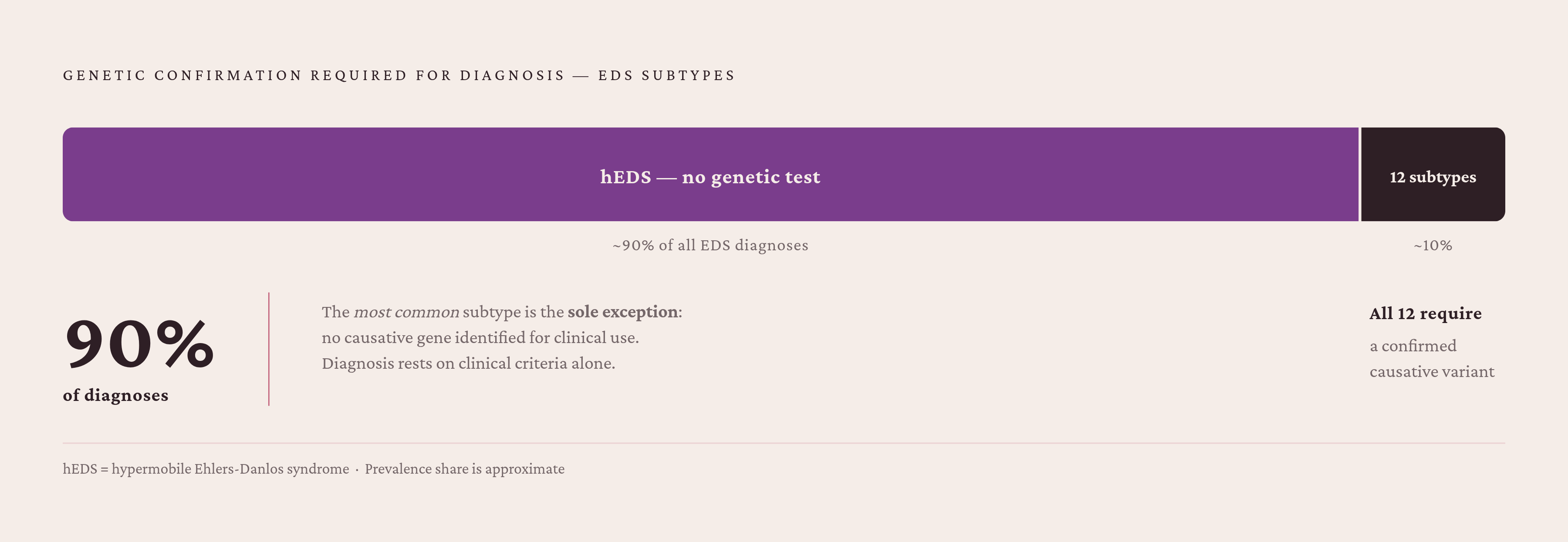
hEDS makes up roughly 90% of all EDS diagnoses, which makes it by far the largest subtype. And yet it's the one exception to the molecular rule above: no gene has been confirmed and validated for clinical use in diagnosing hEDS. There's no blood test. No swab. The diagnosis rests entirely on clinical criteria, which is exactly why the 2017 classification tightened those criteria considerably compared to what came before.
In the UK, prevalence sits around 1 in 500, which puts hEDS at four times the threshold typically used to define a rare disease (1 in 2,000). That's a lot of people relying on a purely clinical diagnosis.
The 2017 criteria for hEDS require all three of the following at once:
- Criterion 1: generalized joint hypermobility, measured with the Beighton score. Thresholds shift with age: above 6 for kids and teens, above 5 for adults up to 50, above 4 for adults over 50.
- Criterion 2: systemic features consistent with a connective tissue disorder, plus family history.
- Criterion 3: absence of skin fragility that would point toward another subtype, plus exclusion of other conditions that cause hypermobility.
The Beighton score has a built-in weakness the classification openly acknowledges: joint range of motion drops with age. Apply the same cutoff to a 10-year-old and a 55-year-old, and you risk over-diagnosing the kid and missing the adult whose joints used to bend that far but no longer do. To patch this, the classification allows the 5-Point Questionnaire (5PQ) to fill the gap. If someone scores just one point below the Beighton cutoff but answers yes to at least two of the five questions, historical placing of both palms flat on the floor with straight knees, bending a thumb back to the forearm, a history of dislocations, that's enough to count as generalized joint hypermobility.
This matters practically. A patient who narrowly misses the Beighton threshold shouldn't get ruled out on the spot. If their symptom history and 5PQ answers support it, they may still meet Criterion 1. Worth bringing that questionnaire's existence up directly if a clinician seems ready to close the door too fast.
hEDS follows an autosomal dominant inheritance pattern, according to the American Academy of Family Physicians' 2021 review in American Family Physician, meaning a parent with hEDS has roughly a coin-flip chance of passing it to each child.
Vascular EDS: why this subtype sits in a different risk category
Vascular EDS comes from variants in COL3A1, the gene coding for type III collagen. That protein isn't just structural filler. It's what gives strength to blood vessel walls, the bowel wall, and the uterus. That's the whole reason vEDS gets treated so differently from every other subtype on this list.
The risk here isn't chronic pain or joint dislocation. It's rupture, arterial, intestinal, or uterine, and that risk is real enough that the 2017 classification devoted a separate companion paper to it, written by Byers and colleagues, covering diagnosis, natural history, and management specifically for this subtype. The severity of vEDS's rupture risk is reflected in that companion paper's scope, which covers diagnosis, natural history, and management in dedicated detail.
For patients with a family history of vEDS, or anyone with unexplained vascular events in their medical background, sudden and severe chest or abdominal pain isn't something to wait out. It's an emergency room visit. That's one of the few places in this entire classification where the criteria translate directly into a real-time safety decision rather than a diagnostic formality.
If a clinical picture includes vascular symptoms, family history of aneurysm, or unexplained organ rupture, that's worth naming out loud to a clinician rather than leaving buried in a chart. The classification gives doctors the criteria to order COL3A1 testing, but somebody has to raise the vascular history first.
The diagnostic delays and misdiagnoses the 2017 criteria were meant to reduce, and haven't fully solved
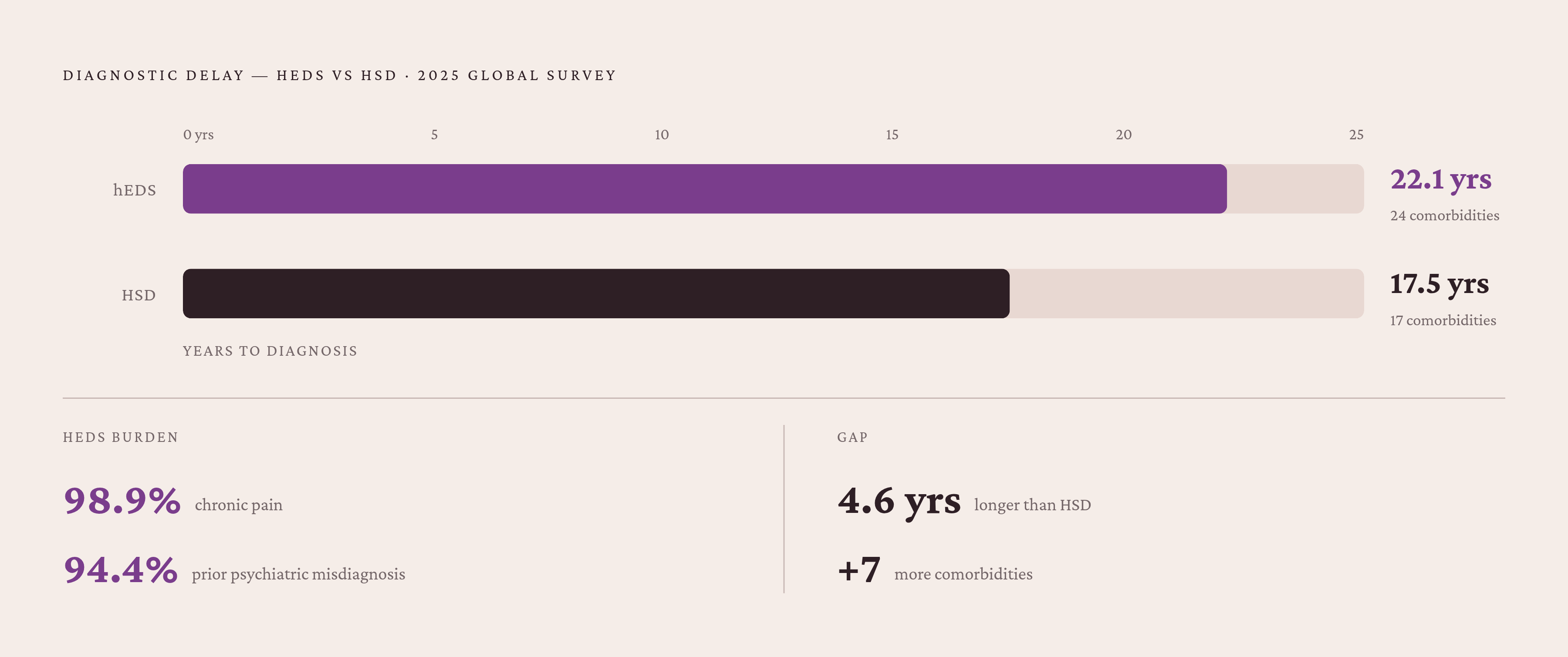
Better criteria on paper haven't translated into fast diagnoses in practice. A 2025 global survey of hEDS patients found a mean diagnostic delay of 22.1 years, with patients accumulating an average of 24 comorbid conditions along the way. Chronic pain showed up in 98.9% of respondents. Gastrointestinal disorders hit 84.3%. Dysautonomia affected 71.4%. Those aren't small numbers, and they represent decades of unresolved symptoms stacking on top of each other before anyone connects the dots.
HSD patients in the same survey fared somewhat better, with a mean delay of 17.5 years and 17 comorbidities. Still long. But shorter, which likely reflects that HSD is a newer diagnostic category.
Misdiagnosis is where this gets uncomfortable. Patients frequently get told they have fibromyalgia, chronic fatigue syndrome, or rheumatoid arthritis before anyone considers EDS. A retrospective chart review of 429 hEDS patients, published by Lee and Chopra in May 2025, found that 94.4% had previously received a psychiatric misdiagnosis. Told it was anxiety. Told they were seeking attention. Told it was in their head.
Symptom onset tends to start in early adolescence, often dismissed as growing pains. That means many patients carry years of relevant medical history that predates their actual diagnosis by a decade or more, history that often never makes it into the conversation because nobody thought to ask.
Diagnosing children adds another layer of difficulty, as presentations in younger patients can be harder to map onto criteria designed with adult features in mind. The fit between standard criteria and a developing body isn't always straightforward.
The 2017 classification gave doctors sharper tools. It didn't fix the deeper problem, which is that plenty of clinicians still aren't trained to recognize EDS in the first place, or don't think to consider it until years of other explanations have been exhausted.
The EDS-POTS-MCAS overlap, and why the classification's comorbidity guidelines matter
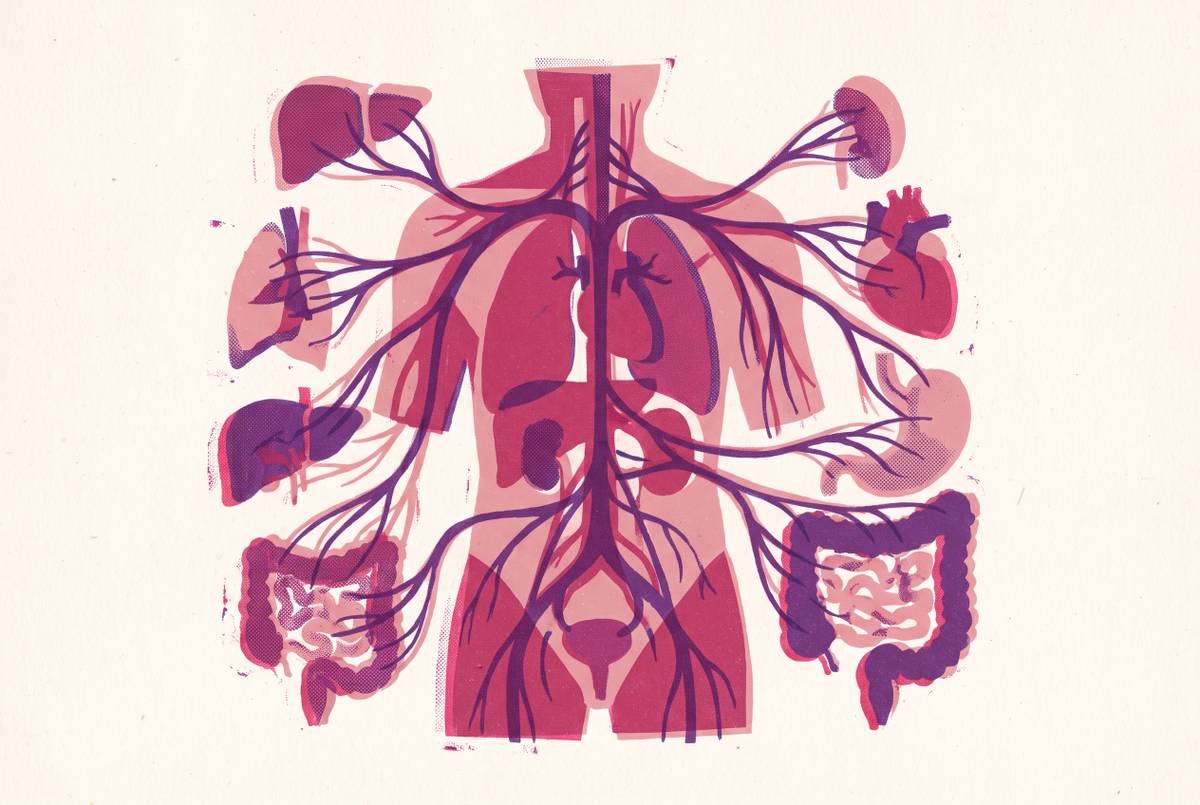
EDS doesn't stay in the joints. The 2017 classification was the first to treat that seriously, publishing dedicated management guidelines covering cardiovascular autonomic dysfunction, chronic fatigue, gastrointestinal involvement, neurological and spinal complications, pain management, and orthopedic care, each as its own companion article in the same journal issue.
The overlap with POTS (postural orthostatic tachycardia syndrome) is the clearest example of why this matters. Roughly 80% of people with EDS experience POTS symptoms. The mechanism is mechanical, not incidental: connective tissue in vein walls is too stretchy to constrict properly when a person stands up, so blood pools in the legs and abdomen instead of getting pushed back toward the heart. In the general population, POTS shows up in about 0.2% of people. In hEDS patients, estimates range from 31% to as high as 94%, depending on the study. Age matters too. Among EDS patients under 25, 72% meet criteria for POTS, a notably higher rate than seen in older age groups.
Mast cell activation syndrome (MCAS) tells a similar story. An analysis covering more than 37,000 patients found that nearly 1 in 3 people diagnosed with MCAS also carried a comorbid hEDS diagnosis. Separately, 38% of EDS patients overall met criteria for POTS, reinforcing just how tangled these three conditions, EDS, POTS, and MCAS, tend to be in the same patient.
Neurological complications show up often enough in the literature to warrant their own section in the classification's companion papers: CSF leaks, cranio-cervical instability, tethered cord syndrome, small-fiber neuropathy. Structural issues like pelvic and rectal prolapse, hiatal hernias, Chiari malformation, and spinal instability get documented as well. None of these are footnotes. They're part of the expected clinical picture for a meaningful share of EDS patients.
A diagnosis of hEDS or HSD is really a starting point. It opens the door to asking a clinician directly about POTS, MCAS, and the neurological complications listed above, rather than waiting for those connections to surface on their own.
How to use the 2017 criteria as a framework for appointments
The major and minor criteria structure gives patients something valuable: a shared vocabulary. Instead of describing a grab bag of aches and oddities, a patient can describe skin hyperextensibility, joint instability, or autonomic symptoms in terms that map directly onto what a clinician is trained to evaluate. That shift, from vague complaint to structured symptom, changes how quickly a doctor can act.
The Beighton score is something a patient can partially self-assess before ever sitting in an exam room. Knowing which joints get tested, and knowing that the 5PQ exists as a supplementary tool when the Beighton score alone may not capture the full picture, means a patient can walk in with relevant history already organized instead of trying to reconstruct it under time pressure.
The comorbidity guidelines published alongside the classification double as a checklist. A patient dealing with fatigue, GI symptoms, and dizziness on standing can name POTS, MCAS, or dysautonomia specifically, rather than presenting each symptom as an isolated, unexplained complaint that a clinician has to piece together from scratch.
The Ehlers-Danlos Society has produced a handout for medical professionals based on the 2017 criteria, and handing that directly to a GP or specialist unfamiliar with the classification isn't overstepping. It's the kind of self-advocacy the classification was actually designed to support.
Subtype also shapes what to ask for. A patient with skin fragility and unusual bruising that lines up with Classical EDS criteria can ask directly whether COL5A1 or COL5A2 testing makes sense, rather than hoping the clinician brings it up first. And for anyone with a family history touching on vEDS, naming that history explicitly, along with the classification's guidance that sudden severe chest or abdominal pain warrants emergency care, gives a patient concrete language to push for a specialist referral instead of settling for reassurance.
Tracking joint dislocations, fatigue patterns, GI flare-ups, and autonomic symptoms in a running log, then bringing that log to appointments, turns the 2017 classification from an abstract medical document into something genuinely usable. Some symptom-tracking apps can generate doctor-ready summaries that make this practical. It's the difference between describing a bad month and handing a clinician data they can act on.
Sources
- The 2017 international classification of the Ehlers–Danlos syndromes
- The 2017 international classification of the Ehlers–Danlos syndromes - Malfait - 2017 - American Journal of Medical Genetics Part C: Seminars in Medical Genetics - Wiley Online Library
- The 2017 international classification of the Ehlers-Danlos syndromes - PubMed
- 2017 EDS International Classification - The Ehlers Danlos Society
- Hypermobile Ehlers-Danlos Syndrome and Hypermobility Spectrum Disorders
- The 2017 international classification of the Ehlers-Danlos syndromes
- ncbi.nlm.nih.gov