Why EDS Is Classified as a Rare Disease Despite Underdiagnosis
The "rare disease" label for hEDS masks a condition far more common than doctors expect.
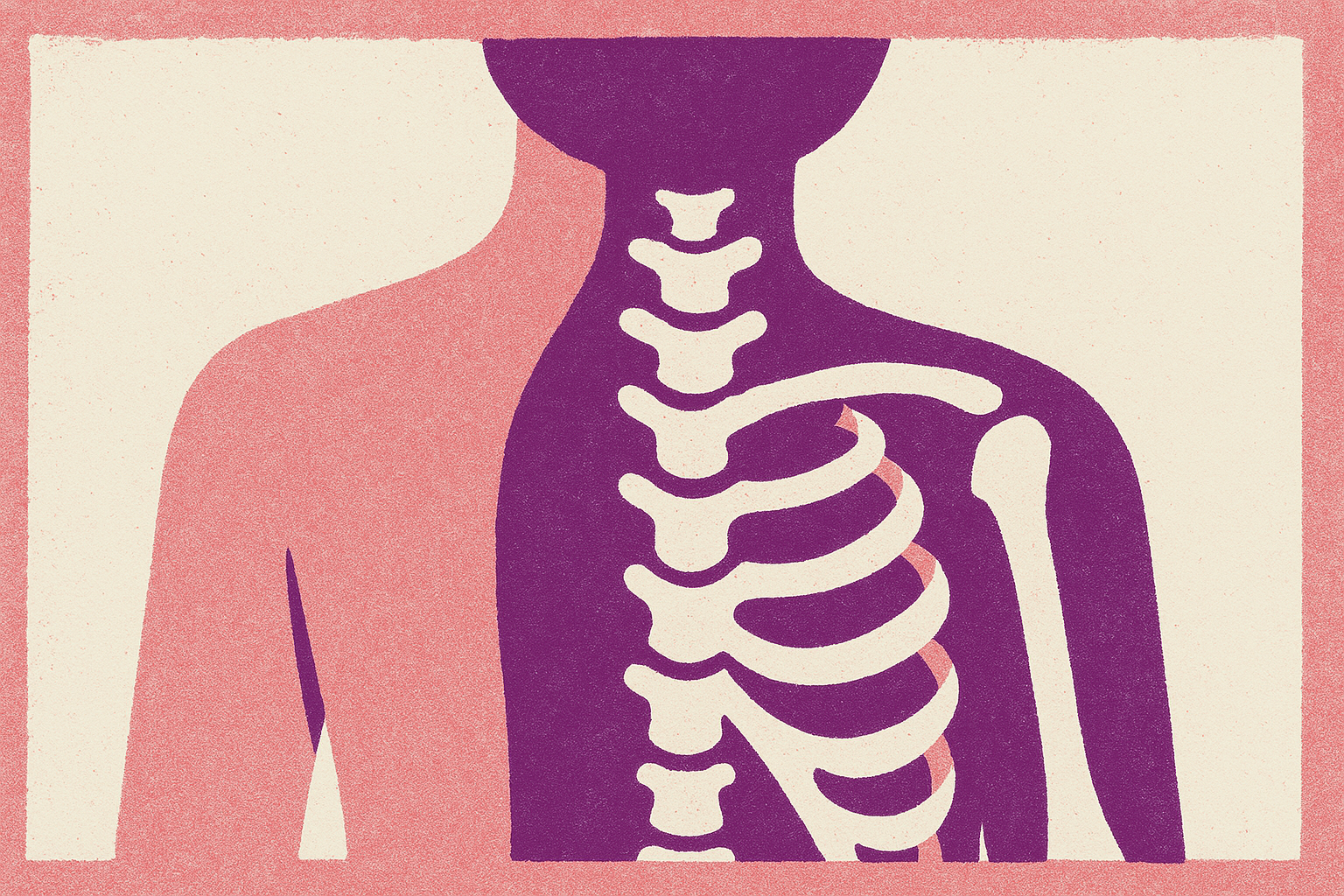
EDS is a group of heritable connective tissue disorders, not one disease, and it carries a "rare" label that fits some of its 13 subtypes and badly misrepresents at least one. That mismatch decides how long patients wait for a diagnosis, which specialists they get bounced between, and whether a clinician even thinks to consider the condition at all. The subtype causing the damage is hypermobile EDS (hEDS), and the "1 in 5,000" figure attached to it is close to fiction.
All 13 subtypes, recognized under the 2017 international classification, share a few hallmarks: joints that bend past their normal range, skin that stretches more than it should, and tissue that tears, bruises, or heals badly compared to a typical patient. Past that, the subtypes split hard on genetics, severity, and how often they turn up in a population. A condition earns the "rare disease" label in most regulatory systems if it affects fewer than 1 in 2,000 people. That single cutoff is the hinge this whole story turns on, and hEDS sits right on top of it, maybe well past it.
The number most often quoted for EDS as a whole is 1 in 5,000, a figure that traces back to Pyeritz's work from 2000 and gets backed up by population data out of two European countries. At 1 in 5,000, EDS clears the rare disease bar with room to spare. But averaging 13 conditions with wildly different rates into one number doesn't describe anything real, it just launders the uncertainty. hEDS is the subtype driving most of the confusion, and most EDS cases overall, and the honest answer is that nobody knows its true prevalence, and experts openly say the population studies needed to settle the question haven't been done. That's not a rounding error. It's the reason patients spend years living with what might be a fairly common condition while their doctors were trained to treat it as vanishingly unlikely.
Why the 1 in 5,000 figure obscures more than it reveals
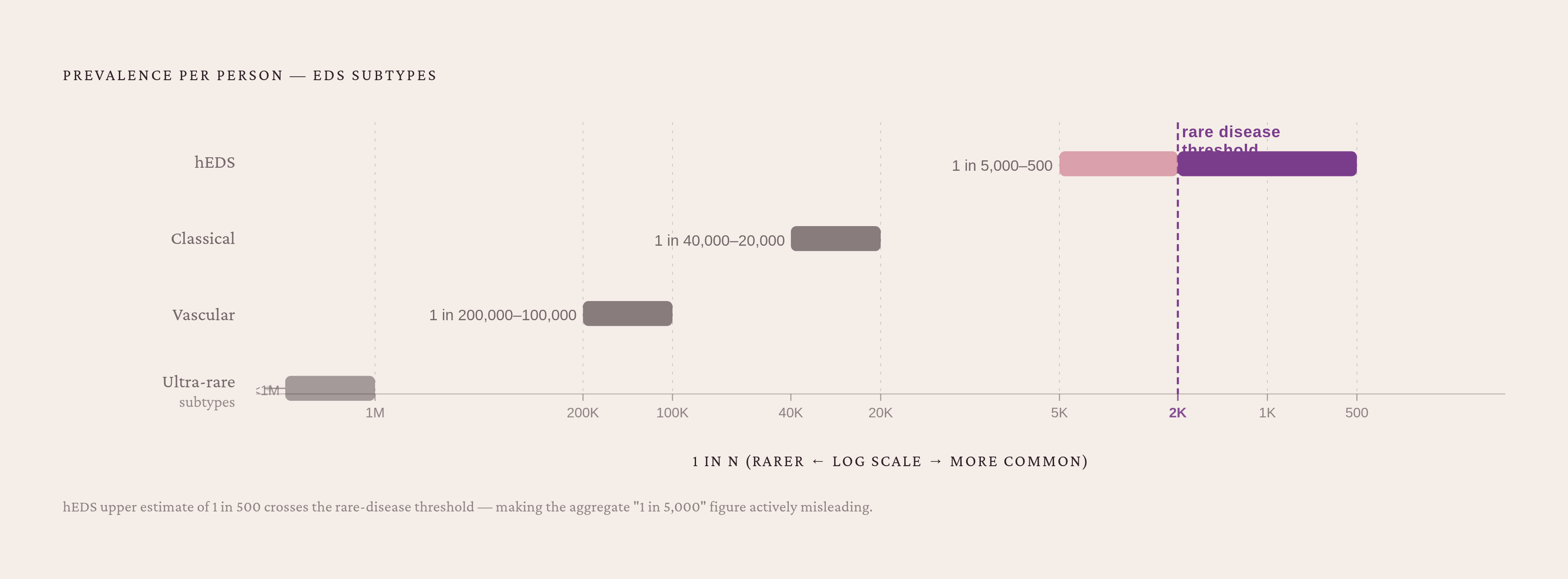
The Ehlers-Danlos Society has taken a clear stance on this: the field should move away from combined prevalence figures without a subtype attached, because one number flattens realities that don't belong in the same sentence.
Break the aggregate apart and the range is stark. Classical EDS runs somewhere between 1 in 20,000 and 1 in 40,000, genuinely rare by any measure. Vascular EDS, the subtype with the highest death risk, sits at 1 in 100,000 to 1 in 200,000. The remaining subtypes affect fewer than 1 in a million people each. Then there's hEDS, estimated anywhere from 1 in 500 to 1 in 5,000. That's a tenfold spread, and the upper end of that range isn't rare under any definition anyone actually uses.
Classical, vascular, and hypermobile EDS together account for the large majority of diagnosed patients. So the 1-in-5,000 headline is really just an hEDS estimate wearing a label meant to cover the whole condition, and it's the estimate experts openly call unresolved. A 2019 study using electronic health records across one region (Demmler et al.) put diagnosed prevalence at roughly 1 in 3,100, already above the supposed baseline, and that number only counts people who made it all the way to a diagnosis. More recent estimates put prevalence as high as 120 per 100,000, well above what older projections assumed. Every one of these newer numbers points the same direction: up.
Tell an entire medical system that EDS is rare, and clinicians stop expecting to see it. That's not a soft cultural effect, it's mechanical. Doctors who aren't looking for a condition don't find it, and the cases they miss never make it into the prevalence count that decides whether the condition gets called rare in the first place. The label creates the blindness that keeps the label accurate on paper.
Why hEDS specifically resists accurate counting
hEDS is the one subtype with no confirmed genetic marker. Even after the 2017 international criteria revision, there's no blood test, no gene panel, nothing that hands a patient a lab result to point to. Diagnosis runs entirely on a physician's exam and clinical judgment, full stop.
That has a direct effect on the numbers. A diagnosis built entirely on clinical judgment depends on whoever's doing the judging, and training on EDS isn't standardized or spread evenly across specialties. The signs a doctor is supposed to weigh, skin hyperextensibility, skin texture, joint hypermobility, tissue fragility, easy bruising, are semiquantitative. They call for a subjective read, not a number on a lab report, so two competent physicians examining the same patient can walk away with two different conclusions. Neither one is wrong by the criteria. That's the problem.
Layer on a structural issue baked into the 2017 revision itself. Before that update, patients fell under a broader category called joint hypermobility syndrome (JHS). The 2017 criteria split that population into two groups, hypermobility spectrum disorder (HSD) and hEDS, but did it without a genetic test to draw a clean line between them. Combined, HSD and hEDS run an estimated 1 in 600 to 1 in 900 in population studies, but the hEDS-only number stays unresolved because nobody can separate the two groups with certainty. Anyone who quotes a precise hEDS prevalence figure is quoting more confidence than the data supports.
The Ehlers-Danlos Society says plainly that current hEDS prevalence figures run low, and just as plainly that nobody can say by how much yet, because the population studies that would apply standardized criteria to answer that question haven't been done. That's not a footnote buried in a methods section. It means the number used to decide whether EDS counts as rare sits on a foundation experts openly call unfinished.
How multisystem symptoms fragment the diagnostic picture
EDS rarely shows up as one clean problem. It spreads across organ systems: joints, skin, the heart and blood vessels, the gut, muscles, and a kind of fatigue that doesn't lift with sleep.
A systematic review found chronic pain in 88.5% of hEDS patients, chronic fatigue in 96.8%, and gastrointestinal complications in 90.5%. Each of those symptoms has a longer, more familiar list of explanations sitting ahead of EDS in a clinician's mental checklist. A doctor who hasn't been trained to think connective tissue reaches for fibromyalgia, irritable bowel syndrome, anxiety, or orthostatic intolerance first, and reasonably so, since those conditions show up more often on their own and don't require connecting dots across specialties.
That's exactly where the picture falls apart. Patients get sent to rheumatology for the joints, gastroenterology for the gut, cardiology for the dizziness and racing heart, and each specialist examines a slice competently while nobody steps back to look at the whole patient. A 2025 systematic review and meta-analysis found vascular complications in 30.03% of EDS patients overall, and 42.36% in vEDS specifically, a reminder that missing the connection doesn't cost the same across subtypes. For vEDS, a delayed diagnosis carries life-or-death stakes. For hEDS, the overlap with fibromyalgia, arthritis, and chronic fatigue syndrome doesn't sit quietly alongside a possible EDS diagnosis, it competes with it, and the more familiar label wins more often than it should.
The diagnostic odyssey in numbers
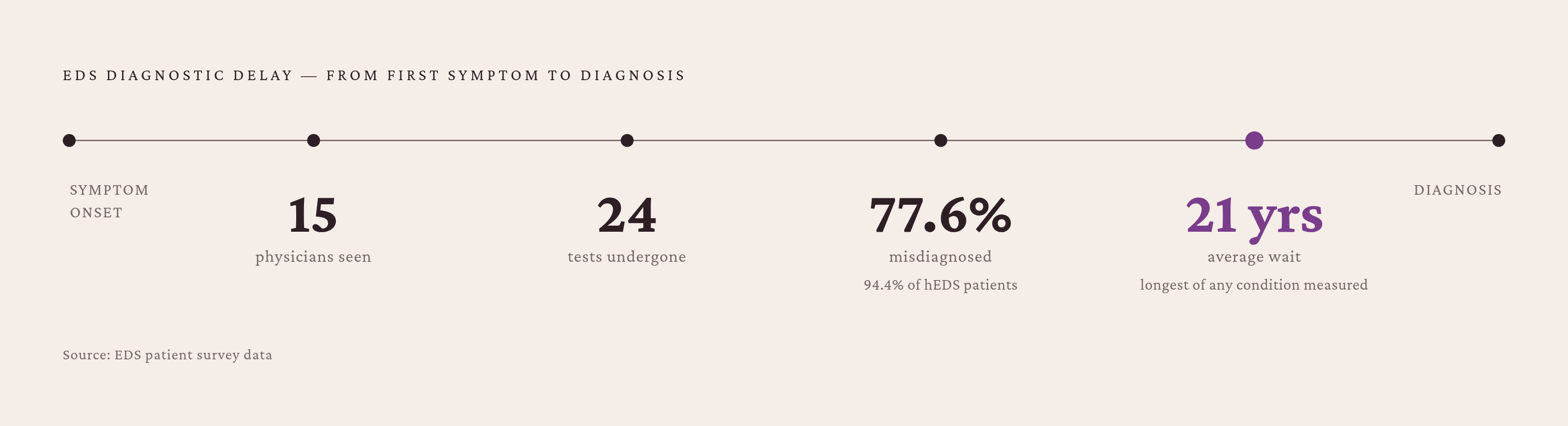
A study from Rare Patient Voice found EDS patients waited an average of 21 years for diagnosis, the longest of any condition the study measured. Along the way, 77.6% had been misdiagnosed at least once, sitting through an average of 24 tests and 15 different physicians before getting an answer.
That 21-year figure isn't an outlier inside EDS research either. A 2019 study put the average at 14 years, with a quarter of patients waiting more than 28. A study cited on ScienceDirect pointed to earlier research finding averages of 5 or more years before diagnosis. Set these next to the European average total diagnosis time of around 4.7 years, and EDS stands out even inside a category built on long, grinding diagnostic paths.
European rare disease data flags a handful of factors that predict longer delays: symptom onset before age 30 (especially during adolescence), being a woman, the number of healthcare professionals a patient has already seen, and a history of prior misdiagnosis. EDS patients tend to check every one of those boxes at once, which is a big part of why the delay compounds instead of just adding up.
The gender gap earns its own mention here. In the Welsh cohort study, women were diagnosed 8.5 years later than men on average. That gap doesn't just stretch out the wait, it points to symptoms getting read and dismissed differently depending on who's reporting them.
Every patient still stuck inside that odyssey, still years from a diagnosis, is an undiagnosed case the prevalence statistics simply can't see. Diagnosed prevalence and true prevalence are not the same number, and the odyssey data says the gap between them runs wide.
The psychiatric misdiagnosis pattern and what it does to counting
A retrospective chart review of 429 patients clinically diagnosed with hEDS (94.8% female, mean age 27.9) found that 94.4% had a prior misdiagnosis on record. Some were told their symptoms were "in their head." Others got labeled attention-seeking, or handed diagnoses like factitious disorder, Munchausen syndrome by proxy, or conversion disorder.
That's not a fringe subset of cases. In the population studied, it's close to the default experience.
Psychiatric misdiagnosis doesn't just slow things down, it actively derails them. Once a patient carries a psychiatric label, physical workups tend to stop cold. Plenty of patients disengage from the healthcare system entirely after being told, in effect, that nothing is physically wrong with them. That disengagement erases them from any future prevalence count just as completely as if they'd never sought care in the first place.
The gender gap in diagnosis timing lines up with this pattern too closely to call it coincidence. Women reporting pain, fatigue, and symptoms that span multiple systems get steered toward psychological explanations faster than men presenting the same complaints. Qualitative research on hEDS patients describes a recurring thread of dismissal, from clinicians, from family, from the systems patients have to move through, and that dismissal doesn't just cause distress. It adds years, functionally, to the time before anyone gets the diagnosis right.
Put together, a sizable population of people with real EDS symptoms gets steered away from the diagnosis that actually fits them. The diagnosed prevalence figure isn't an honest estimate of how common the condition actually is. It's a floor.
Why the "rare" classification has real consequences for patients who aren't rare
The Ehlers-Danlos Society frames the stakes plainly: treat the whole EDS family, hEDS and HSD included, as rare, and clinicians, hospital systems, and policymakers conclude it isn't worth their attention. Resources and training go toward conditions everyone agrees are common instead.
The reverse matters just as much, and it's the part that gets lost when patients push back on the rare label. Classical EDS, vascular EDS, and the ultra-rare types depend on the research funding and clinical attention that come attached to a rare disease designation. Strip that label away across the board and those patients lose real, tangible support. The fix here isn't "EDS isn't rare." It's "hEDS specifically probably isn't, and lumping it in with the subtypes that are hurts everyone."
A classification system built around a binary rare-or-not decision can't handle a family of conditions where one subtype might affect 1 in 500 people and another affects 1 in 200,000. If hEDS prevalence really does sit closer to 1 in 500, it ranks among the more common heritable connective tissue conditions out there, not some edge case a generalist physician can reasonably expect to go a whole career without seeing.
The loop closes on itself. Clinicians who believe EDS is rare don't look for it. Patients who don't get looked for don't get diagnosed. Undiagnosed patients never show up in the prevalence data. Low prevalence data keeps the rare label stuck in place. This isn't a hypothetical failure mode, it's the lived experience of a large share of the community, right now.
What patients can do with this understanding before and during appointments
The clinician across the desk may genuinely believe EDS is too rare to bother ruling out. Showing up prepared to make the case isn't overstepping, it's necessary, and patients shouldn't apologize for it.
The multisystem symptom pattern that fragments a diagnosis across specialists can work the other way too, if it gets documented right. Pain, fatigue, GI symptoms, skin changes, joint instability, tracked together over time, tell a far more convincing story than any one symptom reported alone to a single specialist. Structured symptom tracking that links what's happening across systems, over months and years, closes the exact gap that lets EDS slip through unnoticed. It shows the pattern instead of one fragment of it.
A timeline helps too: when symptoms started, every prior diagnosis received (psychiatric labels included), and the order of specialists seen along the way. That timeline hands a clinician the connective thread a scattered medical record usually leaves out.
Health apps built for chronic, multisystem conditions, the kind that let patients log symptoms by voice or text, track patterns across sleep and daily activity, and turn all of it into a summary ready to hand a doctor, go straight at the burden a 21-year diagnostic odyssey piles onto one person. Talking to others who've already gone through diagnosis matters just as much. People who've sat through the same appointments can explain what the diagnostic criteria actually look like in practice, and which words tend to get a clinician's attention, the kind of knowledge that's hard to pick up inside a fifteen-minute visit.
None of this is self-diagnosis, and it shouldn't be framed that way to a doctor. It's walking into the room with enough organized, documented evidence that the clinician can do the job right the first time. The diagnostic delay research says plainly that patients who show up this prepared get better outcomes, faster.
Sources
- Prevalence of vascular complications in Ehlers-Danlos syndrome: a systematic review and meta-analysis - PMC
- Are the Ehlers-Danlos Syndromes and Hypermobility Spectrum Disorders Rare or Common? - The Ehlers Danlos Society
- Diagnosed prevalence of Ehlers-Danlos syndrome and hypermobility spectrum disorder in Wales, UK: a national electronic cohort study and case–control comparison - PMC
- Extracutaneous features and complications of the Ehlers-Danlos syndromes: A systematic review - PMC
- An exploration of the journey to diagnosis of Ehlers-Danlos Syndrome (EDS) for women living in Australia - PMC
- rarepatientvoice.com