Mast Cell Activation Syndrome in EDS Patients
Why this immune condition gets missed in connective tissue patients and how to spot it.

Mast Cell Activation Syndrome, or MCAS, is an immune condition where mast cells fire off too often and too intensely, dumping histamine and dozens of other chemical messengers into tissues across the body. For people with Ehlers-Danlos Syndrome, it's almost never a standalone diagnosis. It shows up alongside connective tissue problems and, often, a heart rate disorder called POTS, and untangling which condition is causing what symptom is the real work of managing all three.
The symptoms of MCAS are scattered by nature: skin flushing, hives, gut pain, nausea, headaches, trouble breathing. That's precisely why the condition gets missed. A case series by Weinstock and colleagues, published in PMC in 2023, put the estimated prevalence at 17% of the general population. That's not a rare disease number. That's a number that should show up on every differential diagnosis list for unexplained multisystem symptoms, and it mostly doesn't.
Part of the reason is timing. MCAS was only described as a distinct syndrome in relatively recent decades, which means many practicing physicians finished medical school without ever hearing the term. It's largely absent from standard curricula even now. So when a patient shows up with rashes, gut trouble, and fatigue that seem to have no connection, MCAS rarely makes the list of suspects. The triggers, foods, heat or cold, stress, hormone shifts, certain medications, look random without a framework to organize them. With one, the pattern snaps into focus.
Diagnosis itself is a slog. Standard allergy panels often come back negative or inconclusive. Serum tryptase, the blood marker doctors reach for first, can sit at a normal level even in patients with confirmed MCAS. Getting a real answer sometimes means a 24-hour urine collection checking for methylhistamine and prostaglandins, sometimes tissue biopsy. None of this is exotic. It's underdiagnosed, not rare, and that distinction matters for how seriously a patient's symptoms get treated on day one.
The diagnostic criteria debate that affects whether patients get taken seriously
Two competing sets of diagnostic criteria are in play right now, and which one a clinician uses can decide whether a patient walks out with a treatment plan or a shrug.
Consensus-1 is the stricter framework. It demands objective biomarker evidence, which means fewer people qualify, but the diagnosis carries more weight once it's made. Consensus-2 takes a looser approach, leaning on symptom patterns and how a patient responds to treatment rather than requiring a lab test to confirm everything. That flexibility lets more people get care sooner, even without a definitive biomarker in hand.
Each side has a real cost. Critics of Consensus-2 worry it opens the door to overdiagnosis, and that mislabeling something else as MCAS could delay catching a different, serious condition underneath. Critics of Consensus-1 point out that plenty of genuinely symptomatic patients get left with no diagnostic home at all, stuck waiting for a biomarker that may never show up on a given day's blood draw.
A paper titled "Progress in mast cell activation syndrome: the global consensus-2 diagnostic criteria at six years," slated for June 2026, appears in Mast Cell Action's March 2025 bibliography update as a key reference point for where this argument currently stands. And the stakes are visible in the numbers already available: available data suggest that only a small minority of patients referred for suspected MCAS actually end up diagnosed with it. That gap points to two problems at once, over-referral on one side, and real confusion among clinicians about which presentations actually fit the condition on the other.
For someone with EDS already carrying a complicated symptom list, this isn't an abstract argument happening in journals. It decides whether new symptoms get folded into "well, that's just your EDS" or get investigated as something separate and treatable. Patients who already face skepticism about symptoms that don't show up on standard tests have the most to lose when the criteria used against them are the strict ones, and the most to gain from a clinician willing to work with the broader framework.
How connective tissue and mast cells are biologically linked in hEDS
Mast cells don't drift loose through tissue. They anchor to proteins in the extracellular matrix, including fibronectin and vitronectin, the same structural scaffolding that's built differently in hypermobile EDS. When that scaffolding is abnormal, the surface mast cells attach to changes, and so, it seems, does their behavior.
This isn't a loose correlation dredged up from patient forums. Disrupted attachment appears to drive up production of proinflammatory cytokines, a direct biological mechanism connecting tissue structure to immune signaling. Immunohistochemistry studies have found elevated chymase, a chemical mast cells release, in skin that looks completely normal on patients showing signs of connective tissue disorders. The tissue looks fine. The mast cells underneath are already active.
A set of studies published in MDPI in October 2024 tied hEDS and MCAS together through genetic factors affecting immune regulation and susceptibility to infection, adding a hereditary thread to a picture that was previously mostly descriptive. And the relationship likely runs both directions: connective tissue structure shapes how mast cells behave, while the mediators mast cells release can, in turn, affect connective tissue itself. Over time, that feedback loop may make joint instability and hypermobility symptoms worse, not just static.
The pattern extends outward from there. Populations with connective tissue disorders and MCAS show overlapping rates of functional gastrointestinal disorders, eosinophilic GI conditions, asthma, neuropsychiatric symptoms, osteoporosis, and orthostatic intolerance. None of this is patients collecting diagnoses because they're anxious or thorough. It's one underlying structural problem expressing itself across several organ systems at once.
What the "trifecta" of hEDS, MCAS, and POTS looks like in practice, and what the research actually confirms
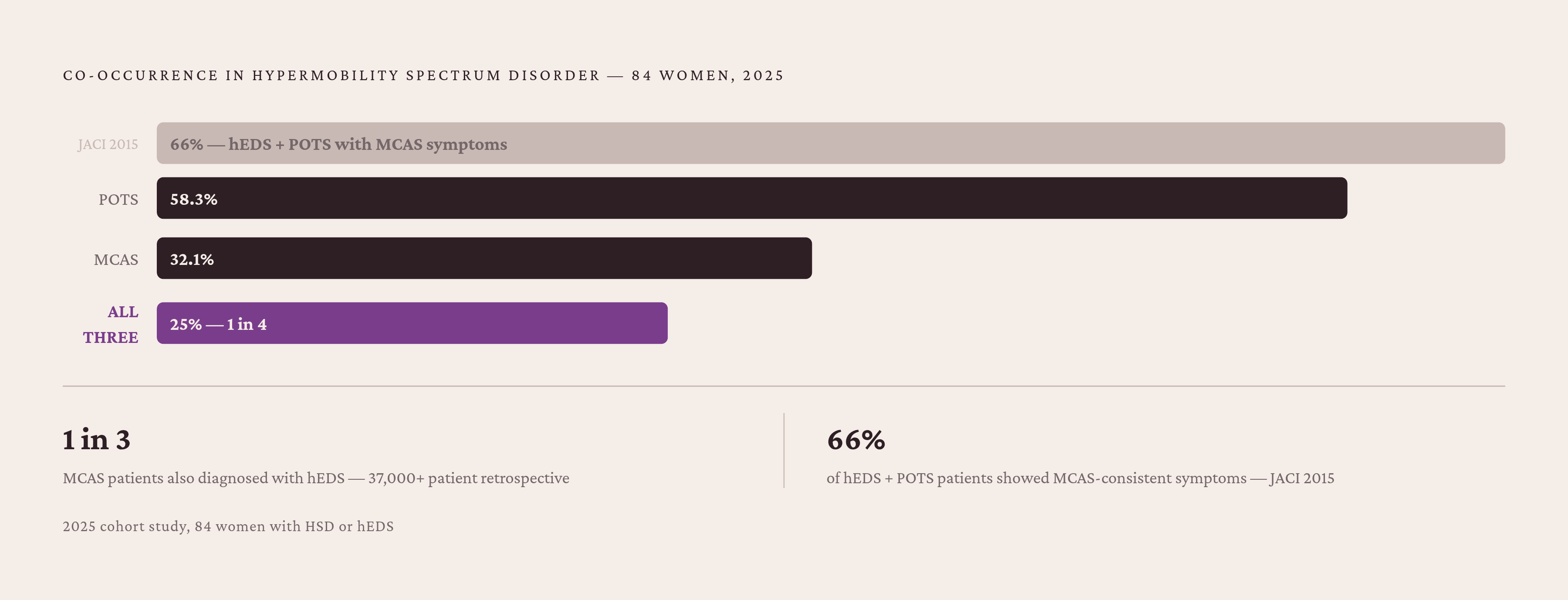
Patient communities have talked about "the trifecta" for years: hEDS, MCAS, and POTS (postural orthostatic tachycardia syndrome) showing up together often enough that it stopped looking like coincidence. Research is starting to catch up to what patients were already noticing.
A retrospective analysis covering more than 37,000 patients found nearly one in three of those diagnosed with MCAS also carried a diagnosis of hEDS. A 2025 study in Autonomic Neuroscience followed 84 women with hypermobility spectrum disorder or hEDS and found 58.3% had POTS, 32.1% had MCAS, and a full quarter had all three conditions at once. Go back further, and a 2015 study in the Journal of Allergy and Clinical Immunology found that 66% of participants with both hEDS and POTS also showed symptoms consistent with MCAS. A 2024 retrospective study using national health records found people with hEDS are 29.7 times more likely to be diagnosed with POTS than the general population, which is not a subtle association.
The mechanism, as far as anyone can piece together, works in a loop. Weak connective tissue makes it harder for blood vessels to constrict and regulate circulation properly, which worsens POTS. The circulatory swings that come with POTS can trigger mast cells to fire, worsening MCAS. And the inflammation, pain, and fatigue that MCAS generates then pile back onto the fatigue and joint instability of EDS. Each condition feeds the next.
However, the epidemiological proof isn't as settled as the pattern suggests. A systematic review published in Annals of Allergy, Asthma & Immunology in February 2025, led by Farley and colleagues, found no studies that met its prespecified diagnostic criteria to confirm a relationship between mast cell activation disorders, hereditary alpha tryptasemia, POTS, and EDS. The review's conclusion was blunt: more rigorous, validated studies are still needed. A separate scoping review from the same month, registered in PROSPERO and published in the Journal of Allergy and Clinical Immunology, reached a similar verdict, finding the current evidence doesn't confirm an association between mast cell activation disorders and POTS or EDS.
Both things are true at once. The clinical pattern is real, reported constantly, and consistent enough across multiple studies to take seriously. The rigorous proof that would satisfy a strict epidemiologist isn't fully built yet. Patients and clinicians shouldn't wait around for that proof before acting on what the pattern already shows.
Some researchers have gone further, proposing a broader cluster sometimes nicknamed the "septad," which folds in gastrointestinal conditions like IBS, autoimmune disease, and neurodivergent conditions including autism, ADHD, dyspraxia, and dyslexia.
The neuropsychiatric symptoms that make MCAS in EDS so hard to separate from "just anxiety"
MCAS comes with a long list of neuropsychiatric symptoms that have nothing obvious to do with allergies: dysautonomia, small fiber neuropathy, muscle pain, migraine, brain fog, restless legs, disrupted sleep, non-pulsatile tinnitus, depression, generalized anxiety, and panic attacks, as documented across case series and reviews of MCAS neuropsychiatric presentations.
A 2025 study analyzed questionnaires from 553 people with MCAS against 558 controls, covering 19 neurologic and 25 psychiatric disorder categories, and found neuropsychiatric conditions reported at much higher rates in the MCAS group. A related study found female patients with MCAS were three times more likely to report ADHD than controls. The 2025 study found something that should reframe how these symptoms get treated: neuropsychiatric symptoms tended to improve when patients received MCAS-targeted therapy, not psychiatric treatment. That's a strong hint these symptoms are mechanistically tied to mast cell activity, not incidental.
Brain fog, sudden anxiety spikes, panic attacks, mood swings, depersonalization: all of these can be triggered directly by foods, environmental exposure, hormone shifts, or additives in medication. None of that sits inside the scope of a standard psychiatric evaluation, which asks about mood and history, not what a patient ate three hours before symptoms started.
Medication response adds another layer of confusion. MCAS patients sometimes react badly to standard treatments in ways that look like noncompliance or exaggeration, when what's actually happening is a mast-cell-mediated drug sensitivity. A patient who says a medication makes things worse, and is right, can end up labeled difficult instead of correctly diagnosed. Without an MCAS framework in the room, these symptoms are functionally indistinguishable from a primary psychiatric condition. Most clinicians don't have that framework yet.
The cost of being misread: misdiagnosis, medical trauma, and what the data shows
Psychiatric conditions do occur at higher rates in people with EDS: Mayo Clinic data puts the figure as high as 43% for classical or hypermobile EDS overall, with anxiety around 25% and depression around 26%. But those numbers tell only part of the story, and the rest of it is uglier.
A retrospective study published in Children looked at 429 patients, 94.8% women, diagnosed with hEDS over a multi-year retrospective period. Of those, 94.4% had already received a misdiagnosis of psychiatric illness from a non-psychiatrist clinician before anyone identified the actual EDS. That's not an edge case buried in a footnote. That's nearly the entire study population.
When no single specialist can explain the full picture, the default move is often a referral to psychiatry, sometimes with a label like "somatoform disorder" or "conversion disorder" attached, which is a clinical way of saying the symptoms are psychological rather than physical. Getting told that repeatedly leaves a mark. Patients report leaving these encounters feeling disbelieved and mistrusted, and the downstream effects are documented: PTSD, a hardened mistrust of the healthcare system, and diagnosis delayed even further because the next doctor inherits a chart full of psychiatric labels instead of physical ones.
Here's the genuinely hard part: real anxiety, depression, and PTSD do show up in this population, sometimes as a direct biological effect of mast cell mediators circulating through the nervous system, sometimes as an entirely reasonable emotional response to years of not being believed. Treating psychological distress as proof there's no physical illness underneath it is not just wrong, it actively causes harm. Actress and activist Jameela Jamil has spoken publicly about living with EDS, POTS, MCAS, ADHD, and PTSD, and about the mental health weight that comes with managing all of it, one of the few visible public accounts of exactly this cluster of conditions.
What effective self-management of MCAS within an EDS context actually involves
Trigger identification comes first, and it takes patience. MCAS symptoms aren't random even when they feel that way in the moment. Foods, temperature swings, stress, hormone cycles, physical exertion, and additives hiding in medication all function as triggers, but the pattern only becomes visible with consistent tracking over time, not from a single bad week.
Complicating things further, triggers aren't the same from one MCAS patient to the next. And in a body that also has EDS, those triggers interact with joint instability, fatigue, and dysautonomia, so a flare often comes from a stack of small factors rather than one obvious cause.
Tracking has to reflect that complexity or it's useless:
- Logging needs to cover multiple organ systems at once, skin, gut, neurological, cardiovascular, not just whichever symptom is loudest that day.
- Context belongs in the log too: food eaten, exertion level, sleep quality, stress, environmental exposure, and where a patient sits in their hormonal cycle.
- Patterns show up over weeks and months, not in a single day's notes, and that longer view is what actually informs a treatment decision.
Chronic-illness-focused symptom tracking tools, the kind built specifically for cross-system tracking with voice or text logging, can surface connections a general fitness app or a paper journal simply isn't built to catch. Juno, for instance, is a 24/7 symptom-tracking companion designed around exactly this kind of multi-system, context-rich logging for people with chronic conditions.
Energy management isn't a nice-to-have here. MCAS flares drain the body physically, and stacked on top of EDS fatigue and POTS-related exertion intolerance, a post-exertional crash is a real and recurring risk. Pacing strategies built around spoon theory apply directly, not as a metaphor but as a practical daily budget.
Medication sensitivity needs its own line of tracking. Fillers, dyes, and additives in ordinary medications and supplements can set off a reaction in MCAS patients, so keeping notes on which formulations cause trouble is a safety measure, not a preference.
Low-histamine diets show up often as a management tool, and they can genuinely reduce mast cell load. They're not a cure, though, and shouldn't be started without medical guidance, since restrictive eating carries its own risk in a body that's already running on empty. Stress deserves the same respect as a physical trigger, since mast cells respond to both emotional and physical stress through the nervous system. Reducing stress here isn't wellness fluff. It's a targeted part of treatment.
How to make clinical appointments work when the symptom picture spans three overlapping conditions
EDS, MCAS, and POTS get managed by three different kinds of specialists, rheumatology, immunology or allergy, cardiology or neurology, and those specialists rarely talk to each other directly. The patient is often the only person in the room who holds the entire picture.
Walking in with structured documentation changes what's possible in a 15-minute appointment. A timeline connecting flares to identified triggers, a running list of medication reactions, a symptom map spread across organ systems: this is the difference between a doctor piecing things together from scratch and a doctor picking up where the last visit left off.
Knowing which specialist to actually pursue matters too. Allergists and immunologists are generally the front door for MCAS diagnosis and management. Some mast cell specialists exist specifically for complex cases, and gastroenterologists become relevant when GI symptoms dominate the picture. Walking into the wrong specialty's waiting room wastes months.
Understanding the Consensus-1 versus Consensus-2 divide, even at a basic level, gives a patient a way to ask a pointed question: which framework is this clinician using, and what does that mean for what tests get ordered and what gets ruled out. A short written summary, brought to the appointment, covering which systems are affected, which triggers have been identified, and which treatments have already been tried, turns a fragmented fifteen-minute visit into something closer to a real conversation. For a condition cluster where no single specialist sees the whole picture, that piece of paper might be doing more work than anyone in the room realizes.
Sources
- Prevalence Of Mast Cell Activation Disorders Amongst POTS And EDS Patients: A Scoping Review - Journal of Allergy and Clinical Immunology
- Prevalence of mast cell activation disorders and hereditary alpha tryptasemia among patients with postural orthostatic tachycardia syndrome and Ehlers-Danlos syndrome: A systematic review - ScienceDirect
- Neuropsychiatric Manifestations of Mast Cell Activation Syndrome and Response to Mast-Cell-Directed Treatment: A Case Series - PMC
- Prevalence and treatment response of neuropsychiatric disorders in mast cell activation syndrome - PMC
- mastcellaction.org
- mdpi.com
- drtaniadempsey.com
- thefibroguy.com