EDS and Sleep Disturbance Patterns
Four separate mechanisms disrupt sleep in EDS, not one problem with one solution.
People with EDS routinely spend eight, nine, even ten hours in bed and still wake up in pain, still foggy, still exhausted. That's not a hygiene problem you fix with a cooler room or less screen time before bed. Sleep disturbance in Ehlers-Danlos syndrome comes from at least four separate mechanisms working at once: pain, autonomic dysfunction, mast cell activity, and post-exertional malaise, each one contributing to the disrupted night through distinct mechanisms. A 2025 study by Crews-Stowe and colleagues, published in Medical Sciences, found that 65.3% of people with EDS sleep fewer than 8 hours a night, and 26.2% average fewer than 6, a rate meaningfully above the 23% of the general population reporting the same. Separately, 77% of EDS patients in another study described severe fatigue, not garden-variety tiredness but the kind that feels like carrying weight. The rest of this piece maps out where each of those mechanisms comes from, because there isn't one fix here. There are four problems wearing one name.
How chronic pain blocks sleep before it even starts
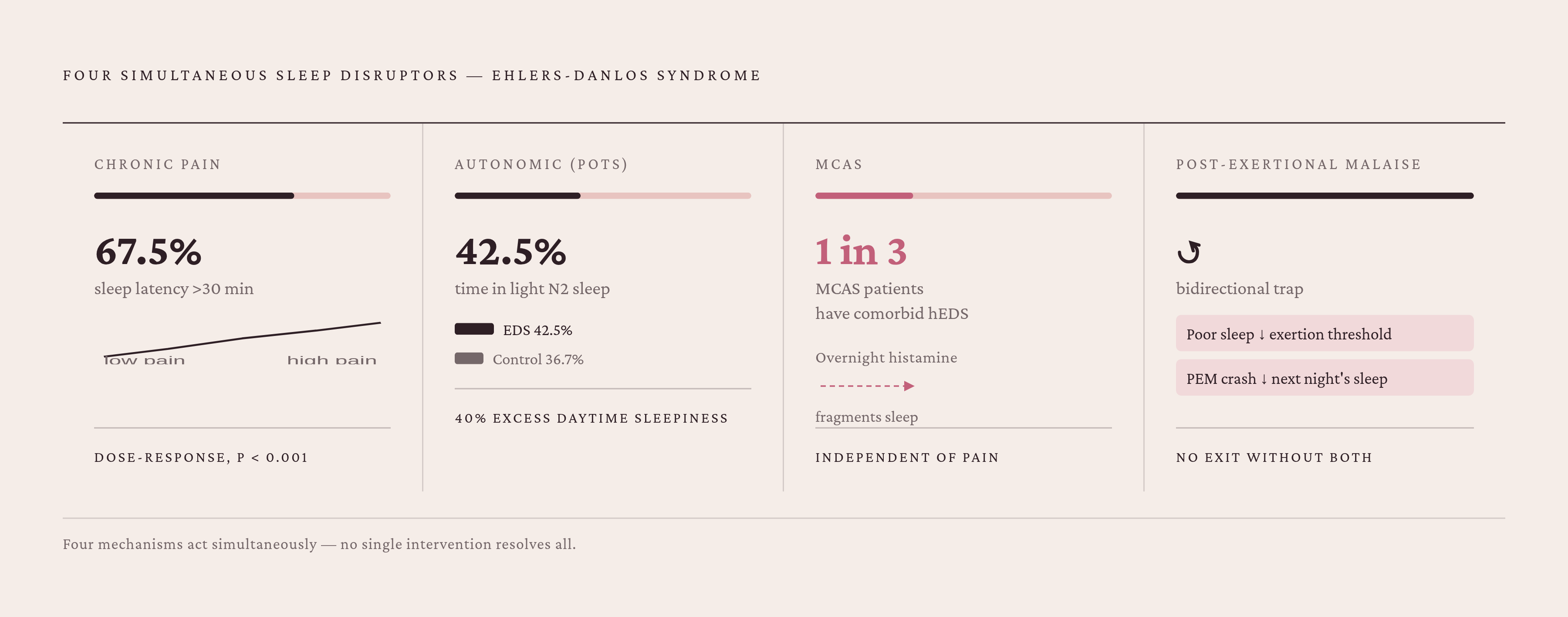
Before sleep architecture even enters the picture, there's the matter of falling asleep in the first place. Crews-Stowe et al. found that 67.5% of EDS subjects had a sleep latency, the time it takes to actually fall asleep, of more than 30 minutes. That's not a minor inconvenience. That's over a third of an hour lying awake, night after night.
A 2026 study in Healthcare by Tudini, Crews-Stowe, and Levine, drawing on 2,365 respondents with self-reported hypermobile EDS, found something sharper than a correlation: a clear dose-response relationship between how often someone experiences pain and how long it takes them to fall asleep (p < 0.001). More frequent pain, longer latency. Every time. The same study found that greater pain frequency independently raised the odds of frequent poor physical health days (OR = 1.82) and poor mental health days (OR = 1.35).
The mechanism isn't mysterious once you understand the tissue involved. In hEDS, connective tissue laxity means joints shift and settle differently once someone lies down. There's no stable position to find, because the ligaments that would normally hold a joint in place are looser than they should be. Muscle tension and positional discomfort keep firing signals that block the nervous system from winding down, which is a structural problem, not an anxiety problem, even though it can look similar to an outside observer.
That dose-response finding predicts how long a patient will lie awake based on that day's pain level, giving them something concrete to document. It takes "I guess I'm just a bad sleeper" and turns it into something a patient can actually document: pain level on a given day predicts how long they'll lie awake that night. Pain level on a given day predicts how long they'll lie awake that night, which is worth bringing to a doctor. It's separate, too, from a diagnosed insomnia disorder. The two can overlap, but they're not the same mechanism, and treating one like the other wastes time.
Autonomic dysfunction's effects on sleep architecture after the patient falls asleep
Falling asleep is only step one. A large share of people with EDS also live with dysautonomia, most commonly POTS (postural orthostatic tachycardia syndrome). One health blog analysis, source unverified, put the rate at 38% of EDS patients meeting POTS criteria, climbing to 72% among those under 25. Treat that figure as directional rather than gospel, but the overlap between EDS and POTS is well established regardless of the exact number.
POTS doesn't just affect standing up. It reaches into sleep itself. On polysomnography, POTS patients showed a higher average heart rate during both REM and non-REM sleep, along with a higher percentage of stage N2 sleep, 42.45% compared to 36.70% in controls, plus poor sleep efficiency and ongoing complaints of insomnia. An elevated heart rate through the night means the autonomic nervous system never fully shifts into the parasympathetic state that supports deep, restorative sleep. The body stays in a low simmer of alert, even while unconscious.
More time in N2, light sleep, comes at the direct expense of slow-wave sleep and REM, the two stages responsible for physical repair and cognitive consolidation. So someone might rack up seven or eight hours in bed and still miss out on the stages that actually do the repair work. An AJMC review found that 40% of POTS patients reported persistent excessive daytime sleepiness, with 22% experiencing it at least weekly and 20% at least monthly.
This is the piece that explains why the next day feels wrecked even after what looked, on paper, like a normal night. The sleep happened. The architecture underneath it didn't hold up. The Ehlers-Danlos Society points out that medications used to manage EDS symptoms can themselves affect sleep and add to daytime tiredness, a confounding layer that's easy to blame on the condition alone when a prescription is actually part of the picture.
The MCAS layer: how mast cell activation adds a biochemical dimension to the disrupted night
Add mast cell activation syndrome, and there's a third mechanism running alongside the first two. This isn't a rare coincidence stacking on top of EDS and POTS. One analysis of over 37,000 patients found that nearly 1 in 3 people diagnosed with MCAS also had a comorbid hEDS diagnosis.
Mast cells release histamine and other chemical mediators, and that release can follow cycles that line up with overnight hours. Histamine is a wake-promoting neurotransmitter, so mast cell activity at night can fragment sleep and cause waking that has nothing to do with pain. Someone can be lying in a comfortable position, pain reasonably controlled, and still wake up repeatedly because histamine is doing its job at the wrong hour.
MCAS also makes people reactive to things in the sleep environment itself: temperature shifts, scents, certain foods eaten too close to bedtime. Someone waking up itchy or flushed at 3 a.m. might never think to connect that to MCAS if they haven't put the pieces together before.
There's a pacing trap here too. Exercise gets recommended constantly as a fix for poor sleep, and for POTS specifically, structured exercise programs are often part of standard care. But according to a source at thehistaminecode.com, those same exercise programs can trigger mast cell degranulation in people with MCAS. So a treatment aimed at one condition can actively worsen another condition that's disrupting the very sleep the exercise was supposed to fix. None of this is a diagnostic checklist. It's context: if MCAS is already part of someone's diagnosis alongside EDS, it may be shaping their nights in ways that look nothing like pain-driven waking.
Once pain, dysautonomia, and mast cell activity have each had their turn through the night, the question becomes what's left in the tank by morning.
Post-exertional malaise and why the unrefreshed feeling compounds across days, not just nights
Post-exertional malaise, PEM, gets misread constantly as simple tiredness after doing too much. Post-exertional malaise, PEM, is not simple tiredness after doing too much, though it gets misread that way constantly. It is exhaustion that follows physical, cognitive, emotional, or orthostatic stress, paired with a worsening of baseline symptoms including cognitive dysfunction, autonomic flare-ups, and sleep disturbance.
That last item, sleep disturbance, sits on both sides of the equation. It's a trigger for PEM and a symptom that gets worse during a PEM crash. That's a bidirectional trap: bad sleep lowers the threshold for what counts as overexertion the next day, which raises the odds of a PEM crash, which then wrecks the following night's sleep too. One patient survey found that over 30% of respondents cited cognitive difficulties as an exacerbated symptom during PEM crashes.
Clinical guidance on these conditions notes that cognitive dysfunction comes from a mix of PEM, orthostatic intolerance, neuroinflammation, MCAS, and dysregulated sleep, not any single cause acting alone.
That means a good day, the kind where someone finally gets groceries done and cleans the kitchen, doesn't just cost that evening's energy. It can corrupt several nights of sleep afterward. Pacing isn't a lifestyle suggestion in this context. It's closer to a clinical necessity, because overdoing it corrupts several nights of sleep afterward, not just the evening it happens.
The psychological weight that sits on top of every disrupted night
None of this happens in a vacuum free of emotional cost. Studies of patients with EDS and generalized hypermobility spectrum disorder found that 53% in a Toronto clinic of over 1,000 patients reported current or past anxiety or depression symptoms, with other research putting that range as high as 87%, and 19% in the Toronto cohort reported disordered eating.
The numbers get heavier from there. PTSD showed up in 4.7% to 34.8% of EDS and G-HSD patients, self-harm in 3% to 29.2%, and suicidal behavior in 7.8% to 18.6%, according to published research on this population. Those figures already carry enough weight on their own, without dramatizing them further. Separately, people with EDS face a substantially higher risk of autism spectrum disorder compared to the general population, per eds.clinic, which matters here because sensory sensitivities tied to autism can make an already difficult sleep environment even harder to tolerate.
Diagnostic delay adds its own layer of chronic stress. Diagnostic delay in EDS is widely documented as spanning many years. That prolonged uncertainty carries real psychological cost, compounded by the fact that mental health support during the pre-diagnostic period is often limited or absent. Many people with EDS report second-guessing their own pain, often after having it dismissed by a clinician. That internalized doubt feeds straight into the anxiety and hyperarousal that keep people awake in the first place.
Anxiety disrupts sleep on its own terms too, through hyperarousal that has nothing to do with joints or histamine. A study of 123 children with hEDS, average age 15.8, published in Rheumatology International in March 2025, found that 80% had anxiety and 42% reported poor sleep, with both anxiety and poor sleep present at notable rates. None of this means anxiety causes sleep problems tied to this joint condition. It sits alongside the physical mechanisms, and each one makes the other worse. That layer deserves the same clinical attention as the joint pain and the racing heart, not a footnote after them.
The importance of tracking the specific pattern of disruption over tracking hours slept
Hours slept is close to useless as a metric here. Someone can spend nine hours in bed, actually sleep for seven of them, and still wake up feeling like they never lay down. The number on a sleep tracker doesn't tell a clinician which of the four mechanisms above is driving that morning.
What actually helps a clinician locate the problem:
Sleep latency. How long it takes to fall asleep, which research links to pain frequency in people with hEDS. Night waking. How many times, and what caused it. Pain, a racing heart, overheating, itching. Each points somewhere different. Morning symptoms. Cognitive fog, pain level, heart rate on standing. That last one flags orthostatic intolerance specifically. Post-exertional pattern. Whether the previous day's activity level corresponds to that night's sleep quality and the next morning's symptoms. Medication timing. Around 41.40% of EDS patients take prescription sleep medication regularly. When it was taken, whether it worked, and whether it left daytime sedation behind all matter to a prescriber trying to adjust a regimen.
Spoon theory functions here as more than a metaphor. A person without chronic illness typically has around 15 spoons, units of daily energy, to spend in a day. Someone with a chronic illness usually starts closer to 5 to 8, and a bad night knocks that down further before the day even starts. Tracking spoon spend from the day before against sleep quality the next morning can reveal the PEM-sleep cycle in a person's own numbers, not just as a concept but as a pattern they can point to.
The pattern is what the research actually supports, not any single night's data. The dose-response relationship in the 2026 Healthcare study exists precisely because frequency and pattern carry the diagnostic weight, not isolated incidents. For a population where 73% already doubt their own symptoms, tracking isn't extra homework. It's how something invisible gets made visible enough to act on.
How to bring a sleep history to an appointment that a clinician can use
Clinicians have limited time, and often limited depth of knowledge on EDS specifically. Patients arrive complex, often carrying several overlapping diagnoses, and frequently carrying a history of not being believed. That means the appointment itself needs preparation going in, not just a recap of a bad week.
Start by sorting the complaint by type before walking in the door. "I can't fall asleep" points toward pain and latency. "I wake up over and over" points toward autonomic dysfunction or MCAS. "I sleep through the night but wake up wrecked" points toward architecture problems or PEM. Each of those sends a clinician down a different path, toward a different specialist, a different test.
A sleep summary to bring along includes a pattern over at least two weeks, not just an account of last night. It should show how sleep correlates with pain days, activity level, and medication timing. It should list which comorbidities are already diagnosed, POTS, MCAS, anxiety, and whether those symptoms are active overnight. And it should note current sleep aids and their actual effect: helping, partially helping, or just adding daytime sedation on top of everything else. That 41.40% figure on prescription sleep medication use only becomes useful information once a clinician knows whether the medication is doing its job.
Whether sleep architecture needs assessment beyond just duration, whether POTS or dysautonomia could be actively disrupting sleep stages, and whether current pain management is affecting the ability to fall asleep at all are three questions to ask outright.
Compiling all of that by hand, after a stretch of bad nights, is its own kind of labor, one that people with EDS are often too depleted to take on. Some smart health tools built for chronic illness now let people log symptoms, activity, and medication by voice or text and generate a structured summary ahead of an appointment, cutting out the manual compiling that this population can least afford to do on a bad week.
The point of walking in with that history isn't to prove the problem exists. The research already does that. Giving a clinician enough structure to find which mechanism to address first replaces guessing from a five-minute conversation. And beyond the appointment itself, other people with EDS have already had these exact conversations before. Peer connection, through community groups built around the condition, tends to reveal the small practical fixes, positioning aids, medication timing tweaks, pacing strategies, that a rushed clinical visit rarely has room for.
Sources
- Sleep Characteristics in Individuals with Ehlers-Danlos Syndrome
- Pain, Sleep Latency, and Mental and Physical Health in Individuals with Self-Reported Hypermobile Ehlers-Danlos Syndrome
- Prevalence of psychiatric and sleep disorders and their impact on quality of life in children with hypermobile Ehlers-Danlos syndrome: an observational study
- medsci-13-00085
- Sleep problems in EDS and HSD - The Ehlers Danlos Society
- psychologytoday.com