Traveling With EDS Practical Considerations
Plan ahead for medications, insurance, and joint protection across every stage of your journey.
Traveling with a connective tissue disorder that leaves joints prone to dislocation, subluxation, and chronic pain, often without any outward sign of trouble, brings its own set of challenges. That invisibility is why generic travel advice falls short. A body with hEDS needs a different kind of planning, one built around joint protection, energy budgeting, comorbidity management, and logistics locked in ahead of time.
Sitting still for hours, sleeping on an unfamiliar mattress, hauling a suitcase through a terminal, sitting in a too-bright gate area with a dozen competing smells: none of this registers as a problem for most travelers. For a body with unstable joints, it's a chain of small stressors that add up fast. And hEDS rarely travels alone. Postural orthostatic tachycardia syndrome (POTS), mast cell activation syndrome (MCAS), dysautonomia, IBS, ADHD, and autism occur alongside it often enough that a single trip usually means managing several conditions at once, each with its own rules. Research consistently shows that EDS patients report complex, overlapping symptoms across the lifespan, with pain, fatigue, and sleep disruption among the most common. Every one of those gets worse in transit.
None of this rules travel out. Some people with hEDS fly internationally for weeks at a stretch; others stick to regional road trips they can control from door to door. The planning principles below apply either way.
Preparing before the trip: medications, insurance, and pre-trip pacing
Medication rules change by country, and controlled substances like morphine sometimes need government sign-off before departure. Some destinations require authorization from the health ministry or a drug control authority before letting a traveler bring certain medications across the border. The relevant embassy is the right place to start that conversation, and it's worth starting weeks out, not days.
Switching medications right before a trip adds a layer of unpredictability nobody needs at that moment. If a change is medically necessary, it belongs earlier in the calendar, with enough runway to see how the body responds before facing airports and time zones.
For anyone managing MCAS, an epi-pen belongs in hand luggage, not checked baggage, and its expiration date needs a check before departure, not after arrival.
A letter from a GP or specialist, listing diagnoses, required equipment (splints, braces, crutches, mobility devices), and any medications that need explaining at security, smooths over a lot of friction at customs and screening. Travel insurance matters just as much, and it has to cover pre-existing conditions specifically, since a standard policy often won't. Some specialist insurers write coverage for complex chronic illness without requiring a phone declaration of every diagnosis, which is worth asking about directly when comparing providers.
Packing itself is a physical task, not an administrative one. Spreading it across several weeks, rather than one long session the night before, keeps a single overexertion from triggering a flare that puts the trip in deficit before it starts. The same logic applies to rest: setting aside dedicated rest days in the weeks before departure is energy banking, not indulgence. It's the same principle as topping off a gas tank before a long drive.
Booking decisions deserve a conversation with a clinician before they're final, not after. Terrain, climate, and physical demands of the itinerary all shape what kind of preparation or modification makes sense. And if physical therapy is part of regular management, check whether sessions can be arranged near the destination, so the trip doesn't mean a total gap in care.
Choosing transport and setting up the journey itself for joint protection
Car travel offers the most control of any transport option. A traveler sets the break schedule, brings a familiar seat cushion, and picks the food. That doesn't make it the "easy" choice automatically, it makes it the adaptable one.
A few road trip specifics matter for EDS bodies:
- Regular stops to stretch, walk, and breathe do more than break up monotony. They stop blood from pooling and keep fascia from stiffening up during long stretches of stillness.
- Small movements while seated, heel raises, pelvic tilts, gentle shoulder shrugs, keep circulation and joints from locking into one position.
Cushions and arm or head support prevent muscle bracing, which fatigues muscles fast and raises the risk of subluxation.
- Motion sickness comes up often in EDS. Acupressure wristbands are a low-effort option some travelers use (a practice noted by movement specialist Jeannie Di Bon), and reading while the vehicle is moving tends to make things worse, not better.
Flights bring their own seat calculus. An aisle seat makes it easier to stand and move without climbing over someone else. A window seat gives a wall to rest the head against for neck support. Oddly enough, a middle seat in an empty row can be the best outcome of all: it gives limbs room to shift position, which cuts down on tension and lowers subluxation risk. Extra-legroom seats buy more room to reposition throughout the flight. Whatever the preference, requesting it at the time of booking rather than at the gate means getting it instead of hoping for it.
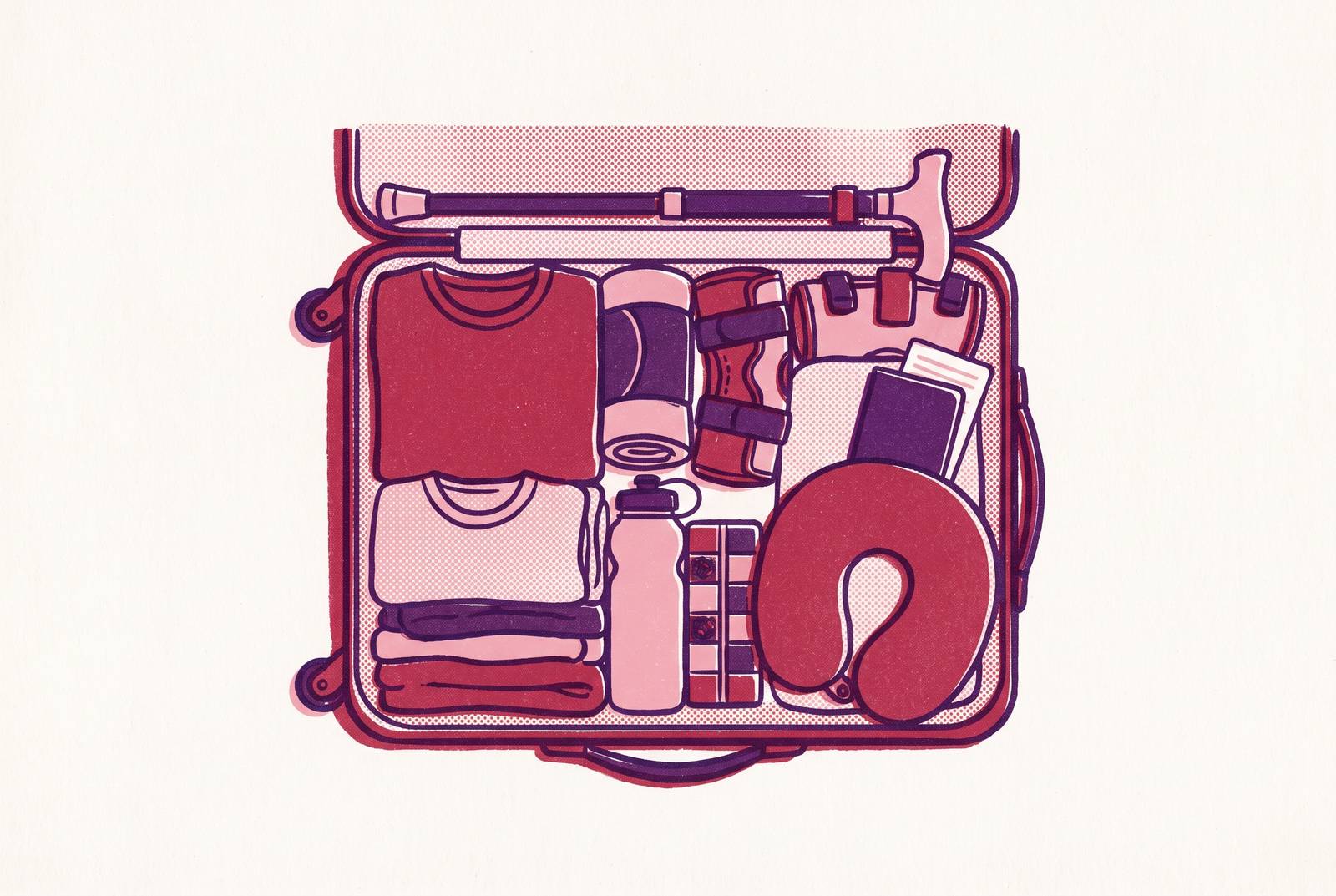
A comfort kit turns a landing that could wreck you into one you land okay from. Karen Del Vecchio, diagnosed at the Johns Hopkins Connective Tissues Disorder Clinic, calls her wrap-around travel pillow "a game changer," since it keeps the head from falling in any direction and cuts down on neck soreness. Beyond that, a lumbar support, an arm-support pillow sized to the individual, and a blanket that pulls quadruple duty as airport seating cushion, cabin warmth, a footrest, and an extra layer under a hotel bedspread that's seen better decades. Light, removable layers matter too, since cabin temperature swings wildly from gate to gate, and seam-free clothing cuts down on sensory irritation. Shoes that slip off easily let a traveler change position without fighting laces or buckles.
Baggage choices carry real physical cost. A backpack with a waist strap moves weight off the shoulders and wrists, and a suitcase that rolls smoothly cuts down on the upper-body effort of dragging a stubborn wheel across tile. Overpacking the carry-on is a trap: every extra pound comes straight out of shoulder and wrist joints that are already working overtime.
MCAS adds a sensory layer to all of this. Duty-free perfume corridors, cleaning product fumes, food court smells: airports are a minefield of triggers. Mapping a route through the terminal in advance, and packing noise-cancelling headphones or earplugs for the sensory overload, cuts down on how much damage that environment can do. And bringing known-safe snacks is cheap insurance against delayed flights or a meal request that falls through, as it did for Del Vecchio when her vegan meal simply never showed up. Salty snacks aren't just comfort food here either, they serve a specific function for POTS, discussed next.
Managing POTS in transit: the specific physiology of flying and what helps
Flying is a uniquely bad environment for POTS. Cabin pressure sits lower than at ground level, humidity drops, dehydration creeps in faster than expected, and hours of sitting still combine with the general stress of travel to worsen blood pooling and heart rate dysregulation all at once.
Hydration needs more attention in the air than on the ground, since cabin air runs both drier and lower in oxygen pressure than what the body is used to. Water alone doesn't cut it, electrolytes need to go in alongside it, and the hydrating should start before boarding, not somewhere over the ocean.
Compression garments help more than most people assume. A 2025 community-based trial published in JACC: Clinical Electrophysiology (Bourne et al.) tested commercially available compression tights on POTS patients and found that compression coverage extending to the abdomen and legs provided greater symptom relief than lower-leg-only garments.
Movement during the flight matters just as much as what's worn. Seated ankle circles, heel raises, and periodic standing near the back of the plane keep blood from pooling and fascia from stiffening. At the gate, walking around instead of sitting through the entire wait cuts down on the blood pooling that starts well before boarding even begins.
Wheelchair assistance, booked in advance through the airline, saves energy for the destination instead of burning it in the terminal, and it sidesteps the long standing lines that are a specific, well-documented trigger for POTS symptoms. Pre-boarding does similar work by cutting time spent standing in the queue, and most airlines grant it for health reasons on request at the gate. Ask the airline directly whether medical supplies and medications qualify for an extra carry-on allowance that doesn't count against the standard bag limit. Some do.
Airport accessibility rights for EDS travelers and how to use them
The Hidden Disabilities Sunflower scheme gives travelers a quiet, voluntary way to signal a non-visible disability without needing to explain anything out loud. Staff at participating airports and airlines get training to offer extra help, patience, and time to anyone wearing the sunflower lanyard. Its own description states that over 300 airports worldwide have adopted the scheme, including Hong Kong International Airport, Montréal-Trudeau International Airport, and Vancouver International Airport, with Nelson Airport in New Zealand joining in April 2025. Lanyards are free at participating airports and also available for purchase through the scheme's website. For hEDS specifically, this matters because there's no cast or visible mobility aid required to use it.
In one country, a federal law bars airlines from discriminating based on disability. It guarantees free assistance, including wheelchair transport, priority boarding, seat accommodations, and help stowing and retrieving mobility devices, and it protects the right to travel with service animals and medical equipment at no extra charge.
A newer rule adds real teeth to enforcement. A transportation regulator's Wheelchair Rule, finalized in late 2024, requires airline employees and contractors who physically assist disabled passengers or handle wheelchairs and scooters to complete hands-on, in-person training. Several provisions took effect January 16, 2025, though the deadline for the hands-on training itself lands June 17, 2026. Some pieces of the rule are currently paused while DOT reviews them, including yearly refresher training, procedures for damaged wheelchairs, certain training and notification requirements (a separate provision under the Accessible Lavatories rule). Accessible bathroom upgrades themselves are moving forward regardless of that pause. The next major regulatory step, Wheelchair Rule II, is expected in 2027.
The scale of the underlying problem is the reason this rule exists. A 2026 article in a human rights law review reports that in July 2025, airlines in one country mishandled an average of 1.14 wheelchairs and scooters for every 100 passengers who boarded with one. That's not a rounding error; that's a chair damaged or lost on a regular basis across the industry.
None of these protections activate automatically from an online booking form. Calling the airline's accessibility desk directly, asking for a Special Service Request (SSR) code to be added to the reservation, and writing down the agent's name and a callback number turns a hope into a documented request. Wheelchair assistance, pre-boarding, seat preference, and medical equipment allowances all need that verbal confirmation and SSR code. A checkbox on a website isn't the same thing, and it won't hold up at the gate the way a coded reservation will.
Energy pacing on the trip itself, applying spoon theory to a travel context
Spoon theory, coined by Christine Miserandino in a 2003 essay, treats daily energy as a fixed number of spoons, with every activity costing a certain number. Once they're gone, the body doesn't refill the drawer quickly. Travel spends spoons at a faster rate than an ordinary day at home: unfamiliar environments, disrupted sleep, tight schedules, unpredictable terrain, and constant sensory input all draw down the same limited supply, and they don't replenish at home-rate speed.
For people managing hEDS alongside ADHD or autism, a useful refinement treats spoons as multiple separate currencies, physical, cognitive, and sensory, among others, each of which can run out independently of the others. A day that isn't physically demanding can still leave someone cognitively wiped out from noise and unfamiliar decisions, which is a different kind of empty than sore joints.
Overdoing it on a good day carries a real cost. Post-exertional malaise (PEM) can follow, worsening symptoms well beyond the triggering activity. This isn't ordinary tiredness that a nap fixes, it's a physiological response, and the boom-and-bust cycle it creates is the single biggest risk in travel that hasn't been planned around it.
A structured framework sometimes called the "4 Ps," Prioritize, Plan, Pace, and Position, gives a concrete way to prevent that depletion cycle, and it applies just as well to a single day of sightseeing as it does to long-term symptom management.
Schedule the most demanding activities during the highest-energy window of the day, cap the number of demanding tasks per day even if that means seeing less than planned, and build in real rest, hotel room recovery time that counts as part of the itinerary, not dead time squeezed out of it. Asking for help with heavy lifting, long walks, or equipment carrying isn't a failure of independence, it's a spoon saved for something that matters more. Del Vecchio found that jet lag after long-haul travel left her near-incapacitated for days after returning home. Harvard Health Publishing estimates roughly one day of adjustment per time zone crossed. Recovery planning belongs on the calendar for after the trip, not just during it.
Lounge access, even a single day pass running around $50, gave Del Vecchio a long layover with comfortable seating, food, and quiet during one trip. That's not a luxury upgrade, but a deposit back into the spoon drawer at a moment when the alternative is a plastic gate chair and fluorescent lighting.
None of this needs an apology attached. A slower pace, more stops, visible supports, and different choices than other travelers make are simply the correct call when the priority is safety, comfort, and having enough energy left to actually enjoy the destination.
Tracking symptoms and patterns during travel, why logging matters more when routines break down
At home, most patterns hold steady enough to predict. Travel brings a different bed, unfamiliar food, a change in activity level, a new climate, and a schedule that isn't the usual one, a new set of variables every single day. Without some kind of tracking, it becomes almost impossible to trace a flare back to its cause, or to know in advance what the body can actually handle on day four of a trip versus day one.
Self-tracking works best as a process with stages: preparation, collection, integration, reflection, and action. Logging isn't the goal by itself, it's a way to surface patterns that are actually useful for the next decision.
Applied to spoon theory directly, some travelers with EDS log daily spoon use in an app or a plain notebook. That log reveals which activities cost more than expected, which makes future trip planning sharper instead of guesswork.
Generic health apps tend to fall short here, since a person juggling POTS, MCAS, fatigue, pain, several medications, and wearable data at once needs all of it in one place, not scattered across four different apps that don't talk to each other. A few tools built specifically for this kind of tracking exist as of mid-2026. Another brings symptoms, pain, mental health, medications, and vitals together in a single tracker aimed at exactly this cluster of overlapping conditions, with shareable insights for clinicians. A third is free to use for anyone managing more than one diagnosis, logs symptoms, medications, and vitals, and connects to wearables including Whoop, Oura, Apple Watch, and Garmin to surface patterns automatically.
Whichever tool a traveler picks, the point stays the same. Travel breaks the routines that normally make symptoms legible, and a log is what puts the pattern back into view.
Sources
- Travelling with Ehlers Danlos Syndrome: how to make your holidays smooth | Disability Horizons
- Traveling with EDS & POTS: Essential Tips | Jeannie Di Bon
- Tips to make international travel easier with EDS
- 10 Tips for Traveling With EDS, POTS, and/or MCAS
- Understanding the Spoon Theory: A Window into Chronic Illness | CMSA
- nplhomemedical.com
- eds.clinic
- pubmed.ncbi.nlm.nih.gov