EDS and Work Disability Accommodations
Flares and job delays complicate EDS work accommodations—documentation of functional limits is key.
Ehlers-Danlos Syndrome doesn't behave like a fixed disability, and that's what makes getting workplace accommodations so hard. Symptoms shift week to week, sometimes day to day, and the people who succeed at getting real accommodations are the ones who show up with documented, specific proof of how the condition actually limits their working hours.
EDS covers 13 recognized types, each tied to different genes and producing different symptom profiles. But the features that matter most at a desk or on a shift floor tend to repeat across types: joint hypermobility, chronic pain, fatigue that doesn't respond to sleep, skin that tears or bruises easily, and autonomic symptoms like dizziness or a racing heart when standing up. Cognitive symptoms appear too, often described as "brain fog," and that term gets thrown around casually enough that it should be treated as a real functional limit rather than a complaint. Common co-occurring conditions like POTS, MCAS, and general dysautonomia make the picture more complicated fast, because each one stacks its own limitations on top of the others. None of this stays constant. A person can have two good weeks, then a flare that knocks out fine motor control or standing tolerance for days at a stretch.
How the diagnostic delay shapes the accommodation journey
Most people with EDS spend more than a decade chasing a correct diagnosis, seeing somewhere around 15 different clinicians along the way, often collecting more than 10 wrong diagnoses before landing on the right one. That delay isn't just a medical footnote. It changes how a person walks into an accommodation conversation, because by the time EDS gets named correctly, many patients have already been told, directly or indirectly, that their symptoms are in their head.
A 2025 retrospective review of 429 EDS patients found that 94.4% had been told by a non-psychiatric physician at some point that their symptoms were psychological in origin. Only 5.6% of patients reached a hypermobile EDS diagnosis without some kind of psychiatric misdiagnosis along the way. Two-thirds of the group had been told at some point they had conversion disorder. Four percent were told they had Munchausen syndrome by proxy or another factitious disorder. And when a psychiatric misdiagnosis did happen, the review found the overall diagnostic delay ran substantially longer.
That history matters for the accommodation process because it means many EDS patients arrive at HR already braced to be doubted. Documentation becomes the antidote. A clean, dated record of functional limitation doesn't just support a legal claim, it counters years of being told the symptoms weren't real.
What qualifies as a disability under the ADA for EDS workers
The ADA doesn't name specific conditions. Instead, it defines disability three ways: a physical or mental impairment that substantially limits one or more major life activities, a record of such an impairment, or being regarded as having one. EDS can absolutely qualify under this standard, but the burden sits with the individual to show how their specific symptoms meet it. A diagnosis alone doesn't do that work. The functional detail does.
The Job Accommodation Network's Accommodation and Compliance guidance on EDS, last updated June 1, 2026, is the clearest starting point for both sides of this conversation, employer and employee alike.
In Tudor v. Whitehall Central School District, decided in 2025, the court held that an employee can qualify for a reasonable accommodation even if they're able to perform the essential functions of the job without one. In Tudor v. Whitehall Central School District, decided in 2025, the court held that an employee can qualify for a reasonable accommodation even if they're able to perform the essential functions of the job without one. That's a notable development in how employer obligation is understood. It means an EDS worker who can technically grind through a full shift doesn't have to prove they're on the edge of collapse to ask for adjustments that would meaningfully help.
Remote work sits on similarly shifted ground. Before 2020, employers had an easier time arguing that in-person presence was an essential job function, full stop. Since then, telework has increasingly been recognized as a reasonable accommodation when the essential functions of a job can be performed remotely. For EDS workers dealing with joint instability, POTS, or unpredictable flare timing, that's a direct and citable point of leverage.
The functional limitations EDS creates at work and naming them clearly
JAN's framework walks this in a specific order: name the limitation, assess how it affects job performance, then identify exactly which tasks are hit. Skipping ahead to "solutions" before doing that groundwork tends to produce accommodations that miss the actual problem.
Physical limitations that need to be named specifically include:
- Trouble sitting, standing, or walking for extended stretches, tied to joint instability or pain rather than general discomfort
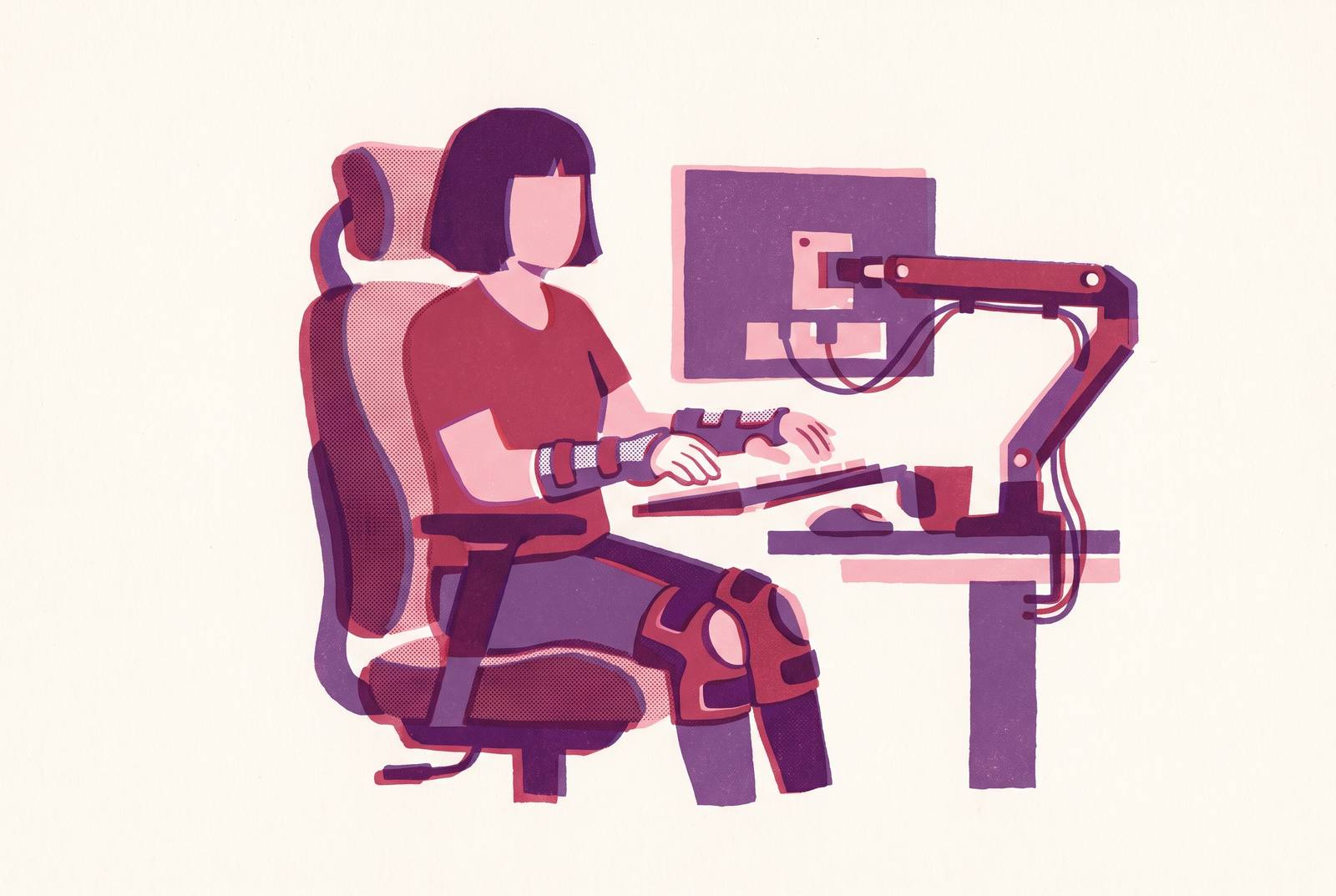
- Difficulty with fine motor tasks like typing, writing, or gripping, caused by joint hypermobility or subluxations
- Skin fragility that makes certain environments, anything with cut or abrasion risk, genuinely unsafe
- Orthostatic intolerance from POTS, which limits how long a person can stay upright before symptoms hit
Cognitive limitations deserve just as much precision. Brain fog isn't tiredness. Confusion, memory gaps, or an inability to focus can hit regardless of how much sleep happened the night before, and it needs to be described as a functional limit, not brushed off as a bad attitude or low effort. Difficulty holding concentration through long meetings or tasks that demand sustained attention falls into the same category.
The hardest part to communicate is the unpredictability itself. An EDS employee might look completely fine on a Tuesday and be unable to type reliably by Thursday. Framing that pattern in terms of frequency and duration, how often flares happen and how long they typically last, lands better with an employer than describing severity alone, because it gives HR something they can actually plan around.
Specific accommodations that map to EDS limitations
Under the ADA, accommodations can touch on many aspects of work, including job duties, work location, schedule, and equipment. All four apply to EDS in different ways.
Scheduling and attendance accommodations tend to carry the most weight day to day:
- Flexible start and end times, to absorb morning stiffness or the aftermath of a bad sleep night
- Reduced or part-time schedules, consistently among the most-requested accommodations across disability categories
- Continuous or intermittent FMLA leave, so a flare doesn't force a resignation
- Permission for unscheduled breaks, to rest joints, lie down, or manage a POTS episode as it happens
Location accommodations follow close behind. Remote work is at the top of the list, and it's on firmer legal footing now than it was before the pandemic: employers who allowed remote work during COVID-19 face a higher bar if they try to deny it later for the same role. Parking close to the entrance and worksite changes that cut down walking distance matter too, especially for anyone managing joint instability or a chronic condition affecting standing tolerance.
On the equipment side: adjustable-height desks and supportive seating cut down joint strain, anti-fatigue mats help with any standing requirement, and voice-to-text or dictation software takes pressure off hand and wrist joints that can't handle sustained typing. JAN's SOAR tool, at AskJAN.org/soar, lists assistive technology options by limitation and should be reviewed before any formal request goes in.
How energy management and pacing shape what accommodations you need
Spoon theory, a term Christine Miserandino coined in a 2003 essay, gives a useful shorthand for this. Every activity costs a unit of energy, a "spoon," and once the spoons run out, that's it for the day, no matter what's left on the to-do list. A person without chronic illness might start the day with around 15 spoons. Someone with a chronic illness might start with five to eight, and during a flare, that number drops further while each task costs more to complete.
A more refined version of the theory splits energy into separate pools: physical activity, executive function, focus, social energy, and sensory tolerance, each draining on its own schedule. That distinction matters a lot for EDS specifically, because brain fog and physical pain don't always move together. Someone can be cognitively sharp on a day their joints are in bad shape, or vice versa, and an accommodation plan built around only one axis will miss half the problem.
This is where activity pacing comes in as a real, evidence-based strategy rather than a self-help buzzword: balancing activity against rest to avoid pushing past a limit and triggering a crash. Overdoing it on a good day, running errands, pushing through a long meeting, taking the stairs instead of the elevator, can produce symptoms that last for days afterward. Once that mechanism is understood, it reframes what accommodations are actually for. They're about preventing bad days from happening as often, giving someone room to pace themselves rather than just making work easier once a bad day has already arrived. They're about preventing bad days from happening as often, by giving someone room to pace themselves on the good ones too.
Building the documented record that makes an accommodation request stick
Long-term disability claims and ADA accommodation requests share the same weak point: because EDS symptoms are invisible and fluctuating, insurers and employers have an easy excuse to deny a request without strong, ongoing documentation behind it.
A useful record tracks:
- Symptom severity on a consistent scale, logged on ordinary days as well as flare days, so there's a baseline to compare against
- Functional impact, meaning how many hours of desk work, standing, or focused activity were actually possible that day, not just how the person felt
- Sleep quality and duration, since that connects directly to both fatigue and cognitive symptoms
- Medication taken, along with any side effects that affected work capacity
- Context: what changed in routine, activity level, or stress right before a flare hit
Journaling alongside a symptom log adds something raw numbers can't: the story behind the data. Noting that a crash followed a two-hour commute or a string of back-to-back meetings reveals which parts of the job itself are triggering flares, and that detail turns into a targeted accommodation request instead of a vague one.
Wearable data adds another layer. Wearable devices that feed data into health-tracking apps can generate objective numbers that back up self-reported symptoms and are much harder for an insurer to wave off as subjective.
Preparing for the accommodation conversation with your employer
The ADA's interactive process is a two-way conversation, not paperwork to submit and wait on. Employers are legally required to engage in good faith, and employees carry that same responsibility. Walking in prepared signals that the request is serious, and it cuts down the odds of getting brushed off.
Before the meeting even happens:
Get a letter from a physician that spells out functional limitations in concrete terms. "Unable to sit for more than 30 minutes without a position change," "requires unscheduled breaks," or "cannot reliably attend in person the day after a high-exertion event" does far more work than "patient has EDS."
- Write out the specific accommodations being requested, each one tied to a named limitation rather than a general ask.
Review JAN's resources at AskJAN.org beforehand, since doing so can surface accommodation options an employer hasn't considered or doesn't know exist.
During the conversation itself, lead with function over diagnosis. Most HR staff have never heard of a given connective-tissue disorder and won't know what it means clinically, but they can act on "cannot type for more than 20 minutes without a break" immediately. Essential job functions have to get done, accommodation or not, while marginal functions can be restructured, reassigned, or dropped. Understanding that line ahead of time keeps the conversation from drifting toward an accommodation that sounds reasonable to HR but doesn't actually address the limitation in question.