Nutrition and Gut Health in EDS
Standard GI advice fails because EDS rewires how the gut actually works.
Connective tissue disorders cause GI symptoms directly, through the same collagen defects that cause joint dislocations and skin fragility. That's not a side effect or a coincidence, and it's not what most people assume when they hear "sensitive stomach." Two conditions that ride along with EDS so often they're practically part of the diagnosis, POTS and MCAS, make the gut picture considerably worse through distinct and compounding pathways. Standard advice for a shaky gut (low-FODMAP diets, "just eat something," a fiber supplement) tends to fall flat here, and the research explains why. This piece walks through what that research found, where the common fixes backfire, and what eating well actually looks like once someone stops fighting the physiology and starts working with it.
GI Symptoms in EDS: Beyond "Stomach Trouble"
Ehlers-Danlos syndrome is a group of inherited connective tissue disorders. The hypermobile subtype, hEDS, makes up somewhere between 80% and 90% of all EDS cases, so most of what gets studied and written about traces back to this one form.
Connective tissue runs through the gut the same way it runs through joints and skin. It's in the smooth muscle walls that push food along, the sphincters that keep things moving in one direction, and the ligaments that hold organs in place. When that tissue is lax, all three functions can slip: motility slows down or turns erratic, sphincters lose their grip, organs shift position in ways that create pressure and pain.
Calling this "functional," in the dismissive sense that word carries in a lot of GI clinics, misses what's actually happening. Researcher Qasim Aziz has described GI symptoms in EDS as real, common, and frequently driven by more than one cause at once. A cross-sectional survey of over 600 people with hEDS or hypermobility spectrum disorder (HSD) found that 98% met diagnostic criteria for a disorder of gut-brain interaction. Not most. Not the majority with severe cases. Ninety-eight percent.
How POTS and MCAS compound the gut picture
Postural orthostatic tachycardia syndrome, POTS, overlaps substantially with EDS, with estimates suggesting that anywhere from 25% to 73% of POTS patients also have EDS or joint hypermobility. When POTS and EDS coexist, GI symptoms hit harder and spread across more of the digestive tract.
The mechanism is why "just eat something" is close to useless advice for this group. After a meal, blood pools in the gut to help with digestion. In someone with POTS, that pooling can trigger autonomic instability: heart rate spikes, blood pressure drops, and the body answers with palpitations, weakness, and fatigue. Large meals make it worse. High-carbohydrate meals make it worse. Eating, something every human does multiple times a day without a second thought, becomes a genuine physiological stressor.
Standing makes GI symptoms worse too. So the two most basic activities of daily life, eating and staying upright, both destabilize the system in someone carrying EDS and POTS together.
MCAS adds a third layer, and it works completely differently from the other two. Mast cells sit throughout the gut lining, and in MCAS they fire off histamine and other inflammatory mediators in response to triggers, food among them. That reaction is immune-driven, not mechanical. It has nothing to do with a slow gut or a weak sphincter, and everything to do with the immune system misreading food as a threat. Someone can eat something perfectly healthy, on paper the "right" choice, and still end up in distress for that reason alone.
What the first large dietary study in hEDS found
Most of what's been known about EDS and diet came from small samples or anecdotes traded in support groups. A study by Topan, Pandya, Chance, Zarate-Lopez, Aziz, and colleagues, published in Clinical Nutrition, changed that. The researchers describe it as the first study to measure nutrition intake, adequacy, and dietary patterns in hEDS and HSD with any real rigor.
The sample ran 425 participants, average age 41, 96% female. That last number matters for reading the results: the findings reflect a population that skews heavily toward women, which tracks with how hEDS tends to get diagnosed, but it also means the data can't be assumed to generalize evenly across sexes.
The headline finding is stark. Only 24.7% of participants met recommended fiber intake, and only 21.2% met recommended carbohydrate intake. Most people hit their protein and fat targets without issue, but fiber and carbs, the nutrients most tied to plant foods and whole grains, fell short for the large majority. Saturated fat came in above recommendations for 88% of participants. Those numbers together show a diet leaning on processed, low-residue foods instead of the whole-food sources that would deliver fiber alongside calories.
The four dietary patterns found in hEDS
The study didn't stop at averages. It sorted participants into four distinct dietary patterns, and each one tells a different story about how people with hEDS actually cope day to day.
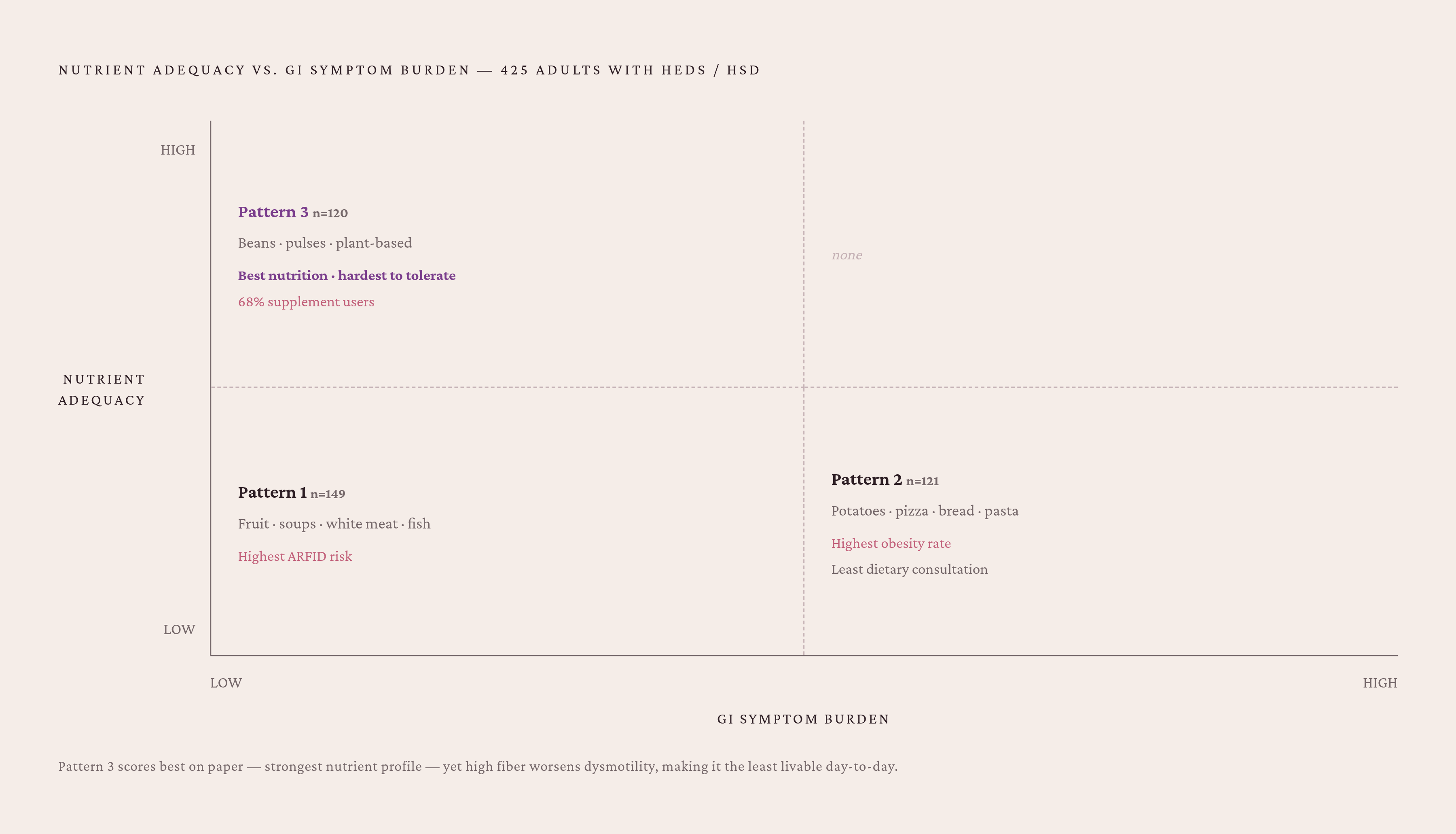
The largest group, 149 participants, centered their diets on fruit, clear soups, white meat, fish, and caffeine-free drinks: a pattern of low food intake overall. This group reported the most digestive trouble, carried the highest risk of ARFID (avoidant/restrictive food intake disorder), and had the lowest fiber and micronutrient intake of the four. Most had a normal BMI. That combination says something specific: these are people already reaching out for help, and the diet that results still reflects severe restriction driven by GI symptoms, not a lack of access to care.
A second group of 121 participants built their diets around potatoes, pizza, white bread, and pasta, heavy on refined and ultra-processed food. They had the highest calorie intake, the highest rates of overweight and obesity, and still reported digestive issues alongside that intake pattern. They were the least likely of the four groups to have had a dietary consultation. That points to a real gap in who's getting nutrition support, and it likely comes down to something simple: when a lot of foods hurt or trigger symptoms, people gravitate toward what's palatable and available, not what's optimal.
A third group of 120 participants ate a vegetarian, health-conscious diet built on beans, pulses, meat substitutes, and plant-based milks. This group had the strongest nutrient profile by far, topping the others across multiple fiber and micronutrient measures. Sixty-eight percent took oral nutritional supplements, more than any other group, which suggests active awareness of deficiency risk. But high fiber and legume intake, sound as it is on paper, can worsen bloating and motility symptoms in a gut that's already dysmotile. The strongest diet on paper is not automatically the most comfortable one to live in day to day, and that tradeoff gets skipped over constantly.
A fourth pattern also appeared in the data, though the three above show the most about how EDS reshapes eating in practice.
Why common elimination diets can backfire in this population
Low-FODMAP diets get recommended constantly for bloating and irregular motility, in IBS and, informally, in EDS. But research from the IBS field shows that sustained elimination diets, low-FODMAP, gluten-free, or dairy-free, reduce populations of beneficial gut bacteria and shift overall microbial diversity. That's the tradeoff most people never hear before they start cutting foods.
A diet meant to calm the gut can, over the long haul, wear down the microbiome in ways that feed back into worse gut-brain axis function. With nearly all people with hEDS/HSD meeting criteria for a disorder of gut-brain interaction in a large cross-sectional survey, that's a direct hit to the exact system already under strain, not a minor side cost.
Gluten-free diets show some promise in limited research, with slight symptom reduction reported in some hEDS patients, but nobody has pinned down why yet. Undiagnosed celiac disease could sit alongside the EDS diagnosis in some patients. It could be non-celiac gluten sensitivity. Or the benefit might have nothing to do with gluten at all: cutting gluten also means cutting a lot of high-FODMAP foods at the same time, and the relief people feel may trace back to that overlap rather than to gluten itself.
Low-histamine diets for MCAS sound logical on the surface. Fewer histamine-triggering foods should mean fewer mast cell flares. But the diet is aggressive by design, cutting across fermented foods, aged cheeses, cured meats, certain vegetables, and more, spanning multiple food groups at once. Piling an unsupervised low-histamine protocol onto a population already running fiber and micronutrient gaps digs those gaps deeper instead of fixing the original problem.
The 2025 AGA guidance for clinicians treating EDS patients
A major medical association issued a Clinical Practice Update Expert Review in 2025, giving clinicians practical, evidence-based direction on evaluating and treating GI symptoms in hEDS and HSD, especially when MCAS or POTS ride along.
Three shifts stand out. The guidance pushes clinicians toward targeted testing tied to the actual symptom pattern, instead of ordering every available test on every patient, and this is the most overdue of the three changes. It also asks doctors to treat EDS itself as an active contributor to GI symptoms rather than an incidental diagnosis sitting next to the real problem. And it names multidisciplinary care, spanning GI specialists, dietitians, and relevant specialists for comorbidities like POTS, as the standard approach, not something reserved for the most severe cases.
On nutrition support, the guidance flags a real problem: enteral and parenteral nutrition (feeding tubes and IV nutrition) get started too often without a full trial of conservative, behavioral approaches first. Once someone's on advanced nutrition support, stepping back down proves difficult. The guidance calls for maintaining support where it's genuinely needed. It's telling clinicians to stop reaching for it as a default when simpler options never got a real try.
On gastric motility, the guidance addresses the need to evaluate gastric motor function in patients with chronic upper GI symptoms, recognizing that underlying causes can be missed without targeted assessment. Targeted testing is built to catch these problems early instead of missing them for years.
Nutrient deficiencies worth knowing about
The Topan study found that fiber, carbohydrates, vitamin D, and some B vitamins fall short at the population level. Symptoms of these deficiencies overlap so heavily with EDS symptoms themselves that guessing gets nobody anywhere. Testing has to replace assumption here.
Vitamin B12 deficiency causes fatigue, cognitive fog, and neuropathy, symptoms that already show up constantly in EDS on their own. Gut dysmotility can impair absorption and drive B12 down even in someone eating a perfectly reasonable, unrestricted diet. That's why a B12 deficiency can sit undetected for years: nobody thinks to test for it, because the symptoms already have an explanation sitting right there in the EDS chart.
Vitamin D came up short across the study population too. Low vitamin D touches pain levels, immune function, and mood, three areas where people with EDS are already carrying a heavy load.
Magnesium matters for nerve signaling, muscle relaxation, and energy production at the cellular level. Low magnesium can worsen cramping, fatigue, and cardiovascular symptoms, all relevant in POTS. In MCAS specifically, magnesium helps keep mast cell activation in check, which makes it relevant to histamine symptoms too, not just muscle and nerve function.
A blood panel, not a guess, is the only reliable way to tell if fatigue traces back to the EDS itself or to a fixable B12 problem that causes it.
Practical nutrition principles that work with EDS physiology, not against it
No single diet works across this population, and the four dietary patterns prove it: what helps one person's motility might wreck another person's histamine tolerance. Still, a few principles hold up across the physiology described above, and a plan can be built around them.
Smaller, more frequent meals reduce the blood-pooling demand that triggers POTS symptoms after eating, more so than a couple of large meals a day. Carbohydrates deserve balancing, not elimination: the study found most participants already fall short on carbs, so cutting further only widens a gap that's already there.
Fiber needs a careful hand. It's clearly under-consumed across this population, but ramping it up fast in a gut with impaired motility can backfire into more bloating, not less. Building fiber slowly, paired with enough fluid, tends to serve better than an abrupt overhaul.
Elimination diets, whether low-FODMAP, gluten-free, or low-histamine, call for professional guidance rather than a self-directed experiment pulled from a forum post. Given the microbiome risks tied to sustained restriction, and the fiber and micronutrient gaps this population already carries, a dietitian who understands EDS, POTS, and MCAS together is worth more than any food list found online.
Nutrient testing deserves a regular place in ongoing care. B12, vitamin D, and magnesium carry consequences that mimic EDS symptoms closely enough to hide in plain sight for years. With 98% of this population meeting criteria for a gut-brain interaction disorder, treating the gut through an isolated meal plan alone misses the wider system that gut is actually part of.
Sources
- Nutrient intake, dietary patterns and relationship to symptoms and comorbidities in hypermobile Ehlers-Danlos syndrome - ScienceDirect
- An exploration of the journey to diagnosis of Ehlers-Danlos Syndrome (EDS) for women living in Australia
- Gastrointestinal Manifestations and Nutrition Support in Hypermobile Ehlers-Danlos, Postural Orthostatic Tachycardia, and Mast Cell Activation Syndromes | Current Gastroenterology Reports | Springer Nature Link
- AGA Clinical Practice Update on GI Manifestations and Autonomic or Immune Dysfunction in Hypermobile Ehlers-Danlos Syndrome: Expert Review - Clinical Gastroenterology and Hepatology