EDS and Proprioception Deficits in Daily Life
How EDS breaks the body's internal position sense, leaving daily movement exhausting and risky.
Proprioception is the sense that tells the brain where a limb sits in space without anyone having to look at it or think about it. Neurophysiologist Charles Scott Sherrington coined the term in the early twentieth century, building it from the Latin "proprius," meaning one's own, to describe signals the body's own receptors send about position and movement. Fascia adds a fourth layer on top of that, a three-dimensional web of tissue wrapped around muscles and organs, dense with mechanoreceptors that pick up tension and movement.
At the molecular level, a channel called PIEZO2 does the actual translating. It's a mechanosensitive ion channel that responds to physical stretch, the deformation of a cell membrane, converting that stretch into an electrical signal the nervous system can read. From there the signal travels a real anatomical path: from the receptors to the dorsal root ganglia, up through the spinal cord, and into the cerebellum and somatosensory cortex, with some of that traffic passing through the craniocervical junction at the base of the skull. That junction detail seems like a footnote until later, when it turns out to matter quite a bit for a subset of EDS patients.
None of this registers consciously in a healthy system. Walking without staring at the ground, touching a nose with eyes shut, catching a stumble on a curb before the brain even processes "curb," these are proprioception doing its job so quietly that most people never notice it exists until something breaks it.
How EDS breaks the signal at the source
Ehlers-Danlos syndrome is a group of heritable connective tissue disorders, caused by genetic mutations that interfere with how collagen gets built, processed, or held together in the extracellular matrix. Collagen is the scaffolding. When the scaffolding is defective, joint capsules, tendons, fascia, and skin all end up loose and overly stretchy, and that's precisely the tissue the proprioceptive sensors are bolted into. Loose housing means the sensors can't fire with any precision or consistency, so the brain ends up working from noisier input about where the joints actually are.
Fascia takes a double hit. Not only is the collagen inside it structurally defective, but fascial densification, where the extracellular matrix thickens and stiffens, further blunts the tissue's ability to register positional change accurately. Some patients also develop structural changes at the craniocervical junction, things like Chiari malformations or craniocervical instability, at the exact spot where proprioceptive signals pass on their way to the brain. So it isn't only a generation problem at the sensor level, it's a transmission problem layered on top.
Subtype matters here too. Hypermobile EDS, the most common form, brings generalized joint hypermobility, widespread pain, and autonomic dysfunction like POTS, though its genetic basis is still being worked out. Arthrochalasia EDS, tied to COL1A1 and COL1A2 mutations, produces extreme joint laxity and recurrent dislocations, including congenital hip dysplasia, where proprioceptive imprecision stacks on top of an already high injury risk. Dermatosparaxis EDS, linked to ADAMTS2 mutations, carries similar tissue laxity and potential proprioceptive fallout. Research across these groups shows reduced proprioceptive acuity in both upper and lower limbs, particularly at the knee and shoulder, with hEDS patients showing higher angular errors on joint-position-matching tasks, and worse hypermobility correlating with worse proprioception.
The brain's capacity to recalibrate, to adapt when given new sensory feedback, appears to stay intact in EDS. The brain can learn. The raw signal quality it's learning from is bad to begin with.
What imprecise position signals feel like from the inside
Subjectively, this clumsiness appears as joints drifting further than expected before the brain catches up to register it. Balance studies back this up: people with hEDS show increased medial-lateral and anterior-posterior sway of the centre of pressure when standing on a firm surface, measurably so with eyes open and with eyes closed, which points to both vision and proprioception being involved in keeping a person upright.
Fear of movement (kinesiophobia) reduces engagement in daily life, which in turn worsens musculoskeletal complications. It's a closed loop, and not a subtle one.
Altered interoception, the perception of internal sensations like heartbeat or dizziness, runs alongside this. POTS-driven palpitations can register as panic. Dizziness can register as acute danger. That combination amplifies anxiety and gets misread, often by the patient as much as by a clinician, as somatization. The hypervigilance many EDS patients carry around body sensations is physiologically driven, not a personality trait or a psychological failing. The body is genuinely sending strange signals, and the brain is responding to real input.
Fatigue follows the same logic. When ordinary movement requires conscious effort to compensate for a position sense that can't be trusted, physical tasks simply cost more energy than they should, and that extra cost accumulates into the fatigue so often reported across the EDS population.
The practical daily-life consequences that follow from the deficit
Basic mobility tasks, walking, climbing stairs, getting up from a chair, show measurable impairment in EDS patients with poor proprioception, and muscle weakness (itself partly caused by unreliable proprioceptive feedback) compounds the problem. Imprecise position signals let a joint travel into a bad position before the brain even registers it's happening, and this delayed registration produces the sprains, dislocations, and nerve or soft-tissue damage so common in this population. Each injury weakens the surrounding structure the proprioceptors depend on, so the next signal is even noisier.
There's a related mechanical problem with muscle recruitment. The brain uses proprioceptive input to decide which muscle fibers to activate and in what sequence, and when that input is degraded, motor control suffers and muscles weaken, which then degrades the sensor function further. It's the same feedback loop as before, just viewed from the muscle side instead of the joint side.
Many people compensate by watching. Since the internal signal can't be trusted, the eyes take over the job, consciously tracking limbs and feet during ordinary movement. That works, to a point, but it's expensive to run and it fails exactly when it's needed most: in dim light, on uneven ground, or any time attention gets pulled elsewhere. AARP reported on Malea Wilson, who lives outside Chicago with EDS and POTS, describing how many "spoons," the finite daily energy units from spoon theory, she burns through just managing her body, often left with almost nothing by the weekend and crashing as a result. That's the arithmetic of proprioceptive and autonomic dysfunction running at the same time, expressed in plain terms.
The energy cost of compensating for a missing sense
Christine Miserandino introduced spoon theory in 2003 as a way to describe finite daily energy in chronic illness: someone without a chronic condition might start the day with around 15 spoons, while someone managing one typically starts with 5 to 8 Psychology Today. EDS adds its own drain on top of that baseline. Loose connective tissue and structural change mean muscles fatigue faster, and weakened muscles further degrade proprioceptive sensor function, so the two deficits feed each other rather than sitting side by side.
Patients can borrow against tomorrow's spoons to get through today, but that just shrinks tomorrow's supply, a debt structure that lines up directly with the post-exertional crashes so many report.
Pacing is the response with actual evidence behind it, and it comes in a few concrete forms. Anticipatory planning means scaling back before a known high-demand event, a wedding, a medical appointment, a house full of guests, and building in recovery time on the other side of it. Tracking energy expenditure, whether in an app or just a notebook, helps identify the patterns that reveal a sustainable baseline, one where crashes become the exception rather than the rule. None of this is about giving up activity. It's about spending a finite resource with some strategy, instead of letting the day's demands write the budget by default.
Misreading of This Deficit as a Psychiatric Problem
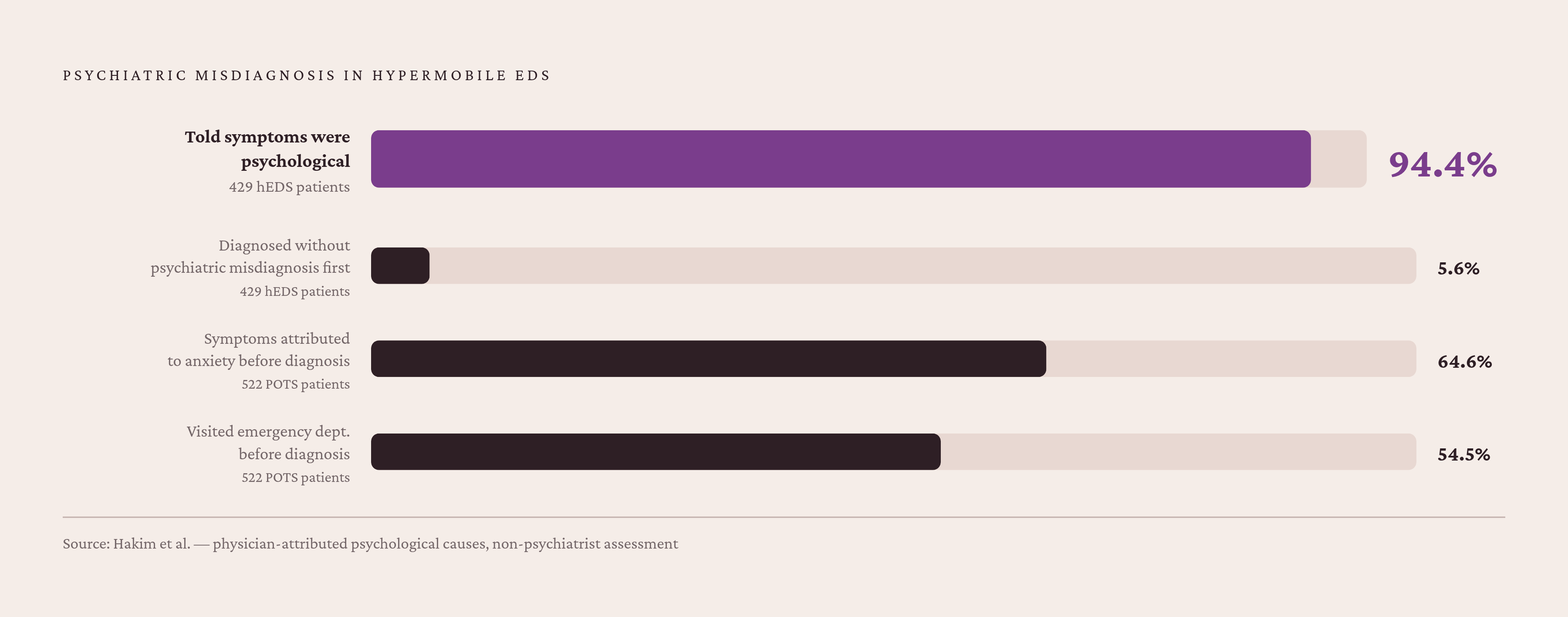
Proprioceptive impairment and heightened interoception together produce bodily experiences that are genuinely strange, and without specific knowledge of EDS, clinicians have a long history of reading those experiences as somatization, anxiety, or attention-seeking. The scale of this misreading is not small. A 2025 retrospective review of 429 patients found that 94.4 percent had been told by a non-psychiatrist physician that their symptoms were psychological, and only 5.6 percent reached an eventual hEDS diagnosis without being routed through some form of psychiatric misdiagnosis first. Over 70 percent of people diagnosed with hEDS and hypermobility spectrum disorder are female, a demographic that already faces higher rates of symptom dismissal in medical settings generally.
POTS tells a nearly identical story. A 2025 Australian patient registry of 522 participants found 64.6 percent had their symptoms chalked up to anxiety before diagnosis, and 54.5 percent had already been to an emergency department for POTS-related symptoms before anyone connected the dots PMC / MJA. Repeated dismissal like this doesn't just delay a diagnosis, it produces something closer to medical trauma, including hypervigilance, a real mistrust of the healthcare system, and a documented reluctance to go back for care even when something is clearly wrong.
Classification instability makes the whole picture worse. A 2025 community survey found 404 people reporting diagnostic delays tied directly to unclear or inconsistent classification criteria, and 384 who were denied treatment, accommodations, or referrals because of misclassification Chronic Pain Partners / EDSAwareness.com. The system isn't just slow to recognize EDS, in a meaningful number of cases it's actively working against the people trying to get diagnosed.
The mental health toll that accumulates when the body keeps misfiring and medicine keeps dismissing
The numbers on psychiatric comorbidity are stark on their own, before any consideration of how much of it traces back to dismissal rather than the condition itself. Roughly 42.5 percent of people with hEDS present with psychiatric comorbidities, mostly anxiety and depression The EDS Clinic. Compared with the general population, EDS carries a 7.4x higher risk of autism spectrum disorder, a 5.6x higher risk of ADHD, and a 3.4x higher risk of depression The EDS Clinic. Broader comorbidity figures across classical and hypermobile EDS put anxiety as high as 25 percent and depression as high as 26 percent, with overall psychiatric comorbidity reaching as high as 43 percent Mayo Clinic Connect.
The mechanisms producing those numbers are not mysterious. Chronic pain produces helplessness and social withdrawal on its own. POTS-driven tachycardia gets misread as panic, which reinforces anticipatory anxiety even though the underlying event is genuinely physiological. Repeated medical dismissal produces PTSD-like responses, hypervigilance, and a real reluctance to seek care the next time something goes wrong. And diagnostic delay itself has a measurable cost: research by Purc-Stephenson and colleagues found longer time to diagnosis correlates with higher depression (r =.26), higher fatigue (r =.25), lower life satisfaction (r = -.25), and greater disease severity (r = -.22). Fear of pain reduces activity, reduced activity erodes self-esteem and deepens isolation, and reduced activity also worsens the musculoskeletal problems that started the cycle.
None of that erases what's also documented on the other side of the ledger. Qualitative and integrative medicine studies among EDS/HSD patients recognise high resilience in this population, a community defined not by its suffering, but by the inadequacy of medical support relative to the complexity of its needs. The same 2025 community survey found 397 people reporting that a correct diagnosis, once it finally arrived, improved access to care, though for many that only came after years of pushing for it Chronic Pain Partners / EDSAwareness.com. It also found 279 people who said the classification process itself had damaged their mental health along the way Chronic Pain Partners / EDSAwareness.com.
Practical strategies for managing proprioceptive dysfunction day to day
Managing a deficit like this starts with treating the visual compensation strategy as a real tool rather than a workaround to feel embarrassed about. Watching feet on uneven ground, checking hand position before a task that requires grip, these are legitimate substitutes for a sense that isn't delivering, and building environments that make that visual check easier (better lighting, clearer sightlines, fewer surprise obstacles) reduces the injury risk that comes with the underlying deficit.
Pacing belongs at the center of any daily strategy. That means tracking energy honestly, planning ahead of known demanding events instead of reacting to them, and treating rest as productive rather than as a failure to keep up. Since muscle weakness and proprioceptive noise reinforce each other, any strengthening work aimed at stabilizing joints is also, indirectly, supporting the sensory side of the system, not just the mechanical side. And given that, without EDS knowledge, clinicians have historically read these genuinely unusual bodily experiences as somatization, anxiety, or attention-seeking, finding clinicians who already understand the connective tissue mechanism behind it, rather than starting from an assumption of anxiety, changes the entire trajectory of care, since repeated dismissal creates hypervigilance, mistrust of the healthcare system, and delays in returning for care. The condition itself may be chronic. How much of daily life gets shaped by fear, dismissal, and unmanaged energy debt is not fixed in the same way.
Sources
- Does EDS Affect Proprioception? | The EDS Clinic
- Mental Health in Ehlers-Danlos Syndrome | The EDS Clinic
- pmc.ncbi.nlm.nih.gov
- Proprioceptive sensitivity in Ehlers–Danlos syndrome patients
- Proprioceptive precision is impaired in Ehlers–Danlos syndrome | SpringerPlus | Springer Nature Link
- Fascia and Proprioception in Hypermobility and EDS - Jeannie Di Bon
- Balance, gait, falls, and fear of falling in women with the hypermobility type of Ehlers-Danlos syndrome - PubMed
- Full article: The association between muscle strength and activity limitations in patients with the hypermobility type of Ehlers–Danlos syndrome: the impact of proprioception