Safe Exercise for Hypermobile EDS
Strength training, not stretching, keeps hypermobile joints stable and functional.
Hypermobile Ehlers-Danlos syndrome, hEDS for short, changes how joints behave under load. Exercise done wrong is a hazard; done right, it's the single most effective tool patients have for staying functional. That distinction, between wrong and right, is what this piece is about.
For hypermobile EDS, the safest exercises are those that build muscular stability around loose joints rather than increasing range of motion: low-impact cardiovascular work such as walking, swimming, stationary cycling, or rowing; progressive strength training kept in a joint's mid-range and added in planned, systematic increments; and proprioception work like single-leg balance progressions, Tai Chi, and modified clinical Pilates focused on core control. For people who also have POTS, recumbent or semi-recumbent modalities come first, with upright activity added only once those are tolerated. Rest worsens the condition because muscles are already doing the job that lax ligaments cannot; when those muscles decondition, the joint loses the only thing keeping it stable, so deconditioning doesn't protect a hypermobile joint so much as strip away its scaffolding entirely.
Start with scale. hEDS shows up in somewhere between 0.75% and 2% of the population, and possibly more than that, which puts it well outside the "rare disease" bucket most clinicians file it under. There's no blood test, no genetic marker, so diagnosis rests entirely on clinical criteria, a hands-on exam and a history. A 2025 global survey of 3,906 respondents found the average gap between symptom onset and diagnosis runs 22.1 years. That same survey found 98.9% of respondents live with chronic pain. Exercise advice for this population doesn't exist in a vacuum; it exists inside a landscape where pain is close to universal and misdiagnosis has cost people two decades.
Resting makes sense on the surface. Joints slip out of place, pain flares without warning, and fatigue can flatten a person in ways that seem out of proportion to what they did that day. Muscles that stop working, though, lose the ability to compensate for connective tissue that was never going to hold the joint in place on its own. Deconditioning doesn't protect a hypermobile joint; it strips away the one thing keeping it stable. That's the paradox this piece works through, section by section.
What joint hypermobility actually does to the body during movement
In a typical joint, ligaments and tendons act like a fence: they mark the end of the range of motion and stop the joint from going further. In hEDS, that fence is loose or missing altogether. Muscles, as a result, have to take over a job they weren't built to do alone, holding the joint stable through its entire range, not just at the end.
Without muscles trained to do that, joints drift into positions that damage tissue, not from a fall or an accident, but from ordinary daily load: reaching for a shelf, standing up from a chair, carrying a bag of groceries. Proprioception, the sense of where a joint is in space, is often impaired on top of this. The brain gets bad data about joint position, which raises injury risk even further, since the body can't protect a joint it doesn't accurately sense.
None of this happens in isolation. The 2025 survey found gastrointestinal disorders in 84.3% of respondents and dysautonomia in 71.4%. Fatigue and lightheadedness aren't separate complaints layered on top of hEDS; they're part of the same underlying picture. In some people, meanwhile, the nervous system's pain processing gets turned up, a state called central sensitisation, so exercise that should feel fine instead produces pain way out of proportion to the activity. This reflects a documented neurological state, not weakness or exaggeration, and it explains why standard fitness advice, more load, push harder, stretch further, tends to backfire badly in this population.
The evidence base for exercise in hEDS is thin but the endorsement is not
A scoping review protocol registered for 2026 aims to map out what's actually known about physical activity safety and benefit in hypermobility spectrum disorders and hEDS, with results expected sometime around mid-2026. That a review like this needs to happen at all says something: the evidence base is still being assembled.
What exists so far points toward benefit, both physical and psychological, but the number of trials is small and they don't measure the same things the same way, so nobody can point to a single definitive number and say "this is how much exercise helps." Despite that, clinical guidance consistently frames exercise as the cornerstone of treatment, and there is trial evidence behind specific pieces: knee strengthening, body awareness training, balance work, core stability, endurance.
That gap between thin data and strong consensus creates real confusion. Some clinicians tell patients to rest. Others say exercise, but don't know what to adjust for a hypermobile joint. Patients end up caught between contradictory advice, often from providers who mean well but haven't worked with this population before. Worth saying plainly: no large randomized trial existing is not the same thing as evidence that exercise causes harm. The clinical consensus doesn't waver on this point, even while the research catches up.
Why is the goal stability rather than flexibility in hEDS exercise?
Exercise can't change how lax a joint is. That's fixed by the connective tissue itself, and no training program rewrites collagen structure. What exercise can do, according to clinical guidance, is build enough muscular strength, endurance, and control around a joint that the joint stays put anyway.
This flips the instinct most people bring into a gym. The goal isn't more range of motion but scaffolding, muscle doing the holding that ligaments can't. Cincinnati's guidance also pushes for whole-body programming rather than treating one joint at a time; strengthen the shoulder in isolation and leave the rest of the chain unsupported, and the problem just relocates somewhere else.
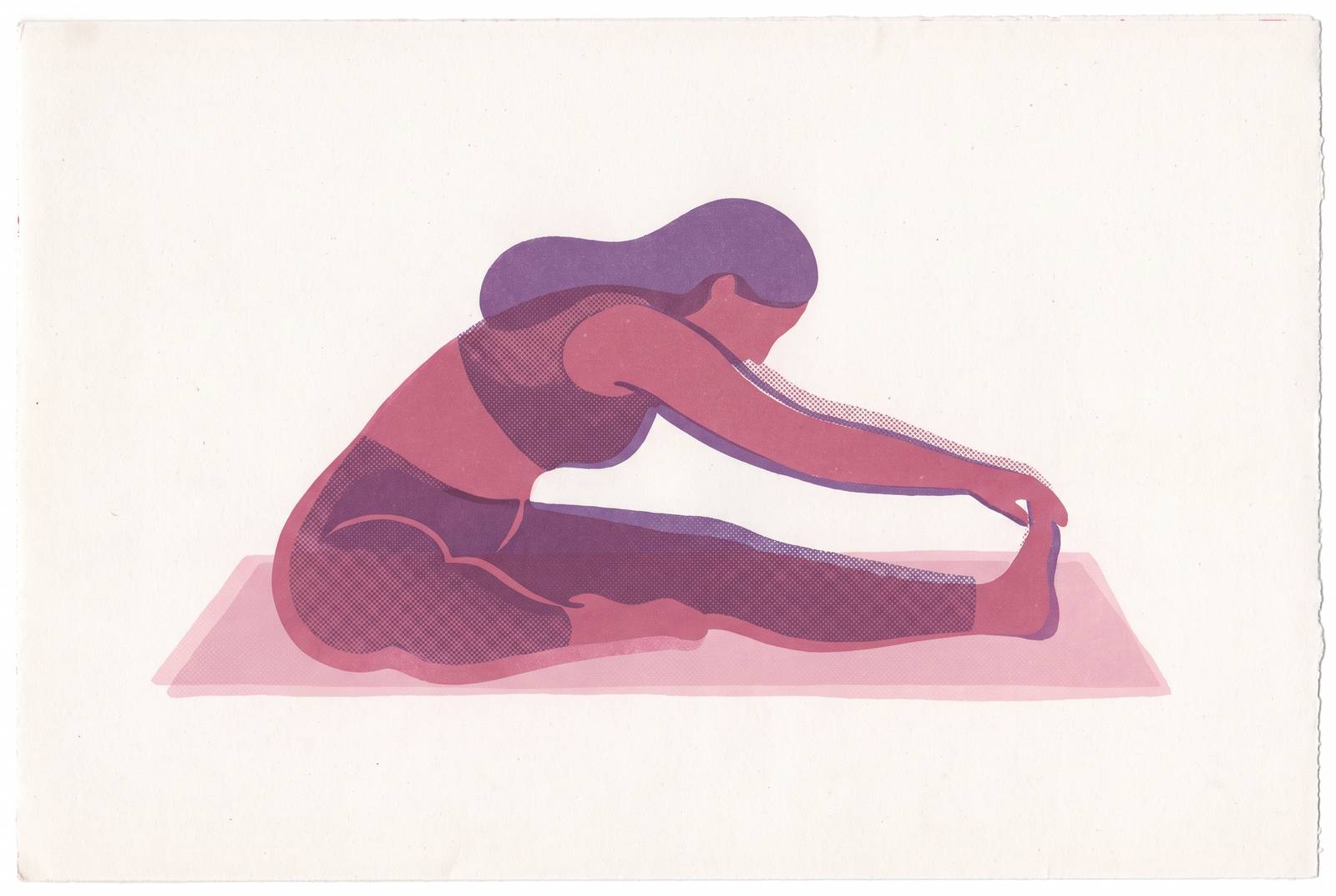
Stretching isn't banned outright. Targeted stretching for tightness or pain relief has a place, but it should stay limited in time and intensity, and it should always be followed by strengthening work, not left to stand alone. A patient who spends 20 minutes stretching and zero minutes strengthening has, functionally, made their joints less stable than when they started.
Finding a baseline before building any routine
Barriers to exercise in this population aren't excuses; they're rational. Survey data on exercise barriers in hEDS and hypermobility spectrum disorders found 87% cited pain, 79% cited fatigue, and half cited fear of injury. Those numbers describe a body that has good reason to be cautious.
The boom-and-bust cycle is the real reason routines collapse, more often than plain lack of motivation. It goes like this: feel okay, push a bit too hard, spend three or four days recovering from the flare that follows, rest completely, then repeat once the pain settles. Breaking that cycle starts with finding a baseline on a bad day, not a good one. That bad-day number becomes the floor to build from, not something to feel discouraged by.
A baseline that works is whatever amount of activity doesn't trigger a flare the next day. For some people that's five minutes of walking. That's the correct starting point. Progression from there should be slow: add duration before intensity, and add it in small steps, not by doubling effort from one week to the next. None of this works without a record of what happened and when, which is exactly why structured tracking matters as much as the exercise itself.
Cardiovascular exercise: low impact, low intensity, built up gradually
The American College of Sports Medicine recommends 150 minutes a week of moderate cardio for general health. That's a fine target to aim toward eventually, though it is not where most people with hEDS should start.
Mayo Clinic physical therapy guidance suggests beginning at no more than half of maximum intensity, using modalities that don't put much stress through unstable joints: walking, a stationary bike, swimming, an elliptical machine. These load the heart and lungs without loading the joints past what they can handle.
Complicating this further, a large share of people with hEDS also have postural orthostatic tachycardia syndrome, POTS. Standing upright during exercise can set off dizziness, a racing heart, even near-fainting. For people managing POTS, exercise is actually a first-line treatment, but the order matters: recumbent or semi-recumbent work, rowing machines, recumbent bikes, swimming, comes first, with upright activity added only once that's tolerated. Fluids and electrolytes after a session matter more here too, since maintaining blood volume is part of managing POTS symptoms. The marker for progress isn't how a session feels in the moment; it's whether the next day passes without a flare. Only then does duration or intensity move up.
Strength training: progressive load builds stability, unguided load creates risk
Shoulders tell the story clearly. Four out of five people with hypermobility spectrum disorder or hEDS report shoulder pain or instability at some point, which makes the shoulder a good stand-in for why strengthening isn't optional.
A lot of clinicians and patients avoid heavier resistance work out of caution, worried it'll do more harm than good. A feasibility study involving 12 patients found they could complete a 16-week progressive heavy shoulder strengthening program safely. Twelve people is a small sample, no argument there, but as proof of concept, it matters: heavy load, applied progressively, didn't break anyone down.
The operating principle is straightforward. Start light, add load in a planned, systematic way, and tissue adapts. What causes damage is random load, or load at the extreme end of a joint's range, not planned progression. Practical entry points include bodyweight work with careful attention to alignment, then resistance bands, then free weights or machines with a controlled range of motion. Keep joints in their mid-range, where muscles have the most control; locking out an elbow or knee at full extension hands the load straight to ligaments that were never built to carry it. Speed matters too. Slow, controlled reps train the stabilizing system, while fast or ballistic movement skips right past it.
Proprioception training: retraining the brain's map of the body
Strength alone doesn't fix a joint if the brain doesn't know where that joint is. That's the proprioception problem in hEDS: the signal coming from the joint to the brain is unreliable, so even a strong muscle can't act at the right moment if it's not getting accurate position information.
Research on isolated, low-level stabilization training, not general functional exercise, but specific work aimed at postural muscle timing, shows it can bring muscle activation timing back close to normal. These changes happen faster than most people expect, and they appear to reorganize how the nervous system coordinates movement.
Useful tools here include single-leg standing and balance board progressions, Tai Chi, and modified clinical Pilates focused on core control and body awareness. One caveat on Pilates: basic mat work, adapted for a hypermobile body, is genuinely helpful, while advanced Pilates that pushes the spine into extreme ranges should be skipped. The point of all this work isn't the exercise session itself; it's teaching the nervous system a pattern it can then run automatically, during a walk, while carrying a bag, while getting out of a car.
When pain during exercise is a signal and when it is noise
A sensitized nervous system can produce real pain from movement that isn't actually damaging anything. That pain feels like injury. It can be disproportionate to what happened, delayed by a day, or spread out into a general ache that outlasts the workout by a wide margin.
Two categories are worth telling apart. Mechanical pain comes from a joint loaded past its stable range; it tends to be sharp, localized, and immediate. Sensitization-driven pain tends to be diffuse, shows up later, and feels bigger than the activity should have produced. Neither one means stopping exercise for good, and both mean adjusting: less load, a shorter session, a return to baseline for a few days.
Combining exercise with cognitive-behavioral approaches, working on how a person interprets pain and what they believe their limits are, shows particularly strong results for reducing disability in both teenagers and adults with hEDS. A useful rule of thumb: if pain the day after is meaningfully worse than pain the day before, the load was too high. That's a signal to scale back, not a verdict on exercise itself. The goal is gradual desensitization through steady, safe exposure, the same approach used broadly in pain rehabilitation.
How tracking symptoms between sessions makes exercise actually work
Every baseline and progression principle above depends on data. Without a written record, patients are relying on memory formed under pain and fatigue, which is exactly the condition memory is worst at handling.
Self-management frameworks for hEDS explicitly build in pacing, physiotherapy exercises, and routine, and better self-management links to better pain control and faster recovery from flares. What's worth logging: type and length of activity, pain level before and after, fatigue the next day, sleep quality, any subluxations or close calls. Weeks of this reveal a threshold specific to that person, something no generic guideline could ever predict in advance.
Patterns matter more than any single bad day. One rough day tells a person almost nothing, while three rough days that all followed sessions over 20 minutes tells them exactly where the ceiling sits. Bringing that kind of log into a physiotherapy or medical appointment changes the entire dynamic; the patient shows up with data, not just a vague complaint, and becomes an active part of building the care plan instead of a passive recipient of it. Symptom-tracking tools built for chronic illness, ones that can surface patterns across sleep, activity, and daily context automatically, cut down the mental effort this kind of tracking takes, which matters a lot for people already managing fatigue and pain on top of everything else.
Working with a physiotherapist — and what to expect from the relationship
Managing hEDS well takes a team: physicians, physical therapists, occupational therapists, psychologists, sometimes an orthotist. No single provider has the full picture, and expecting one to is setting up for gaps.
A physiotherapist who actually understands hypermobility works differently from a general sports physio. Less focus on stretching for range of motion, more on motor control, joint alignment, and load that increases in small, deliberate steps. Worth bringing to a first appointment: a symptom log, a list of which activities reliably cause flares, and details on past injuries, including how they happened.
Some responses from a clinician are worth treating as red flags: being pushed to stretch further, being told to push through joint pain, or being handed a generic deconditioning program that ignores hypermobility altogether. Any of those suggests the provider hasn't worked with hEDS patients before. The Ehlers-Danlos Society and similar patient organizations keep resources for finding clinicians with relevant experience, and seeking a second opinion is a reasonable, normal step. Patient education carries real weight here too: understanding personal triggers, flare patterns, and self-care in detail is tied to better pain control and quicker recovery when a flare does happen.
The psychological weight of exercising with a body that feels unpredictable
Psychiatric conditions, mostly anxiety and depression, show up in roughly 42.5% of people with hEDS. That number isn't a side note to the exercise conversation; it shapes how that conversation has to go.
Fear of injury, reported by half of survey respondents as a barrier to exercise, makes sense on its face, since joints really do sublux without warning. When that fear gets in the way of movement that would actually help, it's something to work through gradually. The dread before a workout, the grief over activities that used to come easily, is a normal response to living in a body that doesn't always do what it's told.
Pairing cognitive-behavioral approaches with exercise rehab improves outcomes beyond what exercise delivers by itself, addressing the thinking patterns around pain and limitation directly rather than leaving them unaddressed. Peer experience carries weight too: behavior change research in hEDS found patients responded strongly to first-person accounts written by others living with the condition, describing how they managed its psychological toll. Shared experience does real work here, offering a template for what's possible. The target worth aiming for is staying functional, keeping pain manageable, holding onto quality of life, rather than athletic performance. Once that becomes the measure of success, the entire relationship with movement changes.