Recognizing EDS Flare Triggers Through Pattern Tracking
Multiple stressors converge to trigger flares, not one identifiable cause.
EDS flares rarely trace back to one bad decision or one obvious trigger. The condition works on convergence: several stressors load onto the body at once, and by the time a flare hits, the search for a single culprit is chasing something that was never there to find.
Why EDS flares resist the single-trigger explanation
Most patients do the same thing after a flare hits: they rewind the last few days looking for the one thing they did wrong. Too much walking. That one coffee. Skipping a stretch. The instinct makes sense. It's how people solve most problems, by isolating the variable that changed. But EDS doesn't work that way, and the search for a single cause usually comes up empty because there typically isn't one.
The known trigger categories for EDS flares are wide and they overlap constantly. Dysautonomia, including POTS, gets destabilized by heat, dehydration, or exertion. MCAS responds to allergens, temperature shifts, stress, or medications. ME/CFS-related post-exertional malaise piles on top of both. Add sleep disturbance, hormonal shifts tied to the menstrual cycle, postpartum recovery, or menopause, and ordinary physical or emotional stress acting on the nervous system and inflammation levels, and the list of plausible contributors to any given flare gets long fast.
These systems don't operate in isolation. Each can carry its own triggers, each can flare on its own timeline, and they can just as easily interact and compound each other. That's why trying to pin a flare on one factor tends to fail: the multi-system nature of EDS makes single-factor attribution unreliable as a method, not because patients aren't paying close enough attention. Community accounts bear this out. Patients describe triggers ranging from overexertion to cognitive load, emotional distress, poor posture, even too much stillness, and some report flares with no identifiable trigger at all. That last category reflects convergence. It's what convergence looks like when the individual pieces are too small or too diffuse to spot on their own.
How the body's signalling amplifies converging stressors
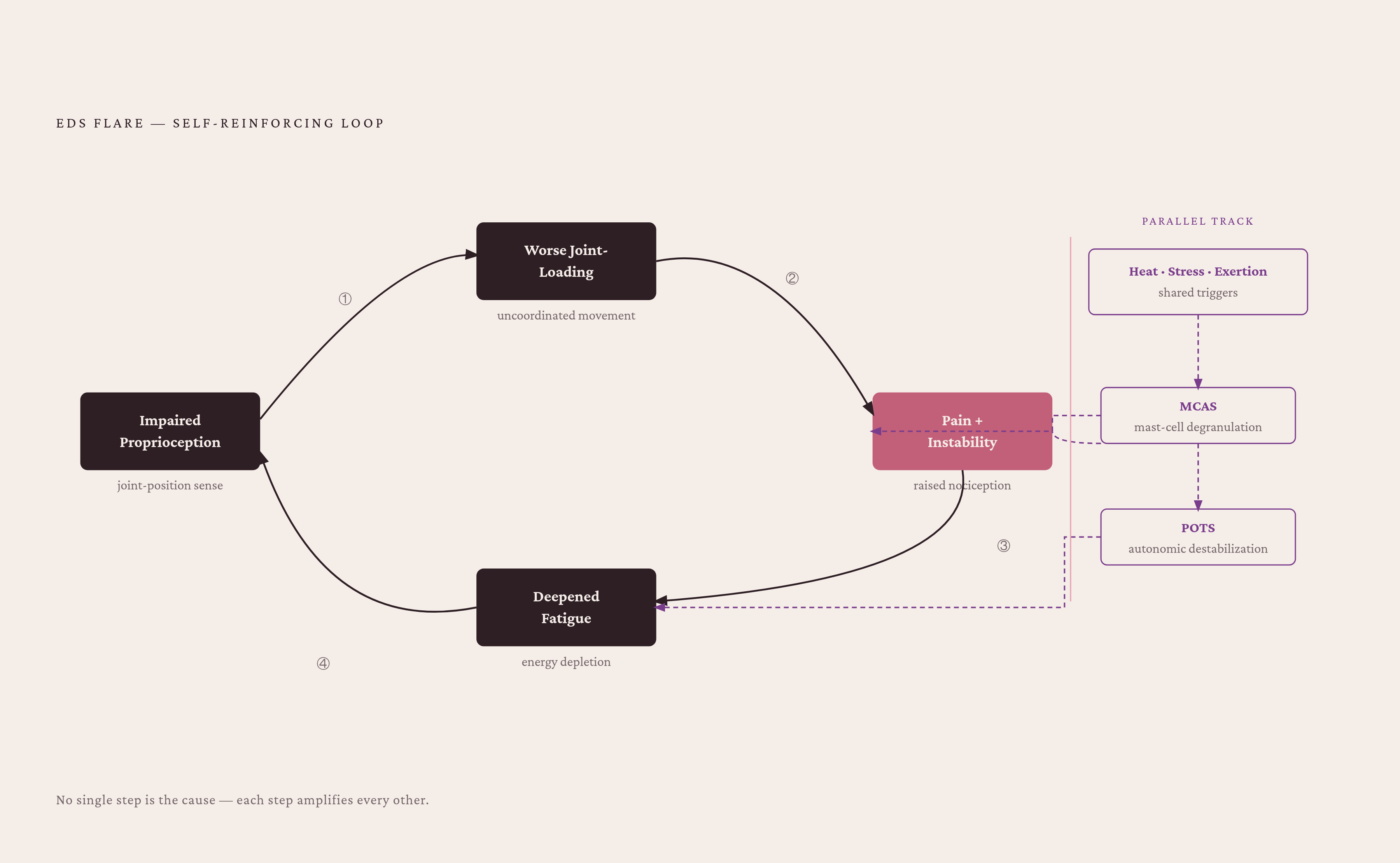
The reason convergence is more dangerous than any single trigger comes down to how EDS affects the body's own internal signaling. Joint position sense, the brain's ability to know where a joint is in space without looking at it, is measurably worse in hypermobile EDS. That sense, called proprioception, is the raw data the brain uses to decide how to load a joint safely. When that data is noisier and less precise than it should be, the brain makes worse decisions about movement, and those decisions don't improve just because someone is having a bad week. If anything, they get worse, because a person moving through pain and fatigue moves differently, and different movement patterns feed the brain even less reliable information.
That sets up a loop. Impaired proprioception leads to worse loading decisions. Worse loading decisions raise pain and instability. Pain and instability deepen fatigue. Fatigue degrades the proprioceptive signal further. Each piece of that loop makes the next piece worse, and a handful of ordinary stressors arriving at once can push the whole system past a threshold it would have absorbed easily on a better week.
MCAS runs its own parallel track. Mast cell degranulation, the process behind many MCAS symptoms, can be set off by several inputs at the same time: heat, stress, exertion, physical pressure. That means the same stressors driving a POTS destabilization, such as heat, stress, and exertion, can independently trigger an MCAS response at the same time. Stress itself isn't just an emotional backdrop to all this. It has a direct physiological effect on the nervous system and on inflammation, so a genuinely hard week doesn't sit next to a flare as a coincidence. It lowers the threshold the rest of the system needs to cross before other triggers tip it over.
Flare severity tracks pain and fatigue rather than how hypermobile someone is. Disability in hypermobility conditions tracks pain and fatigue, not the degree of joint laxity measured on a Beighton score. A flare's cost to a given patient reflects how the whole interconnected system was loaded that week, not some fixed structural property of their joints. Severity is a systems question.
The 48-72 hour investigation window
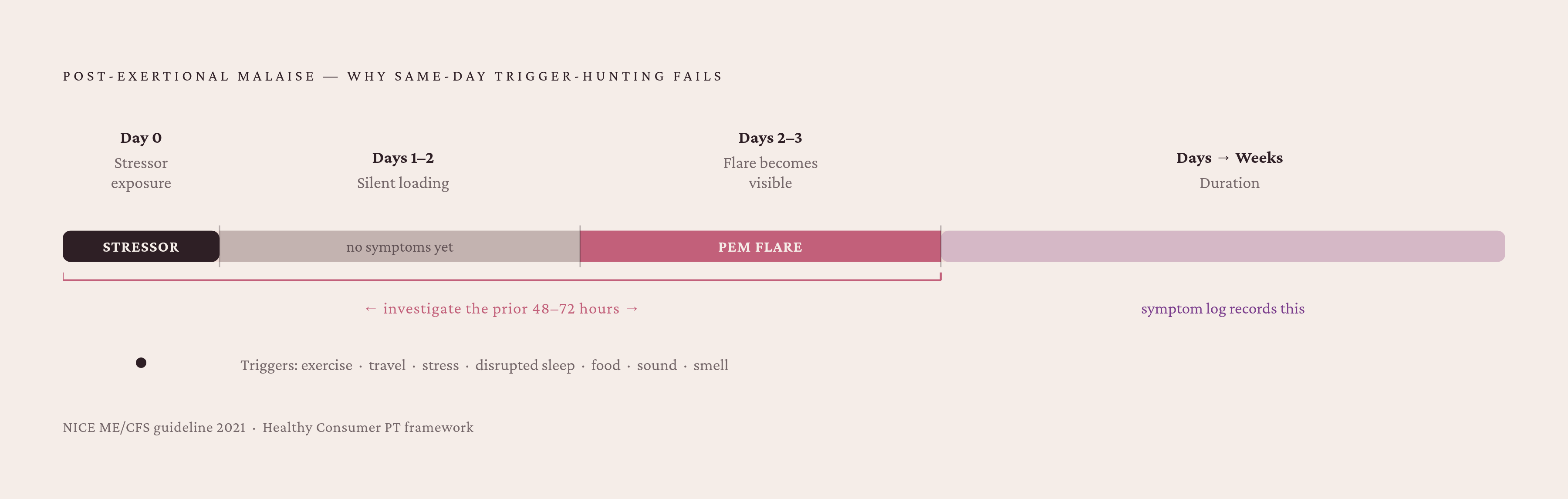
None of this arrives on schedule. Post-exertional malaise, the defining feature of ME/CFS and common where ME/CFS overlaps with EDS, typically becomes visible hours to days after the exertion that caused it, and it can last for days or weeks once it does. That delay is the whole reason same-day trigger-hunting fails so consistently.
Clinical guidance has caught up to this. The 2021 NICE guideline on ME/CFS built its energy management advice around staying inside individual energy limits, balancing activity against real rest, and managing flares and relapses directly, and it explicitly rejected any approach built on steady, fixed increases in activity. NICE went further than simply declining to recommend graded exercise therapy. It withdrew a prior recommendation for it, because a plan built on the assumption of steady progress doesn't hold up against a body that pays back exertion on a multi-day delay.
That delay sets the unit of time tracking has to work in. A practical clinical framework for investigating a flare, reflected in guidance from Healthy Consumer PT, points patients back over the prior two to three days: new exercise, more travel than usual, added stress, disrupted sleep, or sensory triggers like food, sound, or smell. Keeping a judgment-free record of that window, something Healthy Consumer PT calls an "Unusual Responses Journal," gives both patient and provider a structured basis for spotting which combinations of stressors actually precede flares, rather than guessing after the fact.
Same-day logging alone can't do this work. A log that only captures how someone feels today records the consequence, not the conditions that produced it. It's the timeframe that matches how the body actually processes and pays back the load it's under, and it's the frame the rest of a tracking log needs to be built around.
What a multi-signal EDS tracking log needs to capture
A tracking log built for EDS has to cover more ground than pain scores. Useful clinical guidance points to a full-system picture: joint and musculoskeletal symptoms, digestive and autonomic signals, skin and tissue changes, medication and treatment entries, food and hydration, and quality-of-life measures covering sleep, fatigue, stress, mood, hormonal phase, weather, and activity level. Leaving out any one of these categories risks missing the exact combination that matters for a given flare.
Sleep deserves its own line in the log, tracked in both directions. Poor sleep reliably precedes symptom upticks, and sleep quality itself is shaped by autonomic dysregulation, so it functions as both a trigger and a downstream effect at the same time.
Hormonal phase belongs in the log as its own variable, and it's frequently left out. One study found roughly a third of people with hEDS reported symptom worsening in the perimenstrual period, with postpartum and menopausal windows also flagged as common uptick periods. A log that doesn't note where someone is in a hormonal cycle is missing a documented contributor to flare risk.
Cognitive and emotional load need to sit alongside physical activity in the same log, in the same category, so it doesn't get skipped. Extra screen time, high-demand mental tasks, and emotionally difficult events all count as reported flare contributors, and a log that only tracks physical exertion has a built-in blind spot.
Activity needs a pacing dimension beyond duration. What matters is whether that activity stayed inside their current tolerance for that particular week, not how long someone was active. The same walk that felt restorative last week can trigger a flare this week, depending on everything else the system is carrying at the time.
Wearable data adds another layer worth including where it's available. Heart rate variability, orthostatic readings, and activity tracking all feed into this picture, and the Hypermobility Hub Pattern Recognition Model lists physiologic monitoring and digital health technologies as one of five pillars alongside longitudinal symptom tracking.
Reading the pattern across logged data, not the individual data points
A single day of logging tells a patient almost nothing. Comparing entries against each other over weeks reveals the value of the log. The goal of consistent logging is to surface the specific combinations of triggers that reliably precede a given patient's flares, because that combination is individual and won't match a generic list of common triggers.
This is the distinction the Hypermobility Hub Pattern Recognition Model draws explicitly. Longitudinal symptom pattern identification, meaning patient-tracked timing, triggers, and severity over time, is treated as its own clinical pillar, separate from the acute clinical evaluation a single appointment can provide. That model is being developed with the goal of peer-reviewed publication as a five-pillar clinical framework designed specifically for the episodic, multisystem nature of connective tissue and autonomic disorders, so longitudinal pattern tracking is an emerging clinical standard rather than a patient workaround. Longitudinal tracking, in other words, is becoming part of the clinical standard itself, not a workaround patients invented to compensate for short appointments.
The pattern that matters is never a single factor. It's not "stress causes flares." It looks more like "stress plus disrupted sleep plus activity above tolerance, inside the same 72-hour window". That specific combination is what crosses the threshold, and no single piece of it would have done so alone.
Tracking also earns its keep by ruling things out. Finding that a suspected trigger doesn't actually precede flares is a real gain, because it lets a patient stop avoiding something unnecessarily and reduces the kind of over-restriction that uncertainty tends to produce on its own.
The obvious objection deserves a direct answer: tracking sounds like one more task on top of an already overloaded system, and for patients whose cognitive load is itself a flare trigger, that objection carries real weight. Tools need to make tracking cheap enough that it doesn't cost what it's meant to save, and that's the problem the next section takes up.
Where current tracking tools leave EDS patients short
The tracking app landscape has spent its development effort in the wrong place. As of 2026, apps have invested heavily in input architecture, building out large symptom libraries, body-map entry, and mood logging, while investing almost nothing in output quality. Patients accumulate a detailed longitudinal record they then can't turn into anything usable inside a clinical consultation.
Demand for structured tracking is real and large. Bearable had grown to more than 900,000 users as of March 2026, confirming that patients want this kind of tool, though benchmarking has flagged known bugs affecting data accuracy across multiple platforms.
Some newer tools are built directly around the output gap. Human Health Tracker combines a large symptom library, body-map location input, and AI-powered pattern recognition with PDF export formatted for a clinical consultation, positioning itself against the exact gap established apps have left open. Flura, built for chronic illness including POTS and ME/CFS, offers AI-powered pattern detection after an initial period of data collection and a physician-formatted PDF report structured for clinical review, a design that addresses the need for multi-system, longitudinal output.
The honest caveat has to stay attached to any of this. Apps do not diagnose or confirm causes, and that limit needs stating rather than papering over. That's a limit stating rather than papering over.
For EDS specifically, a tool's value depends on whether it handles the full category list established earlier: autonomic signals, hormonal phase, cognitive load, pacing context, not pain ratings alone. A generic symptom logger built for a single-system condition will miss the exact convergences that matter for EDS, no matter how polished its interface is.
Bringing tracked patterns to a clinical appointment effectively
Providers work with what patients bring them, and a symptom diary gives a clear record of symptoms and how they've been managed between visits, something no single appointment can reconstruct on its own. Consistent logging fills in the picture of daily life that a fifteen-minute consultation simply can't capture.
Tracking validates a patient's own experience, cutting into the self-doubt that so often comes with symptoms other people can't see. That function carries particular weight for EDS patients, many of whom have already been through years of misdiagnosis before reaching a confirmed diagnosis.
The format a patient brings matters as much as the content itself. A raw stream of daily entries isn't a clinical communication. What a provider can actually use is a structured summary that names the convergence pattern, flags the specific days-long windows preceding major flares, and separates a stable baseline from genuine deterioration. Patients with hEDS and HSD are positioned to be active partners in shaping their own care, and patient education and psychological support are specifically named as intervention targets for this population. Arriving at an appointment with organized pattern data is participation in designing the care plan itself.
There's a concrete reason this matters right now. New EDS diagnostic criteria are scheduled for publication on December 2, 2026 in the American Journal of Medical Genetics Part C, under the Road to 2026 process, with best-practice care and management pathways to follow in March 2027. Those criteria are intended to better reflect the multisystem, episodic reality of EDS rather than treating it as a collection of isolated joint complaints. Patients who walk into that transition already holding months of organized, multi-signal pattern data will be in a strong position to make use of a framework built to recognize exactly the kind of convergence their tracking has already documented.
Managing the emotional cost of flare
Tracking helps make sense of a flare's causes, but it doesn't remove what a flare costs emotionally. Plans get cancelled. Work gets missed. Relationships absorb the strain of a body that doesn't give reliable warning before it stops cooperating. None of that is solved by a better log, and pattern tracking was never meant to.
What tracking does offer, on the emotional side, is a break from self-blame. A patient who understands that flares come from convergence, not from one mistake, has less reason to spend a flare interrogating what they did wrong. It replaces self-blame with a recognition that flares come from convergence, not a single mistake, easing years of wear from searching for a cause that was never there. Years of searching for a single cause and failing to find one wears on a person, especially stacked on top of the diagnostic delays and dismissals many EDS patients already carry before diagnosis.
Grief has a place in this too. Flares interrupt plans, careers, and relationships on a schedule no one gets to choose, and that disruption deserves to be treated as a real loss rather than something to push past quietly. Support that addresses the psychological weight of a chronic, unpredictable condition belongs in the same care plan as the physical management of it, built in from the start.
Pattern tracking, done well, gives a patient something concrete to hold onto in the middle of that unpredictability: evidence that the flare has a logic to it, even when the logic is made of five things converging instead of one. That doesn't make the flare painless. It makes it legible, and legibility is its own kind of relief.