EDS and Anxiety the Bidirectional Relationship
EDS produces anxiety through three biological pathways, not merely as stress from diagnosis.
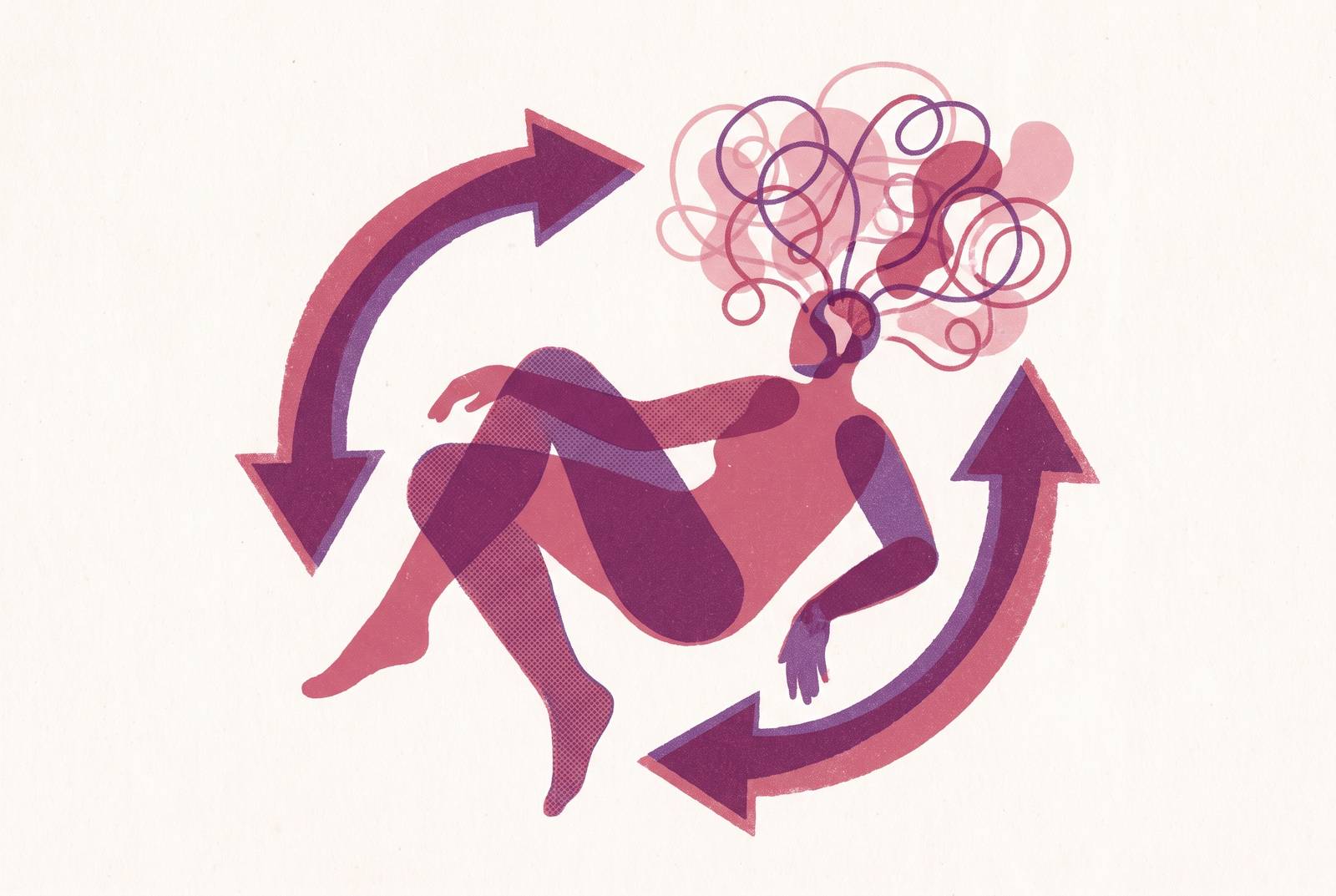
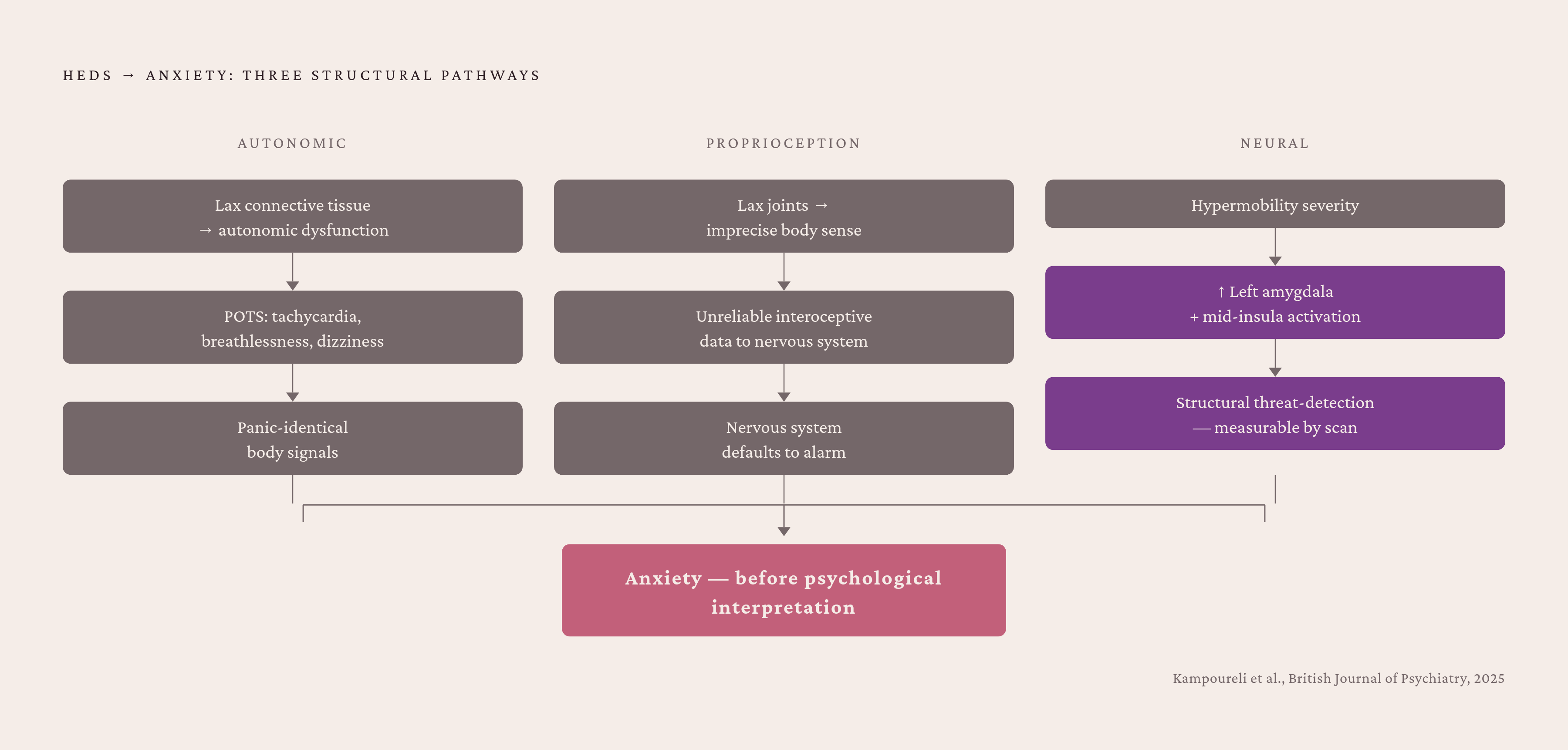
Anxiety in Ehlers-Danlos Syndrome is produced directly by the body, through at least three separate biological pathways, before it ever becomes a feeling the patient has to interpret, rather than being a side effect of living with a hard diagnosis.
Why EDS Produces Anxiety as a Direct Physiological Output
A racing heart. Shortness of breath. A sense of lightheadedness that arrives without warning. For many people with hypermobile EDS, these sensations occur constantly, and they feel exactly like panic. That's because, in a physiological sense, they often are a form of panic, just not one that started in the mind.
Hypermobile EDS, the most common and most frequently studied subtype of the condition, comes with autonomic dysfunction built in, including a high rate of postural orthostatic tachycardia syndrome, or POTS (Westerman et al., Frontiers in Neurology, 2025). POTS produces tachycardia, breathlessness, and lightheadedness on standing or with mild exertion. Those three symptoms are also the textbook presentation of a panic attack. The nervous system in a person with POTS is registering a real drop in blood flow, a real spike in heart rate, a real instability in how the body is regulating itself. The EDS Clinic describes how this autonomic dysfunction mimics panic attacks closely enough that it creates a cycle of anticipatory anxiety and emotional hypervigilance, where the patient starts bracing for the next episode before it even begins.
A second pathway runs through the joints themselves. Lax joints send the brain imprecise information about where the body is in space. Westerman and colleagues point to a related problem: altered interoception, the brain's unreliable reading of internal signals like heart rate, breath, and gut sensation in people with hypermobility. When the signals coming in are imprecise on two fronts at once, joint position and internal state, the nervous system has less reliable data to work with. A system running on unreliable data tends to default to alarm, because caution costs less than missing a real threat.
The third pathway appears in a brain scan, which settles any question about whether this is "real. A 2025 paper in the British Journal of Psychiatry (Kampoureli et al.) found that people with joint hypermobility and anxiety show increased activity in the left amygdala and the mid-insula, the brain regions responsible for processing threat and representing the body's internal state. The paper also found that the severity of a person's hypermobility correlated directly with how active the anterior insula became during anxiety. That is a structural, measurable link between the joints and the brain's threat-detection system, not a pattern inferred from symptom checklists.
None of this means the anxiety is fixed or inevitable at the genetic level. A September 2025 genome-wide association study preprint found that the genetic overlap between hEDS and neuropsychiatric conditions, including anxiety, exists alongside other neuropsychiatric and pain-related conditions, with the researchers pointing to environmental and physiological drivers as the larger factor. That distinction matters, because it means the loop connecting EDS and anxiety can be interrupted. It is a mechanism, not a life sentence.
How anxiety, once triggered by biology, feeds back into the body and amplifies physical symptoms
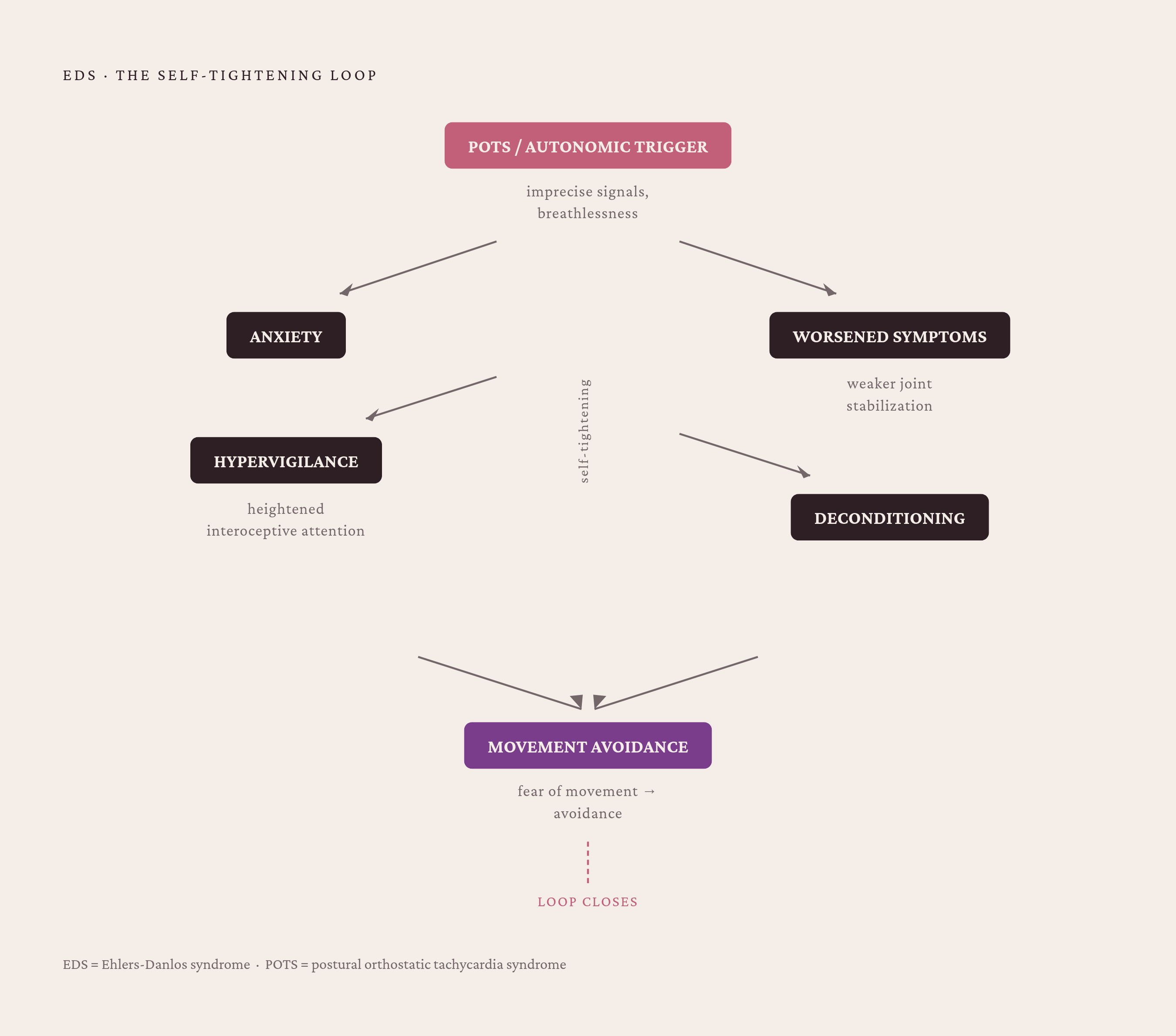
The relationship runs both directions. Once anxiety gets triggered by one of those biological pathways, it turns around and makes the physical symptoms worse, through pain amplification, hypervigilance, and a fear of movement that produces real, measurable deconditioning over time.
Start with attention. People with EDS already have heightened interoceptive sensitivity: they notice internal sensations, a skipped heartbeat, a wave of dizziness, more readily than most people do. Anxiety sharpens that attention even further. The EDS Clinic describes this directly: heightened awareness of sensations like palpitations and dizziness ends up triggering or worsening the anxiety itself. The body's ordinary background noise starts to sound like an alarm, and the alarm trains the person to listen for it even more closely next time.
Movement gets caught in the same trap. Consider someone with POTS who tries a short walk and feels their heart rate spike. The sensation is frightening, so the next day they walk less, until eventually they stop walking. Over a few weeks of avoiding that walk, their body deconditions. Muscles that once stabilized loose joints get weaker, so the joints themselves become less stable. The next attempt at the same short walk now feels harder and more alarming than the first one did, and the cycle tightens. Researchers studying respiratory symptoms in EDS and related hypermobility disorders (Al Kaabi et al., Journal of Clinical Medicine, 2025) describe exactly this cascade: fatigue, pain, anxiety, fear of movement, and deconditioning feeding each other, each one narrowing what the patient can do a little further.
Breathing adds another layer to the same pattern. Respiratory symptoms are themselves a feature of autonomic dysfunction in EDS, and breathlessness reads to the brain as a threat. That reading raises anxiety, anxiety raises the breathing rate, and a faster breathing rate worsens the original breathlessness. Each part of the loop feeds the next one: biology triggers anxiety, anxiety sharpens pain sensitivity and hypervigilance, hypervigilance shrinks movement, shrunken movement worsens physical function, and worsened function generates more of the biological signals that started the whole cycle.
How high the mental health burden is across the EDS and hypermobility population
This loop is close to the standard experience across the hypermobile EDS and hypermobility spectrum population, not a rare complication affecting a small slice of people with EDS, and that is why mental health conditions like anxiety and depression belong inside the clinical picture of EDS itself, rather than being treated as separate problems that happen to show up alongside it.
Researchers at the GoodHope Ehlers-Danlos Syndrome Clinic concluded that mental health support needs to be a standard, built-in part of multidisciplinary EDS care, not an optional extra offered after the physical symptoms are addressed. Westerman and colleagues reach the same conclusion from a different angle, arguing for an integrated care model that treats the physical, neurological, and psychological sides of EDS at the same time, by the same team, rather than handing patients off between separate specialists who never compare notes. When two separate lines of research converge on the same recommendation, that convergence indicates how consistently the mental health burden occurs across this patient population. It demands a coordinated response from the medical system. The next section shows how far short of that the system currently falls.
Psychiatric Misdiagnosis and Diagnostic Delay in the Anxiety Cycle
The loop described above is hard enough to live with on its own terms. The medical system, as it currently operates, tends to make it worse, by pathologizing the anxiety while missing the EDS that is driving it.
People with EDS often wait many years for a correct diagnosis of hypermobile EDS, seeing a long string of clinicians along the way and collecting multiple alternative diagnoses before anyone names the actual condition; the EDS Clinic documents this pattern. During those years, a patient reporting tachycardia, breathlessness, and dizziness gets read, very reasonably from the clinician's side, as describing a panic disorder. Survey data compiled by EURORDIS shows that psychiatric misdiagnosis in rare disease populations is tied to some of the longest diagnostic delays recorded, and to a higher rate of inappropriate treatment, including unnecessary medical, surgical, or psychiatric interventions that never touch the underlying cause.
The specific harm here has a clear shape. POTS-driven tachycardia gets treated as a panic disorder. Nobody is looking for the autonomic dysfunction, so it goes untreated. The anxiety, which was biologically driven from the start, does not go away, because the physiological trigger producing it is still active. The patient, meanwhile, has been told the problem is psychological, and the one thing they know to be true, that something is happening in their body, has just been contradicted by the person meant to help them. That sequence repeats across years and across clinicians for a lot of people with EDS, and it erodes two things at once: trust in the medical system, and trust in their own read of their own body. Recognizing that pattern names a systemic failure that has shaped the experience of an enormous number of EDS patients, rather than blaming any one clinician for missing a rare and historically under-taught condition, so that the pattern can finally be interrupted at the root, which is diagnosis.
What an integrated understanding of the loop means for how patients manage day to day
Once the physiological basis of the loop is clear, day-to-day management starts to look different, with the goal becoming reducing the physical inputs that set the anxiety cascade in motion in the first place, while protecting the limited energy that anxiety burns through fast.
Pacing, the structured management of physical and cognitive activity to avoid post-exertional flares, follows directly from this. Pacing is a direct countermeasure to the exact loop described earlier: anxiety driving avoidance, avoidance driving deconditioning, deconditioning driving worse symptoms, rather than a soft lifestyle suggestion layered on top of EDS treatment. Heart rate monitoring gives patients something to pace against that isn't just a feeling. In POTS specifically, the line between a manageable effort and a symptomatic crash can be measured in beats per minute, which turns a vague sense of "pushing too hard" into a concrete number a patient can watch in real time.
Tracking symptoms across several dimensions at once, pain, heart rate, sleep, activity, emotional state, medication, and known triggers, gives patients the material to start telling apart two different kinds of anxiety episode. Some have a clear physiological precursor: a POTS spike, a bad night of sleep, a day with too much activity. Others don't show an obvious physical trigger and may respond better to behavioral or psychological approaches instead. Without tracking, those two categories blur together into one general feeling of "anxious again," and it becomes impossible to know which lever to pull.
A useful model for how this tracking should actually work comes from Li and colleagues' stage-based framework for personal health tracking: preparation, collection, integration, reflection, and action. The point of all five stages together is pattern-level insight, not a growing pile of logged data points. Tracking a heart rate number every day without ever stepping back to look at what it correlates with produces exactly the burden patients are trying to avoid: more data, no clearer picture. The tool only earns its place in a daily routine if it helps surface what matters, a pattern connecting last Tuesday's crash to Monday's overexertion, rather than just accumulating entries nobody has time to review.
Wearable devices, smartwatches and heart rate monitors in particular, add real value here because they supply objective numbers in moments when a patient's own sense of their energy level is too unreliable to trust. A person deep in a flare is often the worst judge of how much they have left to spend. A number on a wrist doesn't have that bias.
Communicating the EDS-Anxiety Loop to a Clinician
Everything above points toward one practical skill: walking into an appointment with a structured account of the pattern, not just a list of symptoms. Saying "I feel anxious" gives a clinician almost nothing to work with. Saying "here is what my body does in the hours before the anxiety escalates, and here is how often that pattern repeats" gives them something they can actually act on.
A patient who can show that a heart rate spike reliably precedes a wave of panic-like symptoms is handing the clinician physiological evidence. A patient who can point to a week of poor sleep followed by a flare, repeated across several weeks, is describing a mechanism, not a complaint. That shift in framing, from subjective feeling to documented pattern, gives a clinician who may not yet understand the EDS-anxiety loop a reason to look past the anxiety and ask what the body is doing.
Sources
- Frontiers
- Respiratory Manifestations and Their Physical, Psychological, and Social Impacts in Ehlers-Danlos Syndromes and Generalized Hypermobility Spectrum Disorders: A Narrative Review
- Rates of mental health concerns among individuals assessed at the GoodHope Ehlers-Danlos Syndrome Clinic
- Rates of mental health concerns among individuals assessed at the GoodHope Ehlers-Danlos Syndrome Clinic
- 1 Complex Genetics and Regulatory Drivers of Hypermobile Ehlers-Danlos
- The Neural Correlates of Autonomic Interoception in a ...