EDS and Insurance Prior Authorization Challenges
Diagnostic uncertainty and fragmented symptoms make EDS uniquely vulnerable to insurance denials.

Prior authorization assumes you have a known condition, a confirmed diagnosis, and a standard treatment path to follow. EDS meets none of those conditions on a regular basis, and that mismatch, not simple bureaucratic friction, is why so many EDS patients hit a wall when they try to get care approved.
Why EDS turns prior authorization into a structural obstacle
Prior authorization runs on a quiet set of assumptions. A patient has a clear diagnosis. A doctor orders a standard treatment. A reviewer checks the request against known criteria and signs off. That model works fine for a broken bone or a routine prescription refill. It breaks down almost immediately for Ehlers-Danlos syndrome.
EDS is a group of 14 heritable connective tissue disorders, and each subtype shows up differently in the body. The most common form, hypermobile EDS, has no confirmed genetic marker. Diagnosis rests entirely on clinical judgment, built from a doctor's exam and a patient's history, without a lab test with a number on it. An insurer is trained to expect objective, test-confirmed pathology before it approves a treatment plan, so its absence gives the insurer grounds to deny or delay the claim.
So the first collision between EDS and prior authorization happens before any request is even filed. Insurers want confirmation. Hypermobile EDS, by its nature, can't always supply it in the form they're looking for. Every section that follows traces a different version of this same gap: a system built for diagnostic certainty, applied to a condition defined by its resistance to easy certainty.
How diagnostic delay arrives at the PA desk
Most EDS patients don't walk into their first prior authorization request with a clean record. They walk in with years of history that work against them: misdiagnoses, dismissed symptoms, notes from providers who guessed wrong before anyone guessed right.
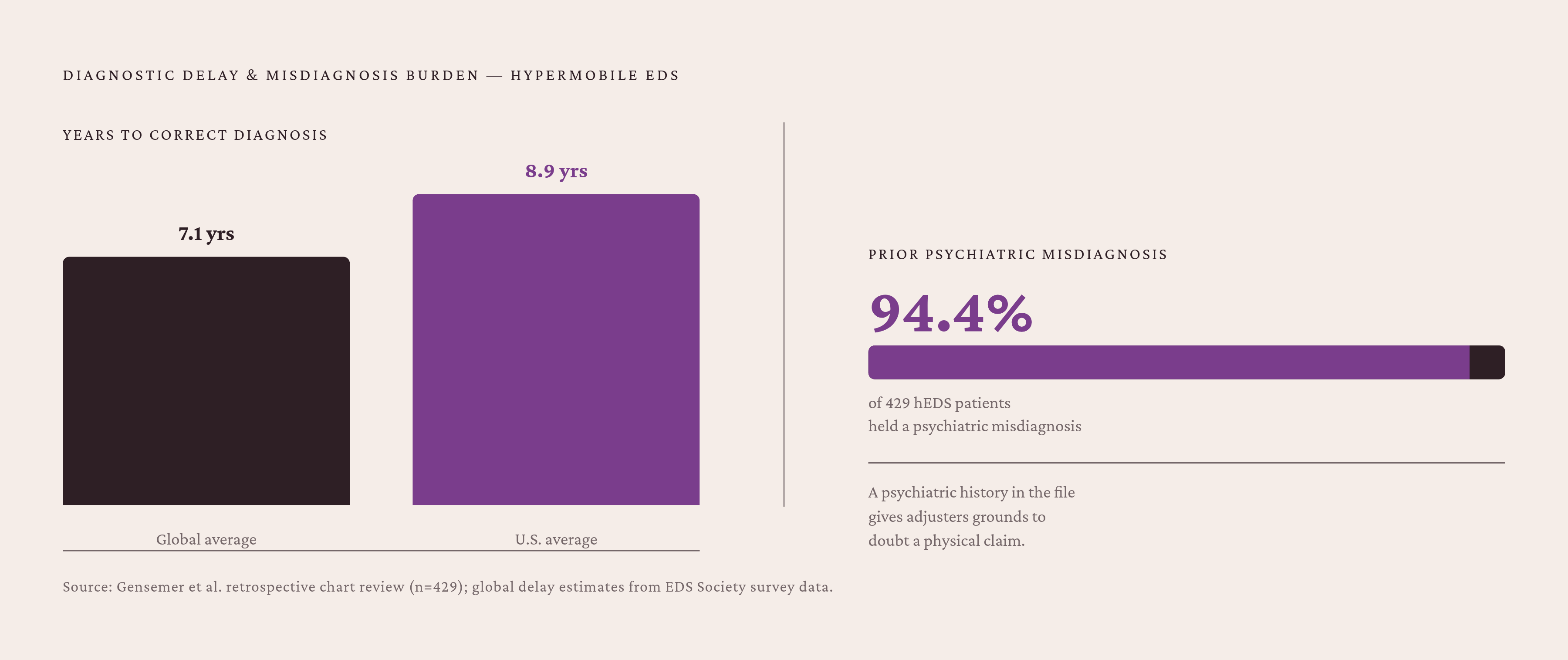
The delay itself runs long. Across patient cohorts, the average time to an EDS diagnosis is 7.1 years, and in the U.S., patient groups report a mean of 8.9 years from symptom onset to correct diagnosis. Every year that passes without a name for the condition adds another entry to a file that an adjuster will eventually read, and the longer that file sits uncertain, the easier it becomes for a carrier to treat the whole claim as unproven.
The misdiagnoses aren't neutral entries either. A retrospective chart review of 429 patients with hypermobile EDS found that 94.4% had previously been misdiagnosed with a psychiatric illness. Many were told they were making it up, that the pain was in their head, that they were seeking attention. None of that fades from the record once the real diagnosis arrives. An adjuster reading a file with a psychiatric history sitting next to a new physical diagnosis has reason, by the system's own logic, to treat the physical claim with suspicion.
Part of why this takes so long comes down to how fragmented care already is. Genetic testing could cut through some of that confusion by identifying related or coexisting heritable disorders, but it isn't reliably covered by insurance, and it isn't available everywhere. That creates a loop with no easy exit: the lack of coverage for testing keeps diagnostic uncertainty alive, and insurers then point to that same uncertainty as grounds to deny the next request.
Why EDS comorbidities confuse adjusters and fragment authorization decisions
A confirmed diagnosis doesn't end the problem; it just moves it. Most EDS patients don't present with EDS alone. They show up with postural orthostatic tachycardia syndrome (POTS), mast cell activation syndrome, digestive disorders, sleep disorders, and anxiety layered on top of the connective tissue disorder itself. Disability carriers tend not to understand how these conditions relate, and that confusion leaves adjusters unsure how to weigh each piece on its own or as part of one larger picture.
Hypermobile EDS often travels as part of a triad with POTS and mast cell activation syndrome. Fragmented care produces fragmented records, and those records don't translate well into a PA system, because it expects one diagnosis tied to one treatment plan.
The confusion adjusters show isn't irrational, because of how the system is built. Most prior authorization frameworks are built to check one diagnosis against one treatment request. A reviewer handles each of those requests separately, and often can't see a diagnosis tying the pieces together. Carriers already look for reasons to deny a claim, and a condition that resists a tidy single-diagnosis framing, the way multi-system EDS does, hands them an argument that requires no extra effort on their part.
Why the invisible, fluctuating nature of EDS symptoms strains standard PA evidence requirements
Prior authorization wants evidence you can measure at a single point in time, objective and stable. EDS symptoms rarely cooperate with that format. You often can't see them from outside the patient's own body, and they shift day to day in ways that resist the kind of snapshot documentation insurers prefer.
A patient who is in severe pain on Monday may look fine in an exam on Thursday, and some carriers treat that variability as a reason to doubt how serious the condition is, when it is actually a known feature of it. The documentation bar, meanwhile, is set high. Long-term disability claims tied to EDS typically need clinical diagnoses, imaging, and a detailed evaluation of physical limitations, so when that record has gaps, insurers get grounds to deny.
Imaging itself often can't carry the weight it's asked to carry. Functional Capacity Evaluations go further, by measuring what a patient can actually do rather than what a scan can see, and they often become the clearest evidence of real-world limitation. Getting one, though, requires access to a specialist, and prior authorization is busy blocking specialist access in the meantime.
Few providers specialize in the full range of EDS presentations, which narrows the field further. None of this means the evidence gap is unsolvable. The solution has to be built deliberately, well before a request goes in, so it's ready before a denial arrives.
The broader PA denial landscape for EDS patients
Prior authorization causes documented harm well beyond EDS, and the condition's specific features (multiple systems involved, symptoms that fluctuate and hide, thin specialist access) line up almost exactly with the features that make that harm worse.
A Johns Hopkins-led review, published in The American Journal of Medicine, found that prior authorization requirements are tied to delays in care, disease flare-ups, hospitalizations that could have been avoided, longer inpatient stays, and lower rates of disease-free survival. Those outcomes track closely with what happens to an EDS patient cut off from physical therapy or from a specialist who actually understands the condition.
Physicians confirm the pattern from their own side of the desk. The AMA's Prior Authorization Physician Survey found that 95% of physicians say prior authorization delays access to care patients need, and most physicians also report patients abandoning treatment outright over authorization disputes. If an EDS patient abandons treatment, they usually lose the physical therapy and ongoing specialist management that their function depends on day to day.
Plan switching makes all of this worse. Anything approved under a previous plan has to be reauthorized from scratch when a patient moves to a new one. A patient managing a stable chronic condition absorbs a disruption like that badly, because EDS leaves very little slack. There isn't room to lose weeks of therapy without the body paying for it almost immediately.
What the PA reform landscape currently offers EDS patients
Reform is happening at both the federal and state level, and some of it addresses real problems with how prior authorization works. None of it was built with a rare, multi-system, fluctuating condition like EDS specifically in mind, so the gaps left behind tend to be exactly the gaps EDS patients fall into.
The CMS 2026 Prior Authorization Rule, effective January 2026, requires faster turnaround times and public reporting for Medicare Advantage, Medicaid, CHIP, and ACA exchange plans. Faster decisions help, but speed alone says nothing about whether the person reviewing an EDS case understands what they're looking at.
Starting January 1, 2026, an industry pledge requires participating insurers to honor existing prior authorizations for 90 days when a patient switches plans, so it directly addresses the problem that hit the Washington state patient. Physicians aren't convinced it will go far: only a third believe the pledge will produce meaningful change, and only 24% report that denials are consistently reviewed by a qualified clinician.
States have moved further in some cases. At least 20 states passed prior authorization reform laws across 2024 and 2025. Alaska and Montana now require a minimum 12-month approval period for chronic conditions, and Alaska goes further by requiring automatic renewal when the treatment plan hasn't changed and the provider certifies ongoing compliance with it. A rule like that would meaningfully cut the reauthorization burden EDS patients currently face for therapy that doesn't change month to month. New Mexico has gone furthest of all, eliminating prior authorization and step therapy requirements for rare disease treatments outright, except where a biosimilar, interchangeable biologic, or generic version exists. That's close to a direct answer to what EDS patients need.
A newer problem is forming alongside this progress. Most EDS files carry multiple overlapping conditions and symptoms that change week to week, so a tool built to flag clean, single-diagnosis cases is poorly suited to them. Reform is happening, but none of it guarantees that the person, or the algorithm, reviewing an EDS case will understand what they're looking at. Patients can't wait on the system to fix itself. Building a stronger case on their own end is still the more reliable path forward.
Building a PA case that accounts for what makes EDS hard to authorize
Every failure point described so far points to the same conclusion: a strong authorization case has to hand the system the things EDS doesn't supply on its own. That means diagnostic clarity, objective evidence of function, continuity with a specialist, and a clear paper trail showing why the treatment is necessary.
Physician documentation carries most of the weight. A generic note won't hold up under review. The letter also has to connect EDS explicitly to every item being requested: it needs to name each comorbidity and explain why POTS, mast cell activation, or a digestive disorder belongs to the same underlying connective tissue presentation. If the patient is seen at one of the 18 Centers of Excellence in the United States that focus specifically on EDS, that detail belongs in the documentation too, since specialist center involvement carries real weight with adjusters evaluating an unfamiliar condition.
A Functional Capacity Evaluation, pursued before a request goes in rather than scrambled together after a denial, shifts who has to prove what. Insurers weigh FCE results heavily when a qualified professional conducts them, because they show what a patient can and can't do in a way imaging often can't. Reading the actual policy language matters because the same set of EDS symptoms can meet or miss a policy's definition of disability or medical necessity depending entirely on how it's described in the claim, so understanding that specific policy language before submitting is worth the time it takes.
Symptom history over months, not a single appointment, is one of the strongest tools against the "fluctuating and invisible" objection carriers raise. A record that tracks pain, fatigue, dislocation frequency, medication changes, and functional impact over time gives a physician something concrete to point to: a pattern of disability that holds even when any single visit looks better or worse than the last. Keeping that record organized matters just as much as keeping it, since a new specialist absorbing scattered notes from a dozen different providers is more likely to miss the full picture than one handed a clear, consolidated history. Because PA systems expect a single diagnosis driving a single treatment path, and EDS patients are instead managing POTS, mast cell activation, and other overlapping conditions at once, one unified record that shows how those conditions connect and compound makes a request read as coherent rather than scattered across several unrelated problems.
Denials shouldn't be treated as the end of the road. A denial functions more often as a pause than a final word, and acting on it requires organized records, a clear clinical story connecting everything together, and the energy to keep pushing, so building the record early, before a denial ever shows up, pays off.
What is changing in EDS classification
EDS lacks the diagnostic precision insurers are built to expect, and that problem hasn't gone away. It is being worked on, and what comes out of that work will shape every authorization request filed after it lands.
The Ehlers-Danlos Society's Road to 2026 initiative is updating the classification criteria and diagnostic guidance for EDS and the related hypermobility spectrum disorders, led by experts from the International Consortium on EDS and HSD. The goal is to bring the framework current with newer scientific understanding and update the 2017 International Classification that's been the standard until now.
Clearer criteria matter for prior authorization in a specific, practical way. When the diagnostic standard is sharper, more physicians recognize when to apply it, documentation across providers becomes more consistent, and the "doesn't fit any clear diagnostic criteria" objection that carriers lean on today gets harder to use. None of that arrives quickly or automatically. Until the updated classification is in place and adopted widely, the documentation habits described above, a longitudinal record, a physician letter that names every comorbidity, a Functional Capacity Evaluation obtained ahead of time, remain what patients actually have to work with. Better classification will eventually fix the deepest assumption prior authorization gets wrong about EDS. Until then, the record a patient builds is still the strongest tool available.